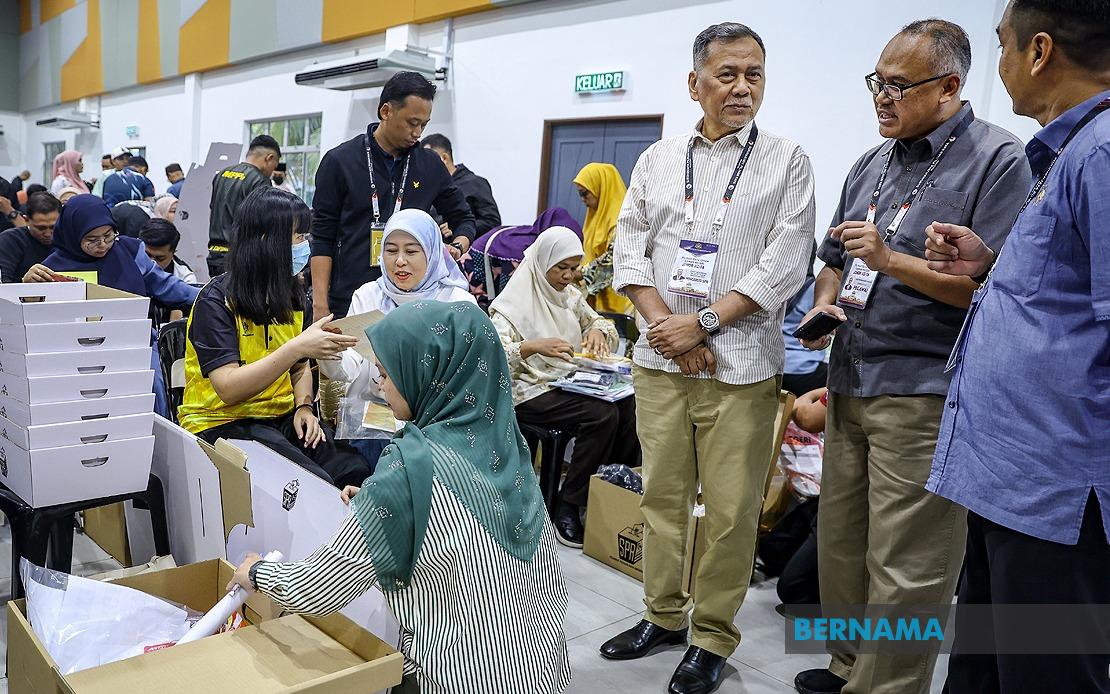
With polling for the 16th Johor State Election set to commence on July 11, the Election Commission has concluded intensive last-minute preparations across all 56 state constituencies, ensuring that voting infrastructure and administrative arrangements are fully operational. EC Chairman Datuk Seri Ramlan Harun oversaw final verification procedures on July 10, personally inspecting ballot box preparations and election equipment at multiple locations in the southern state to guarantee readiness for what officials expect to be a smooth electoral exercise.
The meticulous verification of voting materials represents one of the election cycle's most pivotal safeguarding measures, determining whether the polling process will function seamlessly and allow the state's 2.7 million registered voters to exercise their democratic entitlements without disruption or logistical failure. By the eve of voting, all Returning Officers managing the 56 constituency-level election operations had completed their preparatory tasks, according to statements made by the EC leadership. This culmination of weeks of planning and coordination signals the commission's confidence that all procedural requirements have been met and that voting day will proceed without significant incident.
Across diverse polling locations examined by the EC, specific operational patterns emerged reflecting the commission's systematic approach. At Sekolah Kebangsaan Bukit Mutiara in the Puteri Wangsa constituency, EC teams worked methodically to label electoral materials, arrange furniture into appropriate configurations, and install guidance signage for voters navigating the facility. The Puteri Wangsa polling centre required conversion of 12 classrooms into distinct voting streams, a task coordinated by 74 EC personnel working alongside 12 police officers assigned to maintain security and order throughout the electoral day.
The preparation strategy extended to accessibility considerations, with facilities specifically designed to accommodate elderly citizens and voters with disabilities. Wheelchairs were distributed to polling centres, while voting streams were organized to minimize physical strain and waiting periods for vulnerable voter groups. Such provisions reflect evolving standards in Malaysian electoral administration, acknowledging that universal participation requires removing practical barriers that might discourage or prevent certain citizens from voting.
In Kluang's Mahkota constituency, similar organizational patterns took shape at Sekolah Kebangsaan Kampong Melayu, where 30 personnel prepared five polling streams to serve approximately 3,000 voters from that area. The Batu Pahat region, specifically at Sekolah Menengah Kebangsaan Dato' Seth in Yong Peng, prioritized comfort and accessibility for seniors, younger voters, and persons with disabilities, indicating that facility design considerations varied according to local demographic profiles and anticipated voter composition.
Morest challenging were logistics in Mersing's Tenggaroh constituency, where island geography created unique operational obstacles. Four islands—Pulau Aur, Pulau Pemanggil, Pulau Sibu, and Pulau Tinggi—required ballot transportation via the Mersing Jetty, necessitating coordination between the Election Commission, Marine Police Force, and Mersing district police headquarters. This island voting operation mobilized approximately 50 personnel and required heightened security protocols to protect electoral materials during water transit, illustrating how Malaysia's diverse topography demands tailored operational approaches to ensure equal voting access regardless of geographic isolation.
The EC leadership issued explicit guidance to voters ahead of polling day, requesting that electors utilize designated time slots to prevent facility congestion and maintain orderly voting flows. Citizens were reminded to carry valid identity documents and comply with instructions from election officials, standard procedures that nonetheless require regular communication given that voting behaviour patterns and voter familiarity with requirements vary across different demographic segments. The EC's pre-election messaging attempted to balance accessibility with operational efficiency, encouraging participation while requesting voter cooperation in maintaining controlled conditions at polling centres.
A substantial candidate field characterized the Johor contest, with 172 contenders competing for the 56 available seats. Pakatan Harapan and Barisan Nasional fielded complete slates across all constituencies, demonstrating their establishment status and organizational capacity. Perikatan Nasional advanced 33 candidates, while Parti Bersama Malaysia, MUDA, the Malaysian Orang Asli Party, and the Socialist Party of Malaysia presented limited candidacies, alongside six independent candidates. This diverse lineup ensured competitive races across the state and presented voters with varied political options spanning the ideological and organizational spectrum.
For Malaysian and Southeast Asian observers, Johor elections carry disproportionate significance given the state's demographic weight, economic prominence, and historical role as a bellwether for broader political sentiment within Peninsular Malaysia. The smooth administration of this election would reinforce perceptions of institutional competence following previous electoral exercises that experienced localized challenges. Conversely, any voting day disruptions could dampen public confidence in the EC's capacity to manage larger national elections, making this election's operational success meaningful beyond Johor's immediate boundaries.
The EC's systematic approach to final preparations—combining equipment verification with facility inspections and logistical coordination across geographically diverse areas—reflected lessons learned from previous state and national elections. By addressing accessibility, security, and operational efficiency simultaneously, the commission attempted to construct an electoral framework that could accommodate mass participation while maintaining ballot integrity. Whether these preparations translated into genuinely friction-free voting would become apparent only as the 2.7 million Johor voters proceeded to their assigned polling centres on July 11, initiating the actual moment of democratic participation that weeks of administrative work had aimed to facilitate.

