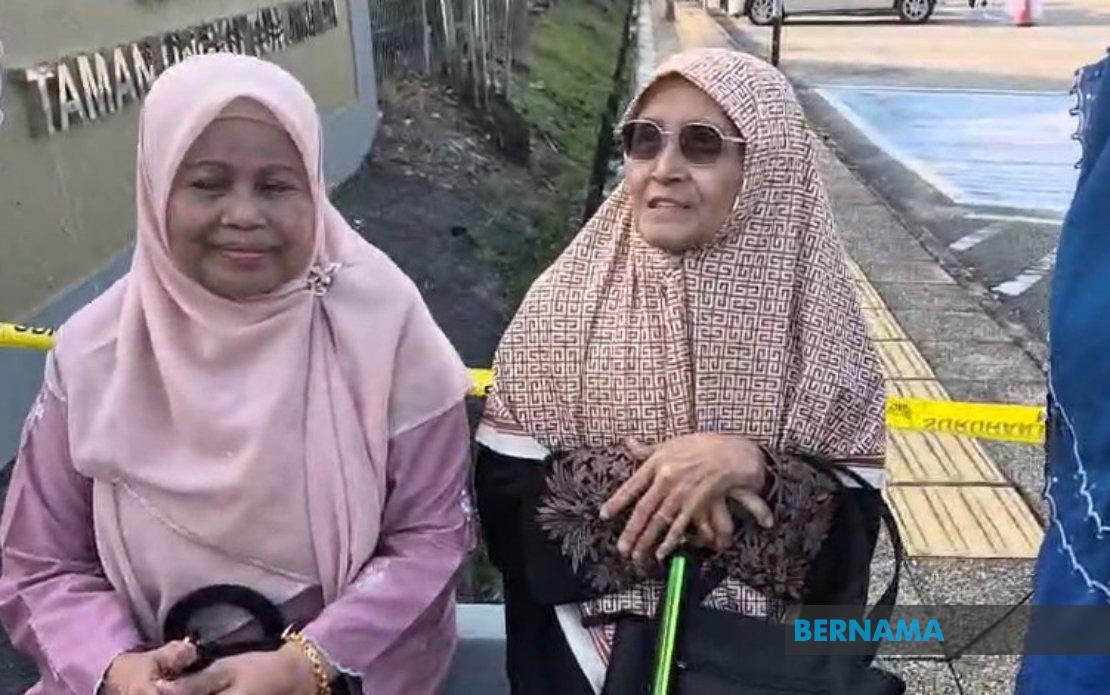
Determined to exercise their voting rights, elderly Malaysians across Johor turned out in significant numbers for the 16th state election held on July 11, with many arriving at polling stations well before the doors opened. Despite weather conditions and physical limitations—some voters depending on wheelchairs to move about—senior citizens showed they remain engaged with the democratic process, treating polling day as an important civic responsibility that warrants careful planning and early action.
Observations at multiple polling centres revealed a consistent pattern: many voters over 70 years old had strategically timed their arrival for the early morning hours, beginning their journey while it was still dark to avoid anticipated crowds and unpredictable rainfall. This coordinated effort to vote before sunrise reflected not mere habit but a deliberate approach to managing the practical challenges of participating in an election day. For working voters and those managing busy schedules, this early departure allowed them to complete their democratic duty and return to their daily responsibilities without disruption.
At Sekolah Jenis Kebangsaan Cina Kulai Besar in the Bukit Batu constituency, 70-year-old Gan Hin demonstrated the commitment common among senior voters. He had arranged with his employer to arrive at the polling station at 6.40 am, casting his ballot before heading to work at a farm in Indahpura. His statement that he makes voting a priority in every election reflected a generation that views democratic participation as a non-negotiable obligation, not merely an optional civic activity. Such arrangements, requiring coordination between voters and employers, highlight how seriously some Malaysians treat the opportunity to participate in elections.
The atmosphere at polling centres held particular appeal for some elderly voters, transcending the mere mechanics of casting a ballot. Sapiah Abdul Rahman, 74, described the polling centre experience as exciting and celebratory, comparable to festival occasions. Her decision to arrive early aimed not only to avoid congestion but to savour the social dimension of election day—the chance to encounter friends and community members in a shared civic space. For retirees with flexible schedules, this combination of political participation and social engagement made polling day a meaningful event worth planning around.
Physical mobility challenges did not deter vulnerable voters from participating. Rohani Sohod, 84 and reliant on a wheelchair, was among the first to arrive at Sekolah Kebangsaan Seri Melati in Johor Bahru. Her presence at the polls, navigating infrastructure and managing mobility requirements, represented an implicit demand that democratic institutions accommodate citizens across all physical conditions. Such participation, particularly when citizens face genuine obstacles, underscores the importance voters attach to representation and influence over their state's governance.
The intergenerational perspective emerged clearly through conversations with long-serving voters. Salma Wahid, 74, has maintained her voting record since 1981—four decades of unbroken participation spanning multiple electoral cycles and political transitions. Her expressed concern that younger Malaysians should engage more actively in voting reflected a common worry among elderly voters that future generations might not inherit the same commitment to democratic participation. This anxiety, voiced by someone whose lifetime of voting demonstrates deep conviction, raises questions about how Johor—and Malaysia more broadly—might sustain civic engagement across generational lines.
Weather presented a genuine challenge that could have suppressed turnout, yet senior voters adapted strategically rather than abstained. In Muar, heavy rainfall that began around 4 am did not deter participation but instead accelerated it. P. Gunasekaran, 63, a private sector retiree, had prepared for deteriorating conditions by waking at 4 am and departing his home at 6 am, arriving at Sekolah Menengah Kebangsaan Seri Muar around 7 am. His experience of heavier-than-expected rain, which had also affected the previous state election, shaped his decision to vote as early as possible. Rather than viewing challenging weather as an excuse, voters treated it as a logistical factor to manage through earlier arrival.
Rokiah Yunos, 80, exemplified how religious practice and civic duty intersected for some voters. She departed after dawn prayers at approximately 7.30 am, having structured her morning routine to accommodate both spiritual and democratic obligations. Her experience of minimal waiting upon arrival at the polls demonstrated the efficiency gains from early participation—she voted immediately upon the polling centre opening, avoiding any delay. Her statement that this represented her first instance of arriving earlier than usual in previous elections specifically because of weather concerns highlighted how even long-serving voters adjust their strategies based on anticipated conditions.
The scale of participation reflected broad eligibility across Johor's electorate. More than 2.7 million registered voters held the right to cast ballots across 1,076 polling centres distributed throughout the state, selecting representatives for 56 state seats. With 172 candidates competing in what constitutes a competitive electoral contest, the infrastructure required to accommodate millions of voters across a geographically large state demands careful coordination. The concentration of senior voters arriving early may have helped distribute demand across the polling day, easing pressure on registration and voting mechanisms during peak hours later in the morning.
The polling process itself, from the perspective of elderly voters navigating it, revealed how election administration must accommodate diverse participant needs. Early arrivals allowed voters to move through the system without pressure, crucial for those with mobility constraints or health considerations. The fact that multiple elderly voters reported smooth, quick voting processes upon early arrival suggested that careful arrival timing—enabled by flexible personal schedules—produced tangible benefits beyond merely avoiding crowds. This pattern implicitly challenges election administrators to consider how polling mechanisms might better serve voters with physical limitations or time constraints even during peak participation hours.
For Malaysian readers, particularly those in states approaching their own electoral cycles, the Johor experience offers meaningful observations about civic participation patterns and the motivations driving voters across demographic categories. The strong turnout among senior citizens, despite considerable practical challenges, demonstrates that age alone does not determine whether individuals engage with democratic processes. Rather, factors including lifetime voting habits, family and community encouragement, flexible workplace arrangements, and the social dimensions of election day collectively shape participation decisions. Understanding these motivations becomes valuable for policymakers, election administrators, and community leaders seeking to sustain and broaden democratic engagement across diverse populations.

