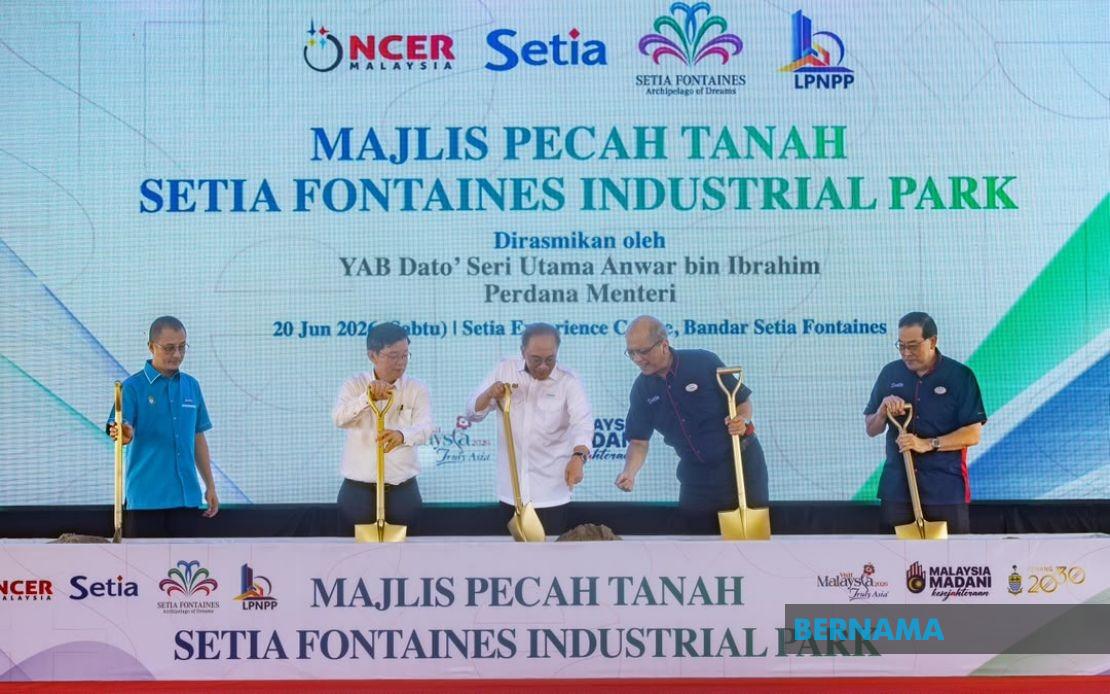
Prime Minister Datuk Seri Anwar Ibrahim has called for a fundamental shift in how Malaysia approaches large-scale development, insisting that both government-linked companies and private enterprises actively construct pathways for middle- and lower-income communities to participate meaningfully in economic growth. Speaking at the groundbreaking ceremony for the Setia Fontaines Industrial Park in Bandar Setia Fontaines on June 20, Anwar framed inclusive development not as a charitable gesture but as essential infrastructure for social cohesion and sustainable prosperity.
The Prime Minister's remarks underscore growing concern within government circles that rapid expansion of high-value investment and commercial activity risks leaving significant segments of the population behind. Anwar articulated this anxiety with particular force, warning that without deliberate intervention, Malaysia faces a scenario where the gulf separating affluent Malaysians from those earning modest incomes becomes progressively more difficult to bridge. His language suggested frustration with development models that generate impressive headline figures while doing little to improve the lived circumstances of ordinary workers and families.
Anwar's specific reference to major institutional investors—Khazanah Nasional Berhad, Permodalan Nasional Berhad, and the Employees Provident Fund—indicates that government pressure on capital allocation is intensifying. By naming these entities alongside private corporations, Anwar signalled that state-controlled investment vehicles, which ostensibly answer to the public interest, must demonstrate tangible commitment to equitable opportunity creation. This reflects a broader policy direction emphasizing that government endorsement and regulatory approval of projects should be conditional on measurable inclusion mechanisms benefiting non-elite Malaysians.
The Prime Minister distinguished between superficial economic metrics and genuine developmental progress, cautioning that growth statistics alone provide misleading indicators of national wellbeing. This analytical distinction carries particular weight in Malaysian political discourse, where competing development philosophies have long debated whether rising GDP translates automatically into improved material conditions for ordinary citizens. Anwar's formulation suggests the administration will increasingly scrutinize whether approved ventures demonstrate concrete benefits trickling across all socioeconomic strata rather than concentrating wealth among established business elites.
The Setia Fontaines Industrial Park project itself exemplifies the type of initiative Anwar believes should model inclusive development principles. Strategically positioned in Bandar Setia Fontaines, the park addresses a deliberate geographic consideration: ensuring that Seberang Perai participates equitably in economic expansion rather than watching capital and opportunity concentrate on Penang Island and in the state's southern corridor. This spatial dimension reflects recognition that unbalanced regional development generates political grievances and inefficient resource utilization across federal territory.
Anwar characterized the industrial park's potential to generate high-calibre employment as contingent on Malaysia's successful transition from lower-value manufacturing toward technology-intensive sectors. This positioning aligns with broader national ambitions to climb global value chains and reduce economic dependence on labour-intensive production vulnerable to competition from lower-wage jurisdictions. The industrial park therefore represents not merely a commercial real estate venture but a testing ground for whether Malaysia can simultaneously advance technological sophistication and maintain inclusive employment prospects for its workforce.
Critically, Anwar identified skills misalignment as a potential obstacle threatening to undermine even well-designed development initiatives. His observation that employers can offer positions without finding qualified candidates reflects a documented phenomenon in Malaysian labour markets, where rapid sectoral transformation has outpaced educational infrastructure adaptation. This skills gap creates perverse outcomes wherein development projects fail to deliver promised employment benefits to intended communities because workers lack requisite technical qualifications, perpetuating inequality despite nominal opportunity creation.
The Prime Minister's emphasis on strengthening collaboration between industry, technical and vocational education providers, and universities—specifically mentioning Universiti Sains Malaysia—signals recognition that inclusive development requires ecosystem-level coordination rather than isolated corporate initiatives. Educational institutions must anticipate labour market evolution and recalibrate curricula accordingly, a challenging proposition when technology sectors transform rapidly. Anwar's framing implies government intends closer integration between employment-creating entities and training infrastructure, potentially including regulatory incentives rewarding firms that invest in workforce development.
Anwar's comments also implicitly acknowledge that technology cycles operate on compressed timescales, with emerging skills becoming obsolete within months or years. This temporal dimension complicates traditional educational approaches that require years to design and implement programmes. The implication is that Malaysia must develop more agile, continuously updated training mechanisms capable of tracking technological change in real time, a capacity currently underdeveloped across most regional economies.
For Southeast Asian observers, Anwar's remarks illuminate Malaysian policy direction concerning inclusive growth, a theme increasingly central to regional development discourse as inequality pressures mount across multiple economies. Malaysia's relative affluence within ASEAN has historically insulated it from some inequality-related political upheaval visible in less developed neighbours, yet middle-class economic anxiety and perceptions of unequal opportunity distribution have grown notably in recent years. Anwar's insistence on conditioning development approval on inclusive benefit distribution suggests Malaysian policymakers recognize that continued prosperity requires demonstrable commitment to broad-based opportunity access.
The industrial park launch thus serves as platform for articulating state expectations regarding corporate social responsibility in an inclusive growth framework. Rather than treating development as purely commercial enterprise, Anwar positioned government as active mediator requiring development actors to demonstrate genuine commitment to benefiting all income tiers. This represents subtle but significant recalibration of state-market relationship, suggesting developmental approval increasingly contingent on meeting inclusive criteria beyond traditional financial and regulatory compliance.
Ultimately, Anwar's intervention reflects conviction that Malaysia's development trajectory over coming years cannot rest on repeating models that generated prosperity unevenly distributed. As technology sectors expand and manufacturing evolves, opportunities genuinely accessible to middle and lower-income Malaysians will determine not only individual economic prospects but also political stability and social cohesion across the nation. The Setia Fontaines Industrial Park will offer early evidence whether rhetorical commitment to inclusive development translates into substantive policy mechanisms ensuring broad-based benefit realization from major projects.
%22%2F%3E%3C%2Fpattern%3E%3C%2Fdefs%3E%3Crect%20width%3D%22100%25%22%20height%3D%22100%25%22%20fill%3D%22url(%23ph2y81qg)%22%2F%3E%3Crect%20width%3D%22100%25%22%20height%3D%22100%25%22%20fill%3D%22url(%23ph2y81qp)%22%2F%3E%3Ctext%20x%3D%2250%25%22%20y%3D%2250%25%22%20text-anchor%3D%22middle%22%20dominant-baseline%3D%22central%22%20fill%3D%22rgba(255%2C255%2C255%2C0.95)%22%20font-family%3D%22Georgia%2C%20'Times%20New%20Roman'%2C%20serif%22%20font-weight%3D%22700%22%20font-size%3D%22320%22%20letter-spacing%3D%22-0.02em%22%3ETV3%3C%2Ftext%3E%3C%2Fsvg%3E)
%22%2F%3E%3C%2Fpattern%3E%3C%2Fdefs%3E%3Crect%20width%3D%22100%25%22%20height%3D%22100%25%22%20fill%3D%22url(%23ph2pvjyg)%22%2F%3E%3Crect%20width%3D%22100%25%22%20height%3D%22100%25%22%20fill%3D%22url(%23ph2pvjyp)%22%2F%3E%3Ctext%20x%3D%2250%25%22%20y%3D%2250%25%22%20text-anchor%3D%22middle%22%20dominant-baseline%3D%22central%22%20fill%3D%22rgba(255%2C255%2C255%2C0.95)%22%20font-family%3D%22Georgia%2C%20'Times%20New%20Roman'%2C%20serif%22%20font-weight%3D%22700%22%20font-size%3D%22170%22%20letter-spacing%3D%22-0.02em%22%3EJudicial%3C%2Ftext%3E%3C%2Fsvg%3E)