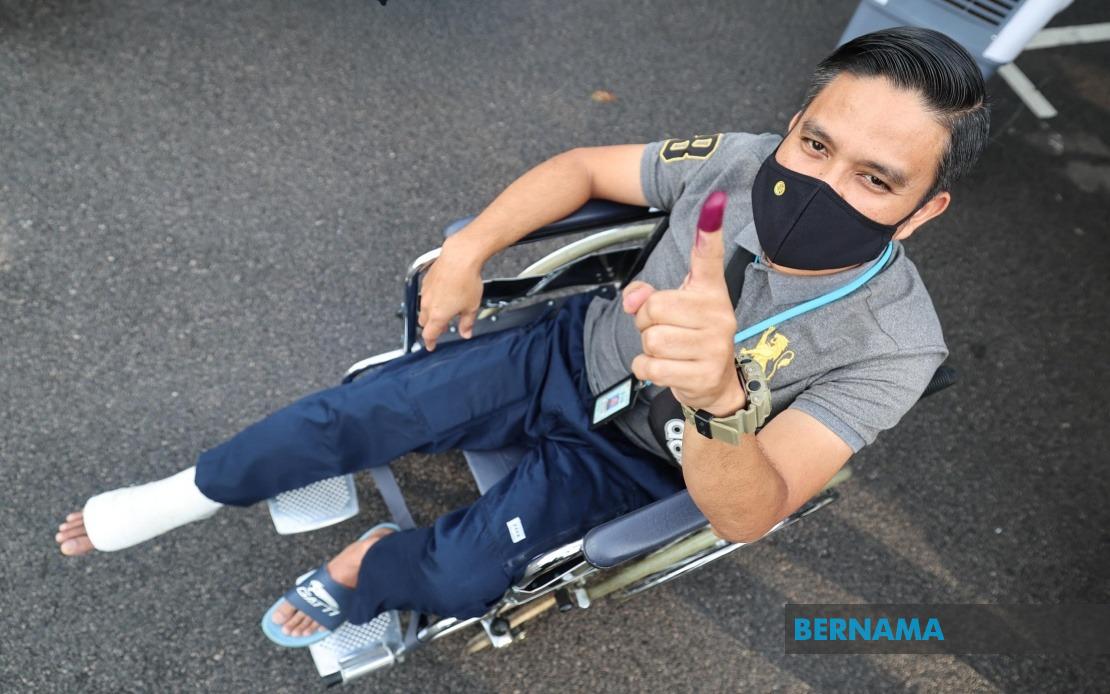
In the annals of electoral participation, few stories capture the spirit of civic responsibility quite like that of Sergeant Syahrizal Musa, a 40-year-old police officer who refused to let physical injury dampen his determination to vote in the 16th Johor state election. Arriving at the early voting centre at the Johor Police Contingent Headquarters on a wheelchair, Syahrizal exemplified the kind of dedication to democratic processes that underpins healthy governance. His decision to cast his ballot despite medical constraints underscores a broader narrative about the importance Malaysians place on exercising their electoral franchise, even when circumstances prove challenging.
The circumstances surrounding Syahrizal's participation in today's poll reveal the reality that sometimes the most compelling civic gestures emerge from the most unexpected quarters. Last week, while engaged in a spirited game of sepak takraw—the beloved Southeast Asian sport that demands agility and coordination—Syahrizal sustained a minor tear to his Achilles tendon. Medical professionals subsequently prescribed complete rest and confinement to a wheelchair until July 16. Yet rather than treating his medical leave as a convenient exemption from voting, the veteran officer arranged transportation from his residence in the Tampoi police quarters and made the journey to participate in the election.
What makes Syahrizal's story particularly resonant is the perspective it offers on institutional loyalty and personal conviction. Stationed at the Internal Security and Public Order Department within the Johor IPK, he has served with the Royal Malaysia Police for more than two decades, a tenure spanning multiple electoral cycles. Throughout his 22-year career, Syahrizal has never missed voting in any election. This unbroken record, maintained across various administrations and political landscapes, speaks to a philosophy that transcends temporary hardship. To him, the right to vote represents something sufficiently fundamental that physical incapacity becomes merely an obstacle to work around, not a reason to abstain.
Syahrizal's athletic background adds another dimension to understanding his resilience. As an accomplished sepak takraw player who has represented the Johor Police Contingent in several tournaments, he is accustomed to pushing through discomfort in pursuit of objectives he values. The discipline cultivated through years of competitive sport—the ability to compartmentalize pain and maintain focus—evidently extends beyond the playing field into his civic life. Even as the Achilles tendon injury rendered normal mobility impossible, this mindset compelled him forward.
The early voting arrangements in Johor reflect the electoral infrastructure designed to accommodate personnel serving in security forces and their families. Across 64 polling centres established throughout the state, approximately 24,751 early voters participated today, comprising military personnel, their spouses, police officers, and members of the General Operations Force with their families. This parallel voting system acknowledges the operational demands placed on security personnel, many of whom may face scheduling conflicts or deployment on the main polling day. Syahrizal's utilization of these facilities demonstrates how such accommodations facilitate broader participation even among those facing additional physical barriers.
The broader context of the Johor election highlights the scale and significance of this democratic exercise for Malaysia's southern state. With 172 candidates contesting 56 seats, the election represents a substantial electoral engagement across numerous constituencies. The ordinary polling day, scheduled for Saturday, will see approximately 2.7 million voters across the state exercise their franchise. Early voting processes like those that accommodated Syahrizal and thousands of others help distribute the logistical burden of managing such a large electorate while ensuring that vital segments of the voting population—those in essential services particularly—do not find their professional obligations incompatible with political participation.
From a sociological perspective, Syahrizal's determination to vote carries implications that extend beyond the individual act itself. His presence at the polling centre, navigating a wheelchair and bearing visible signs of injury, sends a powerful message about the normalcy and importance of electoral participation regardless of circumstance. In a region where voter turnout and engagement fluctuate considerably, narratives of ordinary citizens overcoming obstacles to vote contribute to cultural narratives that reinforce democratic norms. When security personnel—individuals trained to prioritize duty and responsibility—demonstrate such commitment to civic processes, they implicitly signal that voting ranks among society's most important obligations.
The conversation between Syahrizal and assembled journalists at the voting centre further illuminates his philosophy. Rather than dwelling on the discomfort of his condition, he articulated a forward-looking perspective, expressing hope that more Malaysians would embrace their electoral rights. This framing—where personal sacrifice becomes subordinate to broader civic exhortation—reflects a mentality increasingly valuable in contemporary democracies. Too often, potential voters cite minor inconveniences as justifications for non-participation. Syahrizal's example implicitly challenges such reasoning, demonstrating that genuine commitment to democratic processes requires transcending everyday obstacles.
The fact that this was Syahrizal's first experience voting while confined to a wheelchair adds poignancy to his participation. Over 22 years of electoral cycles, he has presumably developed various voting routines and rhythms. Yet faced with an entirely new circumstance demanding adaptation, he did not permit unfamiliarity to become an excuse. Instead, he accepted the challenge of navigating the polling centre in an unfamiliar state, demonstrating that civic duty adapts to changed circumstances rather than the reverse. This flexibility and determination offer lessons for election management authorities considering accessibility improvements that benefit not only those with permanent mobility challenges but also those experiencing temporary injuries.
The Johor election itself occurs at a significant moment in Malaysian political discourse, following various developments that have kept electoral dynamics fluid. The participation of security personnel through early voting mechanisms, and particularly stories like Syahrizal's, underscore that electoral engagement crosses institutional boundaries and encompasses diverse segments of society. Police officers, military personnel, civilians across numerous professions—all converge at polling centres united by commitment to democratic processes.
Looking forward, the early voting period now concluded, attention shifts toward the main polling day when the state's broader electorate will determine the political direction of Johor. Yet the images and stories from today's early voting—particularly that of a determined police sergeant navigating a wheelchair to fulfil his civic responsibility—will likely endure as reminders of what electoral participation fundamentally represents. It is not merely a right conveniently exercised when circumstances prove favorable, but rather an obligation willingly undertaken even when doing so demands overcoming genuine physical and logistical obstacles.
Syahrizal's journey from his quarters in Tampoi to the Johor Police Contingent Headquarters, undertaken despite medical leave and wheelchair confinement, ultimately reflects values that underpin stable democracies. Civic participation, when embraced as a non-negotiable responsibility rather than an optional activity, strengthens democratic institutions and reinforces the legitimacy of electoral outcomes. In Johor, where 2.7 million voters will soon determine their state's political future, such examples of unwavering commitment to democratic processes provide a template for the kind of engagement upon which meaningful governance depends.

