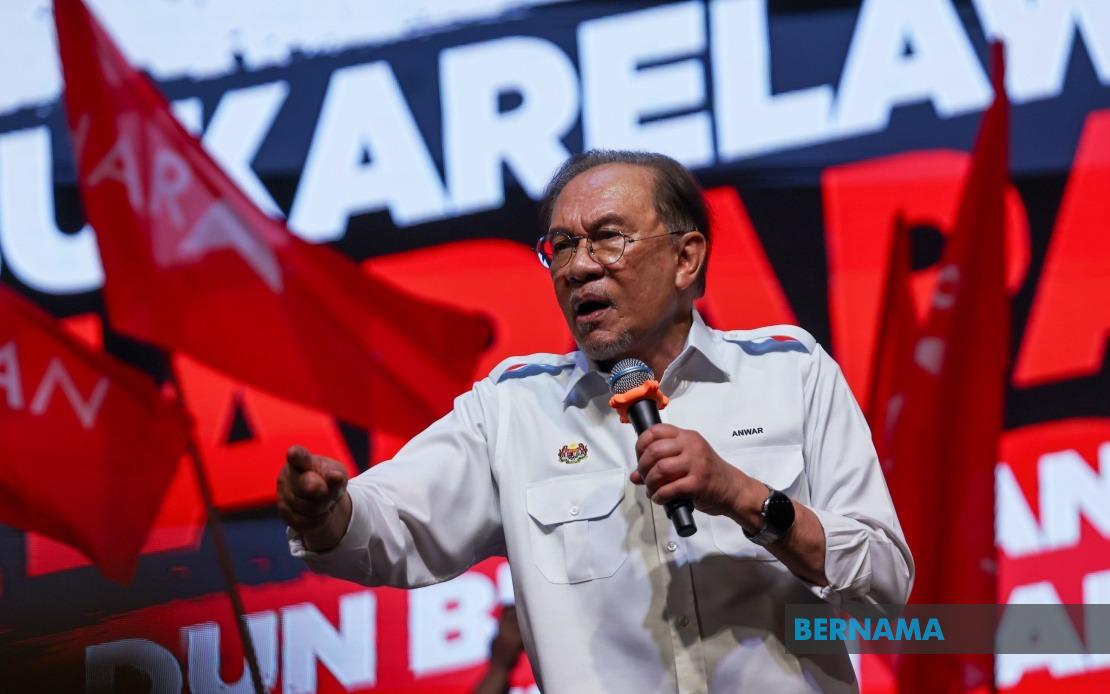
Prime Minister Datuk Seri Anwar Ibrahim has moved to counter what he characterises as a deliberate misrepresentation of the Democratic Action Party's stance toward Malay rights, positioning the issue as central to defending the cohesion of the ruling coalition ahead of critical state elections. Speaking in Muar, Anwar rejected the narrative promoted by critics seeking to label DAP as a racially motivated organisation, framing instead the party's approach as pragmatic acceptance of constitutional protections for the Malay-Bumiputera community within a broader framework of inclusive governance.
As chairman of the Pakatan Harapan coalition and leader of the Unity Government, Anwar cited concrete examples to substantiate his claim that DAP has demonstrated willingness to support measures traditionally associated with Malay-Bumiputera interests. He pointed specifically to the party's absence of objection to the government's intention to gazette 20.23 hectares of land in Bandar Malaysia as Malay Reserve Land, presenting this as tangible evidence that DAP operates within constitutional boundaries rather than seeking to dismantle established protections. This measured acknowledgment reflects the delicate political balance required to maintain multiracial coalition stability in Malaysia's fractious political landscape.
Anwar's intervention addresses a persistent line of attack deployed by opposition forces seeking to fracture the Unity Government by amplifying communal anxieties. The premier articulated a distinction between recognizing specific constitutional safeguards for Malays and Bumiputeras on one hand, and maintaining equitable treatment across all communities on the other. This positioning attempts to reframe the debate from one of conflicting racial interests to one of efficient resource allocation serving multiple constituencies simultaneously, a rhetorical strategy essential for coalition survival in multiethnic Malaysia.
The Prime Minister elaborated on practical initiatives demonstrating the government's commitment to Bumiputera advancement, citing expanded allocations for Perbadanan Usahawan Nasional Berhad and various community programmes targeting the Malay demographic. Simultaneously, he underscored his obligation as leader to prevent exclusionary policies affecting other communities, specifically mentioning that development programmes benefiting Chinese and Indian populations must not face obstruction. This dual emphasis encapsulates the central tension within the Unity Government: balancing the constitutional expectations of the Malay-Muslim majority against growing demands for equitable treatment from minority communities increasingly mobilising politically.
Anwar's articulation of inclusive governance extends beyond symbolic gestures to encompass a broader economic philosophy. He contended that Malaysia's current economic expansion should translate into tangible improvements in living standards distributed across racial and socioeconomic lines, rather than concentrating wealth among political elites or favoured constituencies. This framing reorients the conversation from static resource division to dynamic growth benefiting multiple groups, a strategy particularly relevant given rising class-based grievances in both urban and rural areas cutting across traditional communal lines.
The Premier's emphasis on providing adequate housing, commercial facilities, and educational quality reflects recognition that material welfare increasingly supersedes purely communal considerations in voter behaviour, particularly among younger demographics and urban populations. By positioning economic development as the legitimate outcome of political service rather than personal enrichment, Anwar seeks to elevate the discourse beyond communal competition toward a performance-based evaluation of governance. This approach potentially appeals to voters across all backgrounds dissatisfied with incumbents perceived as prioritizing private gain over public welfare.
Anwar's comments arrive amid the Johor state election campaign, where 172 candidates are contending across 56 state assembly seats. The polling takes place on July 11, with early voting scheduled for July 7, making the Prime Minister's intervention strategically timed to shape narratives during a crucial phase when voter preferences remain fluid. Johor, as Malaysia's second-most populous state and a traditional UMNO stronghold, represents contested terrain where the Unity Government must demonstrate broad-based appeal beyond its core constituencies.
The timing of Anwar's statement reflects heightened sensitivity within the coalition to accusations of communal bias, particularly given the DAP's minority status within a government where UMNO and Islamic parties wield substantial influence. Recent political developments have intensified scrutiny of power-sharing arrangements, with opposition actors consistently attempting to delegitimize the coalition by framing DAP participation as a threat to Malay-Muslim interests. Anwar's preemptive defence aims to neutralize such messaging before it crystallizes voter preferences in upcoming contests.
For Malaysian readers, the underlying significance extends beyond immediate electoral calculations. The necessity of such clarifications underscores the fragility of multiracial coalition-building in a political ecosystem where communal anxieties remain potent mobilising forces. The debate reflects ongoing tensions between Malaysia's constitutional commitments to Bumiputera rights and contemporary pressures for meritocratic, non-discriminatory governance—tensions that no governing arrangement has decisively resolved. Anwar's framing suggests the Unity Government's approach involves managing rather than resolving these tensions, a strategy that may prove sustainable only if economic performance delivers material improvements for voters across communities and if opposition actors find other grievances less politically productive.
The sustainability of this inclusive governance model depends significantly on implementation effectiveness. Anwar's rhetorical commitment to equitable resource distribution must be accompanied by visible investments in predominantly non-Malay constituencies and transparent allocation mechanisms perceived as fair by multiple communities. Without concrete delivery, the distinction he draws between respecting constitutional protections and ensuring broader equity risks appearing as merely sophisticated political messaging rather than substantive policy reorientation. The upcoming election results in Johor will provide early evidence regarding whether voters find this balancing act credible.

