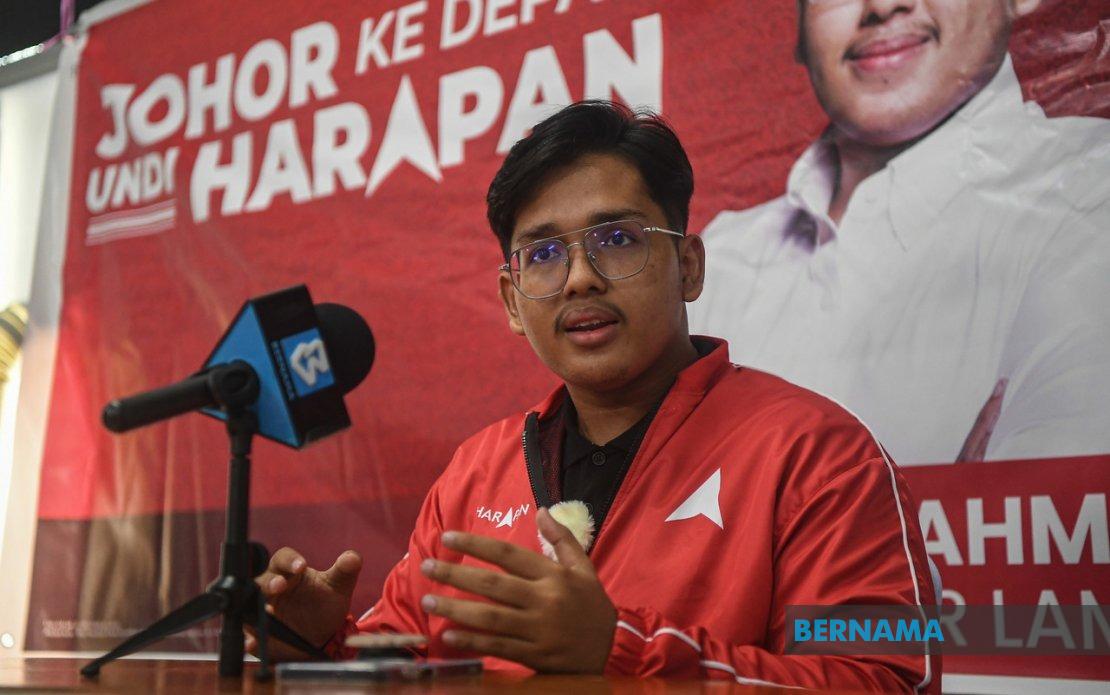
At just 23 years old, Danish Hossman Abd Rahman has emerged as Pakatan Harapan's candidate for the Johor Lama state seat, positioning himself as a fresh voice for a constituency that has long grappled with uneven development patterns. Campaigning under the banner "Wajah Baharu, Johor Lama" (A New Face, Johor Lama), the young politician is making an audacious pitch centred on reversing rural exodus and creating sustainable economic opportunities within the constituency itself. His platform reflects a recognition that many Johor communities have been left behind as attention and resources concentrate on more urbanised areas, a pattern that has accelerated youth migration to Johor Bahru and beyond.
The core of Danish's campaign message addresses a persistent demographic challenge facing rural Malaysia: the drain of young talent from villages to cities and overseas. Federal Land Development Authority (Felda) settlements across Johor Lama, which were originally conceived as development schemes, have increasingly become places of origin for migration rather than opportunity. Danish argues that this trajectory is neither inevitable nor desirable, and that strategic investment targeted at these communities could fundamentally alter economic prospects. He contends that when young people from Felda areas migrate to Johor Bahru or Singapore for employment, the settlements lose not only population but also entrepreneurial energy and household spending that would otherwise circulate locally.
To address this challenge, Danish is advocating for stronger coordination between state and federal authorities to ensure that development policies and projects reach beyond the usual beneficiaries. His emphasis on federal-state cooperation is particularly significant in Malaysia's context, where policy implementation frequently stumbles when political alignment falters between different levels of government. Johor's political complexities—where different coalitions may control state and federal positions—make such coordination even more critical. Danish's call for seamless partnership suggests an understanding that a single representative alone cannot unlock development without institutional support from above.
Beyond broad economic appeals, Danish has pinpointed a specific administrative gap that exemplifies how rural constituencies are underserved: the absence of an Immigration Department branch office in Kota Tinggi. Residents currently must travel to Johor Bahru, Kulai, or Mersing to handle passport applications and immigration matters—journeys that consume considerable time and resources for people in rural areas. The proposal to establish a local immigration centre addresses a mundane yet significant quality-of-life issue that affects ordinary citizens' engagement with the state. Such infrastructure improvements, while less glamorous than factory investments, represent the kind of grassroots governance that resonates with voters in underestimated constituencies.
The Johor Lama contest presents a three-way competition that will test whether Danish's youthful appeal and forward-looking agenda can overcome the advantages of incumbency. Norlizah Noh, the sitting representative from Barisan Nasional, brings established networks and the machinery of the ruling coalition, while Aisah Esa represents Perikatan Nasional's attempt to consolidate its support in the state. For Danish, youth is simultaneously his greatest asset and his main vulnerability—younger voters may find his approach refreshing, whilst older constituents might question whether experience matters in local representation. The contest will partially serve as a referendum on whether voters in Johor Lama are seeking continuity or change.
Danish's campaign strategy reveals how electoral politics in Malaysia is evolving beyond traditional methods. He is deliberately combining door-to-door engagement with digital outreach, acknowledging that different voter segments consume political information through different channels. The Johor Lama constituency encompasses more than 32,000 voters spread across rural settlements, villages, and small towns—a demographic composition that requires varied communication approaches. His emphasis on direct interaction signals respect for personal connection, whilst his active social media presence demonstrates technological literacy that younger voters increasingly expect from their representatives. This mixed approach suggests a candidate who is not betting entirely on either the old or the new, but recognising that effective grassroots politics demands both.
The positive reception Danish reports on social media aligns with broader patterns of youth engagement in Malaysian politics, particularly in constituencies where young people have felt persistently overlooked. Whether this enthusiasm translates into actual votes will depend significantly on whether his policy proposals address voters' most pressing immediate concerns—employment availability, cost of living, and access to services. Rural voters are often characterised as more pragmatic and less swayed by rhetoric; they vote for candidates they believe will deliver tangible improvements. Danish's specific proposals regarding immigration services and investment attraction suggest he understands this pragmatism, though translating campaign promises into implemented projects requires resources and political leverage.
The timing of the Johor state election—with polling scheduled for July 11 and early voting on July 7—comes at a moment when rural development remains contested terrain in Malaysian politics. Multiple coalitions are competing for voter support partly by promising to address the development imbalance between urban and rural areas, yet results have often disappointed. Danish's campaign implicitly acknowledges that previous efforts have fallen short, positioning himself as offering a new approach rather than defending the status quo. His willingness to engage directly with the specific grievances of Felda residents and rural Johor communities suggests at least a recognition of what voters actually care about.
For Malaysian and Southeast Asian observers, the Johor Lama contest reflects broader questions about how younger politicians can effectively represent rural constituencies whilst respecting their distinct needs and concerns. The region has seen numerous examples of youth candidates who struggle with rural voters precisely because they appear disconnected from agricultural rhythms, community hierarchies, and the economic realities of non-urban life. Danish's emphasis on creating local employment within Felda communities rather than encouraging integration into distant urban markets indicates a more nuanced understanding of rural development than sometimes appears in national political discourse. Whether this translates into a winning platform will reveal much about the current priorities of Johor's rural electorate.

