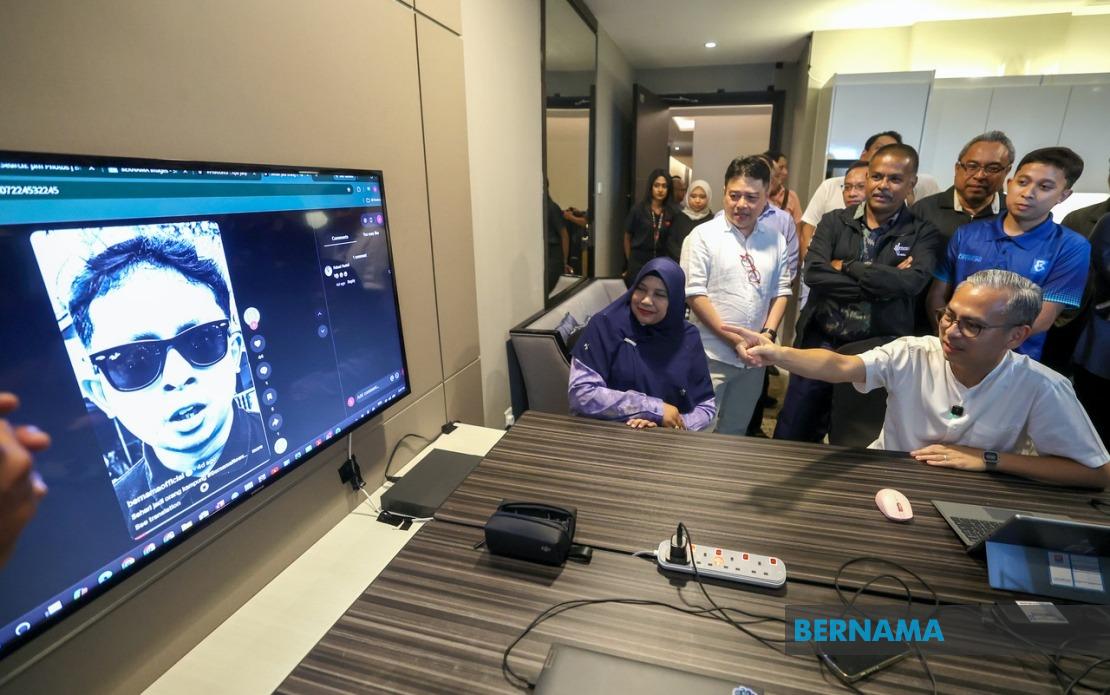
Communications Minister Datuk Fahmi Fadzil has thrown his weight behind the Malaysian National News Agency's election coverage efforts, visiting the Bernama Operations Centre in Johor Bahru on July 7 to assess preparations for the state polls scheduled for July 11. The minister's endorsement reflects broader concerns across Southeast Asia about maintaining robust public information infrastructure during democratic exercises, particularly in major state-level contests that shape regional political dynamics.
Fahmi's inspection revealed a well-coordinated operation with 44 personnel deployed across the state—a substantial commitment for what amounts to one of Malaysia's most significant subnational electoral events in recent years. The team comprises journalists, cameramen and photographers tasked with delivering real-time coverage spanning Johor's geographical expanse, from the eastern reaches around Endau to the western maritime boundary at Tanjung Surat and northward into Johor's interior regions. This dispersed footprint underscores the logistical complexity of covering a 56-seat contest across a state that ranks among Malaysia's largest by area.
The minister's visit extended beyond ceremonial inspection, encompassing substantive engagement with working journalists and operational staff. Spending more than an hour at the centre, Fahmi examined broadcasting equipment, editorial facilities and support infrastructure while interacting directly with reporters preparing coverage. Such ministerial attention to news operations carries symbolic weight in affirming government commitment to transparent electoral communication—a principle increasingly important as media ecosystems across Southeast Asia face pressures from digital disruption and competing information sources.
Fahmi specifically acknowledged the role of Bernama's leadership in orchestrating the election assignment. Chief Executive Officer Datin Paduka Nur-ul Afida Kamaludin and Editor-in-Chief Arul Rajoo Durar Raj received commendation for logistical coordination and resource allocation, with the minister describing preparation levels as exceeding satisfactory standards. Such institutional recognition matters because Malaysia's national news agency functions as a foundational component of the country's public information ecosystem, setting editorial and operational benchmarks that influence coverage quality across the broader media landscape.
The election context itself underscores why comprehensive coverage proves essential. The July 2024 Johor state election attracted 172 candidates competing for 56 seats, figures indicating competitive contests in multiple constituencies. Early voting had commenced on the day of Fahmi's visit, with the full polling scheduled for Saturday, July 11. For electoral stakeholders ranging from voters seeking balanced information to candidates requiring fair media access, reliable news agencies function as crucial gatekeepers ensuring information flows transparently throughout the campaign cycle and counting process.
Bernama's operational model for election coverage reflects established practices in Malaysian electoral journalism, where the national agency coordinates with newsroom personnel to produce daily wire reports, broadcast packages and digital content. The Operations Centre structure enables centralized editorial coordination while distributed field teams gather primary reporting material. This dual-layer approach theoretically maximizes both editorial consistency and ground-level reporting detail, addressing the challenge of covering complex political narratives across geographically dispersed constituencies.
Fahmi's public appreciation for Bernama's work also carries broader significance for media-government relations in Malaysia. By publicly validating institutional news infrastructure, the Communications Minister sends signals about the government's stance toward independent information provision during electoral processes. Such affirmations matter particularly in regional contexts where media freedom metrics sometimes register concerns, as they demonstrate ministerial recognition that robust public broadcasters serve democratic rather than merely propagandistic functions.
The minister's emphasis on facilities and support systems being at "satisfactory levels" highlights practical considerations often overlooked in broader media criticism. Election coverage demands sustained operational intensity—extended shifts, rapid deadline cycles, and coordination across multiple platforms simultaneously. Whether newsrooms possess adequate technical infrastructure, editorial support and personnel resources directly shapes coverage quality and accuracy. By inspecting these fundamentals, Fahmi addressed the unglamorous but essential dimensions of how electoral journalism actually functions at implementation level.
For Malaysian readers and regional observers, the implications extend beyond a single state election. The 172 candidates and 56 seats in Johor represent political contests that shape not only state governance but influence national political calculations, coalition dynamics and policy directions affecting Malaysia's broader trajectory. Access to accurate, timely information about candidate positions, campaign developments and electoral outcomes therefore carries significance beyond local interest. Well-resourced news coverage facilitates informed voter decision-making and contributes to electoral legitimacy by ensuring the public receives information sufficient for meaningful democratic participation.
The deployment of Bernama personnel across Johor's full territorial span—from Endau's eastern reaches through central and western zones to Tanjung Surat—reflects logistical realities that Malaysian news organizations regularly navigate. Unlike centralized urban elections, state-wide contests in geographically expansive territories require distributed reporting infrastructure to capture regional variations in campaign dynamics, candidate strength and electoral trends. Bernama's approach of basing coverage at an operations centre while maintaining field teams throughout the state addresses this structural challenge.
As Southeast Asian democracies continue modernizing electoral systems and expanding digital information channels, government affirmation of traditional news agency capabilities remains relevant. While social media and alternative platforms increasingly influence political communication, national agencies like Bernama provide institutional anchors for factual reporting standards, editorial accountability and professional journalistic norms. Fahmi's recognition of these functions reflects ongoing regional understanding that maintaining institutional news infrastructure remains essential even as media ecosystems diversify.
The minister's visit ultimately served multiple communicative functions simultaneously: acknowledging Bernama's operational preparations, demonstrating government engagement with public information systems, and signaling confidence in the agency's capacity to deliver balanced coverage during a significant electoral exercise. Whether such visible support translates into enhanced coverage quality or broader media ecosystem improvements remains to be assessed after results emerge, but the symbolic alignment between ministerial attention and institutional news operations reinforces the principle that electoral integrity depends partly on information infrastructure working effectively to serve the voting public.

