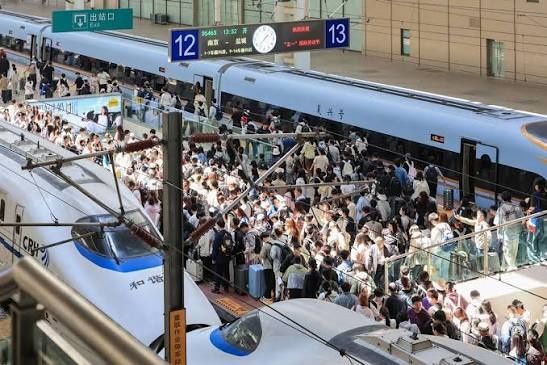
China's railway network has reached unprecedented levels of passenger traffic, recording more than 2.3 billion journeys across the country during the opening half of 2026. The milestone represents a sustained 5 per cent growth trajectory compared to the same period last year, according to figures released Monday by the China State Railway Group Co., Ltd., the state operator overseeing the sprawling national rail infrastructure.
The volume of daily train operations expanded correspondingly to accommodate this surging demand. China Railway deployed an average of 11,468 passenger trains each day throughout the six-month window, reflecting a 5.8 per cent increase measured against the previous year's comparable period. This expansion demonstrates the network's ongoing capacity investment and operational flexibility in response to travel patterns across the world's most populous nation.
A particularly striking dimension of this growth involves international passengers, whose numbers have climbed dramatically as Beijing's transit visa-free programme takes effect. The railway system facilitated over 12.31 million trips by foreign visitors during the first half of 2026, marking a robust 33.6 per cent year-on-year surge. This trajectory underscores how policy initiatives designed to attract inbound tourism and facilitate regional mobility are translating into measurable transportation demand, with railways positioned as a primary beneficiary of this opening.
Cross-border rail corridors have emerged as particularly dynamic segments within this broader expansion. The China-Laos Railway, a flagship Belt and Road initiative linking Kunming with Vientiane, transported 188,000 cross-border trips during the period, up 25.9 per cent from a year earlier. This performance reflects deepening economic integration within Southeast Asia, where improved transport connectivity reduces friction for commerce, investment flows, and personal mobility between neighbouring markets.
The Guangzhou-Shenzhen-Hong Kong high-speed railway similarly demonstrated resilience and growth potential, handling 16.96 million cross-border journeys in the first half of 2026, an increase of 13.8 per cent year-on-year. This route's sustained performance highlights the enduring appeal of premium rail services connecting major metropolitan areas within the Greater Bay Area, particularly as business and leisure travel patterns normalise and strengthen in the post-pandemic era.
Beyond raw passenger volumes, China Railway has pursued diversification strategies intended to broaden the appeal and functionality of rail travel across demographic and lifestyle segments. The operator initiated 1,797 tourist trains nationwide during the first six months, partnering with local cultural and tourism authorities to package rail journeys as experiential offerings rather than purely utilitarian transportation. This approach reflects international best practices in railway marketing whilst capitalising on domestic and international demand for curated travel experiences.
Enhanced passenger amenities have accompanied this expansion, with the network introducing quiet carriage designations to accommodate those seeking peaceful journeys, alongside pet-friendly travel services that acknowledge changing consumer preferences regarding companion animals. These incremental service improvements matter considerably in competitive transport markets, where marginal enhancements in comfort and convenience increasingly influence modal choice, particularly among affluent travellers with flexibility across transportation options.
For Southeast Asian observers, China's railway expansion carries multifaceted implications. Enhanced cross-border connectivity through routes like the China-Laos Railway creates fresh economic opportunities for regional players, facilitating supply chain integration and labour mobility whilst strengthening cultural and educational exchanges. Malaysia and other ASEAN members face both opportunities and competitive pressures as Chinese rail infrastructure increasingly functions as a gateway for visitors and investment flowing into and through the region.
The transit visa-free policy's demonstrated effectiveness in driving railway passenger growth suggests that removing travel frictions yields measurable economic returns, a lesson potentially applicable elsewhere within Southeast Asia as governments consider comparable facilitation measures. Higher international passenger volumes justify sustained infrastructure investment and service innovation, creating virtuous cycles where improved offerings attract additional demand, generating revenues that fund further enhancements.
Looking forward, China's railway sector appears positioned to consolidate these gains and explore emerging opportunities. The integration of digital technologies, expansion of premium service tiers, and development of innovative tourism products will likely characterise competitive positioning in the coming years. For Malaysian businesses and policymakers monitoring regional transport trends, China's rail expansion underscores the strategic importance of modern infrastructure and customer-centric service delivery in capturing emerging mobility demands within an increasingly integrated Asian economy.

