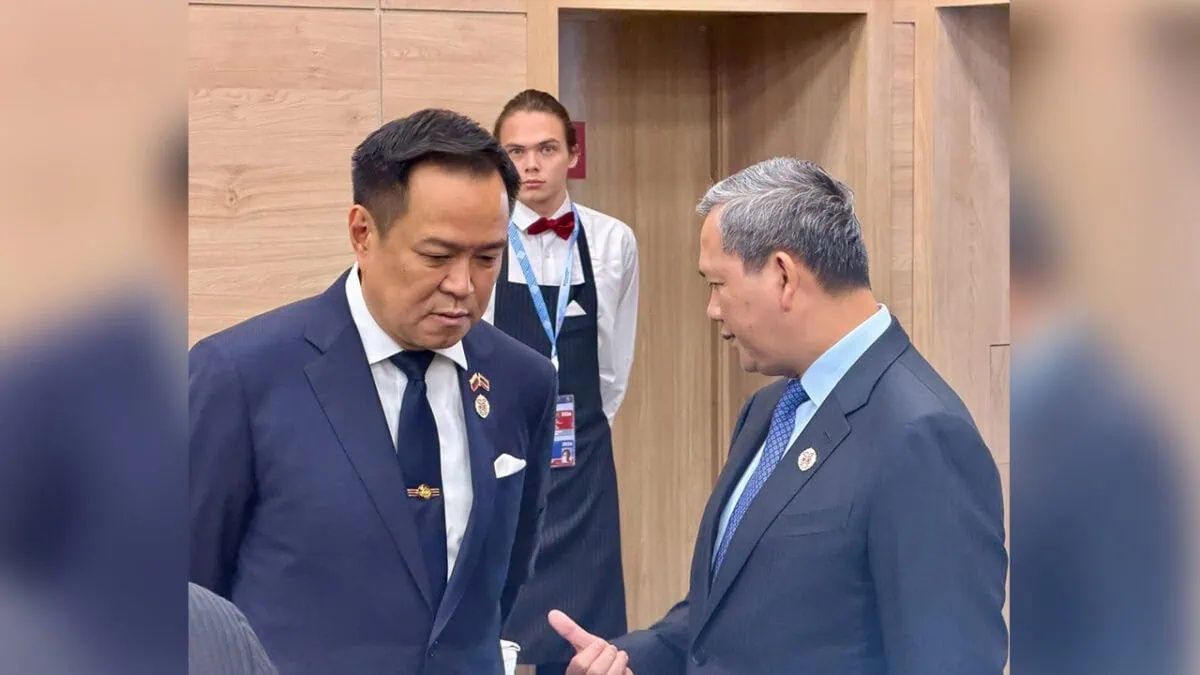
Prime Minister Hun Manet has escalated Cambodia's push for Thailand to move forward on long-stalled border demarcation work, calling specifically for Bangkok to appoint leadership to the Joint Boundary Commission during a recent encounter with Thai counterpart Anutin Charnvirakul. The appeal, made on the sidelines of an Asean-Russia engagement meeting in Kazan, reflects mounting Cambodian frustration over the slow pace of bilateral boundary negotiations that have remained largely dormant despite existing agreements between the two countries.
The exchange between the two leaders, though described by both sides as informal and brief, underscores the persistent salience of border issues in Cambodia-Thailand relations even as both governments publicly emphasise their commitment to peaceful dialogue. Hun Manet characterised the conversation in a social media post on Friday as touching on fundamental mechanisms for resolving disputes, with his remarks focusing on the practical barriers preventing progress on land boundary demarcation. The encounter in the Russian city offered a rare opportunity for high-level discussion on a matter that has periodically destabilised regional relations and generated domestic political pressure in both capitals.
At the heart of Cambodia's position is frustration with Thailand's apparent inability or unwillingness to fill the vacant JBC chief position, a procedural requirement that has effectively stalled the practical work of joint surveys and boundary marking. Hun Manet explicitly referenced Point Three of a Joint Statement signed on December 27, 2025, which presumably obligates both sides to pursue these activities. By publicly naming this specific commitment, the Cambodian premier was signalling that the onus for advancing negotiations now rests with Thailand, a diplomatic tactic designed to build regional and international pressure on Bangkok to match Cambodia's stated readiness to proceed.
Cambodia's strategy reflects a carefully calibrated dual-track approach to managing its border disputes with Thailand. On maritime issues, the kingdom is pursuing compulsory conciliation under the UN Convention on the Law of the Sea, a mechanism that formalises dispute resolution through established international legal frameworks. For land boundaries, Hun Manet has indicated preference for bilateral negotiations conducted through the JBC, signalling Cambodia's desire to avoid internationalising these disputes whilst simultaneously maintaining recourse to international law if bilateral channels fail. This hedging strategy allows Phnom Penh to appear reasonable and committed to peaceful resolution whilst preserving options should Thailand prove obstructionist.
Thai Prime Minister Anutin provided a markedly less detailed account of the Kazan exchange, characterising it as merely a fleeting conversation conducted "on the margins" of larger meetings. His description of the encounter as "pulling each other aside by the elbow" conveyed a sense of casualness that contrasts somewhat with Hun Manet's more substantive public framing. Anutin's brevity may reflect Thailand's own domestic sensitivities regarding border negotiations, particularly given his comment that Thai citizens would be "furious" at any discussion about reopening land border crossings. This remark reveals the intense domestic political pressures both governments face when addressing boundary matters, a factor that often constrains diplomatic flexibility.
The differing public presentations offered by each leader nevertheless converge on fundamental principles. Both Hun Manet and Anutin affirmed that neither side desires conflict and that established mechanisms—including UNCLOS, the JBC, and the General Border Committee—provide adequate frameworks for managing disputes. Thailand's commitment to maintaining these multilateral and bilateral channels mirrors Cambodia's stated preference for institutional approaches to boundary resolution. The convergence on methodology, even as emphasis differs, suggests underlying agreement that military confrontation is not an option either capital wishes to pursue.
For Malaysia and other Southeast Asian nations, the Cambodia-Thailand border situation carries regional implications. The ability of Asean members to manage bilateral disputes through peaceful institutional mechanisms strengthens the broader regional framework for conflict prevention. Conversely, protracted stalemates or escalation would undermine confidence in Asean's capacity to manage internal tensions and could create space for external powers to exploit divisions. Cambodia's decision to raise the issue during an Asean-Russia engagement meeting—rather than, for instance, during bilateral Asean forums—also signals an attempt to internationalise the concern beyond the association's traditional scope, potentially seeking broader diplomatic support for its position.
The timing of Hun Manet's public statement deserves scrutiny. By making his remarks about Thailand's JBC chief appointment at an international forum and amplifying them through social media, the Cambodian premier ensured that Thai intransigence, if it persists, becomes part of a public record visible to regional observers and international interlocutors. This strategy differs from quiet diplomacy and suggests either that Cambodia believes quiet negotiations have reached a plateau or that public pressure represents a necessary tool to overcome Thai bureaucratic or political obstacles to appointment decisions. The specificity of his reference to the December 2025 Joint Statement indicates that Cambodia has documentation of Thai commitments and intends to hold Bangkok accountable to them.
Thailand's reluctance to appoint JBC leadership may stem from complex domestic considerations rather than outright opposition to border demarcation. Leadership transitions, bureaucratic capacity constraints, or internal disagreements between Thai agencies about boundary demarcation methodology could all contribute to delayed appointments. Additionally, Thai concerns about how demarcation might resolve disputes—particularly regarding contested areas—could create political resistance to appointing a chief who might be pressured to reach unfavourable compromises. Anutin's public commitment to existing mechanisms may thus represent an effort to reassure Cambodia of Thailand's intent whilst privately managing domestic obstacles to moving the process forward.
Looking forward, the Cambodia-Thailand border situation will likely remain a test case for Asean's conflict management capabilities. The willingness of both leaders to frame their disagreements in terms of institutional frameworks and peaceful resolution offers hope that mechanisms exist to prevent escalation. However, the apparent stagnation in practical implementation—evidenced by the unfilled JBC chief position—suggests that institutional arrangements alone may be insufficient without the political will to staff them adequately and make difficult compromises. The Kazan encounter may prove pivotal if it catalyses Thai action on the appointment issue, or it may represent another cycle of rhetorical commitment unmatched by operational progress.