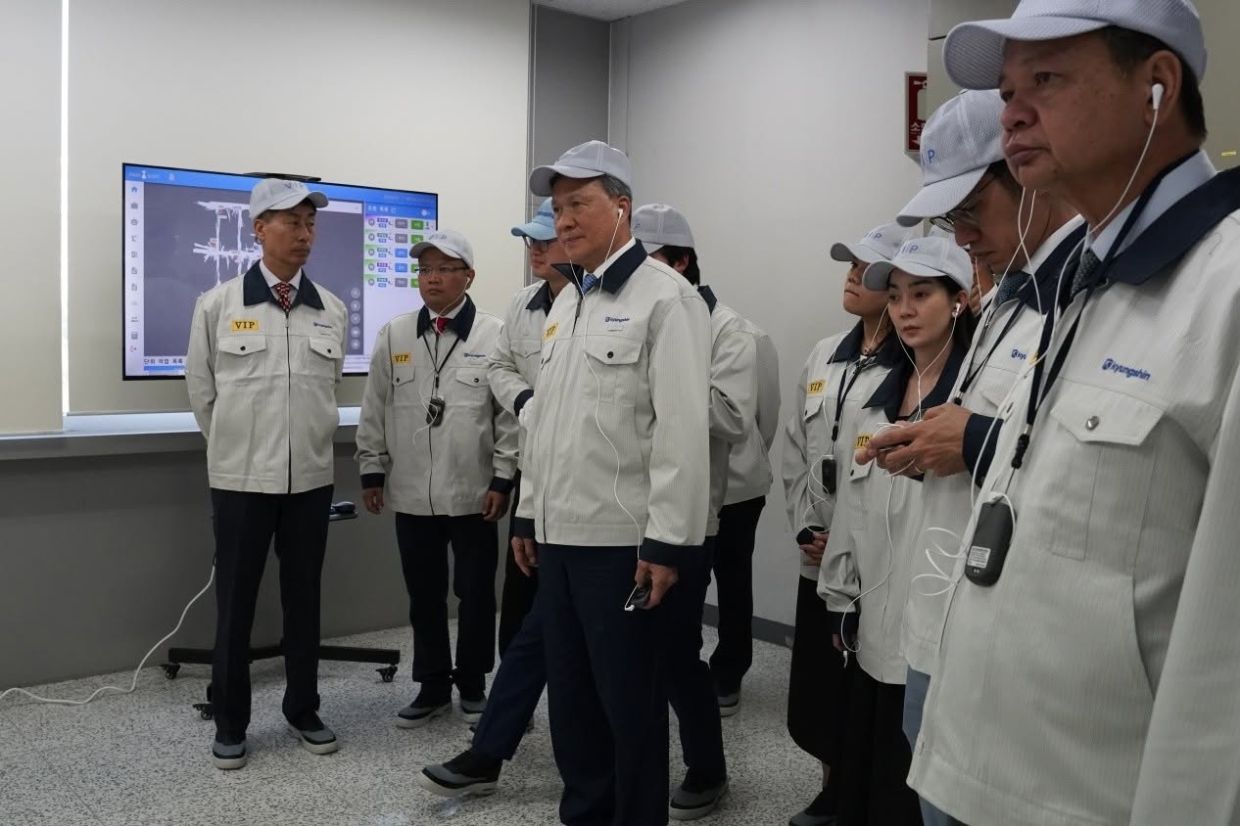
Cambodia is actively repositioning itself as a destination for advanced manufacturing and technology-driven investment, moving deliberately away from its decades-long dependence on garment production. During a recent investment promotion mission to South Korea, Deputy Prime Minister Sun Chanthol, who also serves as first vice-chairman of the Council for the Development of Cambodia, led a strategic engagement with South Korean firms already operating in the Kingdom and those considering expansion. The mission, which included factory inspections, high-level corporate meetings and an investment roadshow in Incheon on June 16, reflects a comprehensive government strategy to deepen economic ties with Seoul while attracting capital into higher-value sectors.
The underlying challenge facing Cambodia's economic planners is structural. For several decades, the nation's manufacturing prowess has rested primarily on garment, footwear and travel goods production, sectors that remain vital sources of employment and foreign exchange but offer limited scope for wage growth and technological advancement. Regional competitors increasingly compete in the same labour-intensive segments, while consumer demand in developed markets has become more volatile and subject to geopolitical pressures. Cambodian policymakers recognise that sustained prosperity requires diversification into industries with greater value-added potential, stronger backward linkages and greater resilience to external shocks. The targeting of automotive components, electric vehicle systems, logistics infrastructure, energy solutions and digital healthcare represents a calculated attempt to anchor the economy to faster-growing global supply chains.
The automotive sector features prominently in Cambodia's pitch, with compelling practical reasons. Daejoo KC Group, a major South Korean conglomerate active in metallurgy, chemicals and automotive components, already operates in Cambodia through two subsidiaries. Camko Motor assembles Hyundai vehicles for domestic consumption and manufactures automotive wire harnesses for export, providing nearly 500 jobs and demonstrating that the Kingdom can support moderately complex vehicle-related production. Camko Infracore handles vehicle importation, maintenance services and spare parts distribution, creating an ecosystem of related services. During his visit, Chanthol encouraged the conglomerate to consider deepening its Cambodia footprint by expanding into additional sectors already present in its South Korean operations, a nuanced appeal designed to leverage existing corporate relationships and institutional knowledge.
The timing of Cambodia's automotive push aligns strategically with the global industry's fundamental transformation toward electric vehicles and advanced electronics. South Korea itself is a centre of EV technology development and automotive electronics manufacturing, giving Korean companies both expertise and capital. By positioning Cambodia as an attractive destination for such industries, the government signals its readiness to integrate into regional and global EV supply chains at a formative stage. Kyungshin Co., Ltd., a leading Korean specialist in automotive electronic components and wire harness systems founded in 1974, already operates a wire harness factory in Kandal province employing 1,467 workers with investment capital of approximately US$20 million. The company's presence since 2012 provides concrete evidence that Cambodia can sustain sophisticated manufacturing operations serving export markets. Chanthol's inspection of Kyungshin's operations was designed to reinforce this message to other Korean firms considering Cambodia as an alternative to higher-cost locations.
Beyond automotive manufacturing, Cambodia's development strategy encompasses logistics, energy infrastructure and advanced services. These sectors offer opportunities for larger capital investments and potentially significant technology transfer. The Incheon-Cambodia Investment Roadshow, organised jointly by the CDC and the Incheon Chamber of Commerce and Industry, functioned as a comprehensive marketing exercise aimed at Korean business leaders. Chanthol's emphasis on Cambodia's new investment law, incentive packages, fiscal benefits and investment protection mechanisms sought to address investor concerns about regulatory stability and security of capital. The inclusion of the Cambodian ambassador to South Korea, CDC officials, Ministry of Commerce representatives and business associations underscored the government's unified approach, aligning diplomatic channels, regulatory bodies and private-sector promotion to send a coherent signal to Seoul's business community.
The healthcare component of the mission reveals Cambodia's ambitions extend beyond manufacturing floors. Chanthol's visit to Incheon Baek Hospital focused on exploring possibilities for advanced medical technology transfer, digital healthcare management systems and establishment of international-standard healthcare facilities. By describing healthcare as a "key priority," he positioned medical advancement not merely as a development goal but as an investment opportunity for Korean healthcare providers and technology companies. This approach reflects sophisticated economic thinking: by improving healthcare standards, Cambodia enhances both the quality of life for its population and the attractiveness of the country to foreign investors seeking skilled workforces in stable, developed communities. The request for technical assistance and knowledge exchange between medical specialists creates framework for ongoing institutional engagement beyond simple capital transactions.
The Cambodia-Korea relationship itself provides favourable ground for deepening economic integration. South Korea has established significant manufacturing presence in the Kingdom over decades, creating corporate networks, workforce familiarity and supply-chain relationships. Korean companies understand Cambodian labour market dynamics, regulatory processes and business culture, reducing the investment risk and transaction costs associated with entering unfamiliar markets. This existing foundation differentiates Cambodia from other Southeast Asian nations competing for Korean capital. Rather than starting from zero, Cambodia can build on demonstrated corporate success stories like Camko and Kyungshin, inviting other Korean firms to participate in an ecosystem where precedent exists.
From a regional perspective, Cambodia's investment strategy reflects broader Southeast Asian dynamics. Vietnam and Thailand have successfully attracted automotive and electronics manufacturing for decades, developing sophisticated supply chains and export platforms. Indonesia offers vast markets but faces infrastructure challenges. Malaysia positioned itself as a higher-tech manufacturing hub but faces rising labour costs. Cambodia's pitch emphasises competitive labour costs, improving business environment, geographic proximity to major Asian markets and growing macroeconomic stability. The Kingdom's integration into regional trade arrangements and its strategic location relative to China, Vietnam and Thailand make it attractive for companies seeking to diversify their manufacturing footprint across multiple countries within ASEAN.
The mission's emphasis on technology transfer and skills development suggests Cambodia understands that attracting capital alone proves insufficient for sustainable development. Factories employing low-skilled workers on minimal wages generate limited local benefits beyond immediate employment. By specifically targeting companies in advanced automotive electronics, digital healthcare and precision manufacturing, Chanthol signalled interest in creating pathways for Cambodian workers to acquire technical skills and for domestic companies to develop supplier capabilities. Such dynamics generate multiplier effects throughout the economy, creating demand for specialized services, intermediate goods production and upgraded educational institutions.
Cambodia's economic diversification strategy faces genuine headwinds. Geopolitical uncertainties affecting global supply chains, competition from other lower-wage nations and the structural challenges of developing institutional capacity all pose obstacles. Nevertheless, the deliberate outreach to South Korea reflects realistic strategic thinking. Rather than pursuing a transformation through domestic innovation alone, Cambodia is leveraging its position within regional production networks and its existing relationships with proven Korean corporate operators. The mission's scope, spanning manufacturing, infrastructure, healthcare and knowledge exchange, demonstrates that policymakers recognise economic development requires coordinated action across multiple domains rather than narrow sectoral focus.
The broader significance for Malaysia and other ASEAN economies lies in Cambodia's implicit acknowledgment that competitive advantage in manufacturing increasingly depends on positioning within advanced global supply chains. Cambodia's success in attracting automotive electronics and EV component manufacturing would create new competitive dynamics within Southeast Asia. It would also validate the model of using existing foreign investor relationships as anchors for broader economic transformation. For Malaysian policymakers, Cambodia's strategic outreach serves as both opportunity and cautionary tale, highlighting the importance of maintaining investor attraction even as labour costs rise and competition intensifies across the region.

%22%2F%3E%3C%2Fpattern%3E%3C%2Fdefs%3E%3Crect%20width%3D%22100%25%22%20height%3D%22100%25%22%20fill%3D%22url(%23ph40buhg)%22%2F%3E%3Crect%20width%3D%22100%25%22%20height%3D%22100%25%22%20fill%3D%22url(%23ph40buhp)%22%2F%3E%3Ctext%20x%3D%2250%25%22%20y%3D%2250%25%22%20text-anchor%3D%22middle%22%20dominant-baseline%3D%22central%22%20fill%3D%22rgba(255%2C255%2C255%2C0.95)%22%20font-family%3D%22Georgia%2C%20'Times%20New%20Roman'%2C%20serif%22%20font-weight%3D%22700%22%20font-size%3D%22320%22%20letter-spacing%3D%22-0.02em%22%3EGRS%3C%2Ftext%3E%3C%2Fsvg%3E)