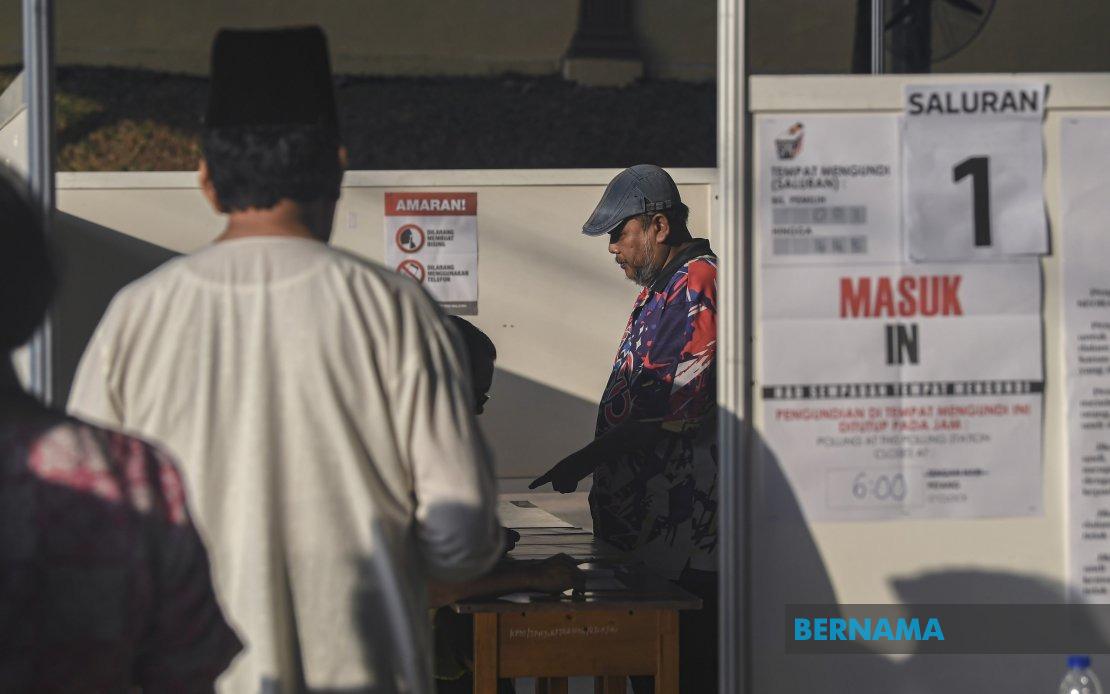
The 16th Johor State Election commenced its voting phase on Wednesday with prominent members of the federal government joining millions of ordinary citizens at the ballot box. Senior cabinet ministers and their deputies arrived at designated polling centres throughout Johor Bahru and surrounding districts during the morning hours, fulfilling their constitutional duties as registered voters. The participation of high-ranking officials underscored the significance of the electoral exercise, which will determine the composition of the state assembly for the next term.
Datak Seri Azalina Othman Said, who serves as Minister in the Prime Minister's Department overseeing Law and Institutional Reform, cast her vote at Sekolah Kebangsaan Bandar Penawar in Pengerang at 8.15 am, making her among the first officials to participate in the democratic exercise. Her early arrival reflected the importance placed on voter participation by the government leadership. Within minutes, Defence Minister Datuk Seri Mohamed Khaled Nordin voted at Sekolah Kebangsaan Rinting 1 in Masai at 8.30 am, demonstrating the broad representation of the federal administration engaged in the state election process.
The morning witnessed a steady stream of ministerial participation as the election machinery operated smoothly across Johor. Plantation and Commodities Minister Datuk Seri Dr Noraini Ahmad voted at Sekolah Menengah Kebangsaan Dato' Onn in Batu Pahat at 8.50 am, while Deputy Works Minister Datuk Seri Dr Ahmad Maslan cast his ballot at Sekolah Kebangsaan Seri Bahagia in Benut at 8.40 am. Deputy Communications Minister Teo Nie Ching voted at Sekolah Jenis Kebangsaan Cina (SJKC) Kulai Besar at 9.30 am, arriving just ten minutes before casting her ballot.
The simultaneous opening of polling operations across Johor represented a logistical undertaking of considerable scale. A total of 1,076 polling centres activated 4,889 separate polling streams, enabling voters distributed across the geographically diverse state to participate without bottlenecks. This infrastructure deployment was essential to accommodating the 2.7 million registered voters eligible to cast ballots in the election. The magnitude of voter registration reflected Johor's significance as Malaysia's second-largest state by population and economic activity.
Scheduling and operational considerations shaped the conduct of the election. Polling operations began simultaneously at 8 am across all centres, ensuring procedural uniformity and preventing early-vote scenarios that might compromise the integrity of the electoral process. Voting would continue uninterrupted until 6 pm, providing a ten-hour window within which voters could discharge their civic responsibilities. This extended voting period was designed to facilitate participation across diverse working schedules and geographic locations within the sprawling state.
The electoral cycle preceding voting day had followed established democratic protocols. The fourteen-day campaign period concluded at midnight the previous evening, marking the transition from an active contest phase to the formal voting exercise. During this interval, political parties and candidates had presented their platforms, engaged with constituents, and mobilised support networks. The structured campaign period ensured all participants operated within defined temporal boundaries while maximising opportunities for public engagement and persuasion.
For Malaysian readers, the Johor state election carries particular significance within the federation's political landscape. Johor's economy and population make its government's composition consequential for broader national policy considerations. The state's role in producing agricultural commodities, supporting port infrastructure, and hosting significant manufacturing operations means that state-level decisions influence national economic patterns. The choice of voters in Johor would therefore reverberate beyond state boundaries, affecting policy directions in areas from commodity management to infrastructure development.
The visible participation of federal ministers in the electoral process carried symbolic weight beyond the individual acts of voting. Such engagement demonstrated the hierarchical government structure's investment in the legitimacy of state-level democratic exercises. When cabinet-level figures cast ballots rather than merely directing subordinates, they affirm the principle that electoral participation transcends hierarchy. This messaging reinforces the normative framework within which Malaysia's democratic institutions operate, emphasising that all citizens, regardless of official position, participate in elections as equals before law and ballot.
The scale of voter registration at 2.7 million reflected the state's demographic significance and the effectiveness of electoral commission efforts to maintain comprehensive voter rolls. This figure encompassed not only long-term residents but also individuals who had relocated within Malaysia, as federal citizens retain voting rights in their states of registration. The breadth of the electorate meant that state outcomes would reflect choices made across diverse demographic and socioeconomic constituencies, from urban centres like Johor Bahru to rural agricultural areas.
The operational success of simultaneous polling across 1,076 centres depended on extensive coordination among election officials, security personnel, and administrative staff. Training programmes, material distribution, and contingency planning had preceded voting day to ensure smooth execution. Malaysian readers familiar with electoral procedures would recognise this logistical framework as reflecting decades of accumulated institutional experience in managing democratic exercises. The complexity of deploying this infrastructure across a state the size of Johor demonstrated the administrative capabilities that Malaysia's Election Commission had developed through successive national and state elections.

