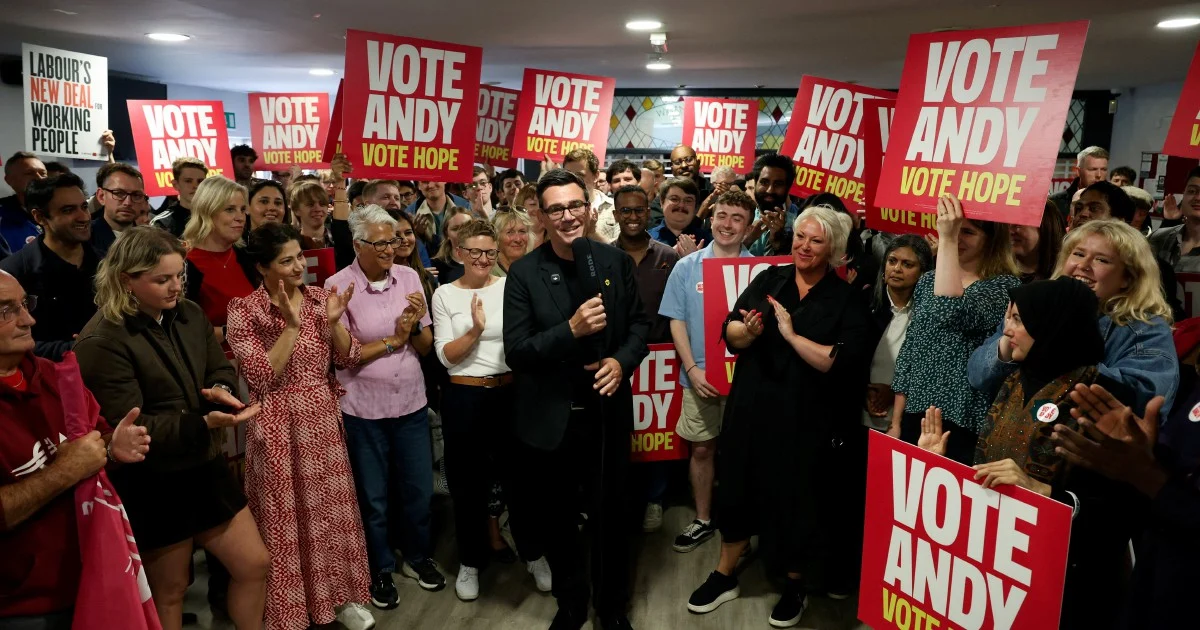
Andy Burnham's trajectory toward a potential challenge to Prime Minister Keir Starmer's leadership appears increasingly advantageous following developments in the upcoming Makerfield by-election. The Labour politician, who has cultivated a prominent profile within the party and emerged as a voice on regional inequalities, now stands to benefit from an unexpected political dynamic unfolding on the right side of British politics. Rather than winning through overwhelming personal popularity, Burnham's prospects are being substantially enhanced by the strategic miscalculation and ideological divisions between two competing conservative movements vying for dominance among right-wing voters.
The Makerfield seat represents a critical juncture in Burnham's political ambitions. Having established himself as a heavyweight figure within Labour circles through his tenure as Greater Manchester mayor and subsequent frontbench roles, the by-election result will serve as a tangible measure of his electoral viability and grassroots support. A decisive victory would strengthen his credentials considerably when contemplating a future leadership challenge against Starmer, lending him the appearance of electoral strength and the ability to mobilize voters in challenging constituencies. Conversely, a narrow victory or unexpected setback could undermine his positioning within party hierarchies.
What makes Burnham's position particularly fortuitous is the ongoing disarray within Britain's centre-right political landscape. The Conservative Party, traditionally the repository of right-wing votes in British politics, finds itself hemorrhaging support and credibility following years of internal strife, policy reversals, and electoral defeats. Simultaneously, Reform UK has emerged as a insurgent force capturing disaffected conservative voters attracted to more hardline populist messaging. Rather than reconsolidating the right-wing vote, these two parties are locked in a competitive struggle that fragments rather than concentrates their electoral appeal.
This fragmentation creates a mathematical advantage for Labour candidates across numerous constituencies. When conservative-minded voters scatter their support between the established Conservative Party and the rising Reform UK alternative, neither achieves the concentration of votes necessary to mount effective challenges to Labour candidates. The by-election in Makerfield exemplifies this dynamic perfectly. What might ordinarily be a competitive contest becomes substantially tilted toward Labour simply because the opposition is fundamentally disunited and competing with itself for the same ideological space.
For Malaysian observers of British politics, this situation illuminates broader patterns visible in democracies across the Commonwealth and beyond. Electoral competition increasingly revolves not just around who can attract the most voters, but how effectively fragmentation among opponents can be exploited. In Malaysia's own multi-party environment, similar dynamics have periodically advantaged coalition partners when opposition votes fragmented among competing alternatives. The principle that a united opposition poses greater electoral danger than divided competitors remains a fundamental axiom of competitive politics.
Burnham's potential ascent through such circumstances raises interesting questions about the nature of contemporary political leadership. His advancement would not primarily reflect overwhelming public enthusiasm for his particular vision or programme, but rather the structural weakness of his opponents. This pattern increasingly characterizes modern democracies where personality-driven campaigns and ideological positioning have given way to calculations about which candidates benefit most from the prevailing fragmentation of the political landscape.
The Conservative Party's establishment has struggled to contain the Reform UK challenge through conventional means. Attempts to accommodate Reform's populist messaging or poach its candidates have achieved limited success. The ideological gap between traditional conservatism and Reform's more radical populism appears unbridgeable, creating a persistent split that shows little sign of healing before the by-election. This structural division will likely persist beyond Thursday's contest, continuing to advantage Labour candidates throughout the remainder of the current parliamentary term.
Burnham's own positioning within Labour reflects his understanding of these broader political dynamics. Rather than operating as a pure Westminster operator, he has maintained a distinct profile emphasizing regional representation and addressing the grievances of left-behind communities. This approach resonates with constituencies where Labour's traditional strength might otherwise be vulnerable to right-wing insurgency. By presenting himself as attuned to ordinary working people's concerns, Burnham appeals to the same constituencies that Reform UK targets, though through fundamentally different ideological frameworks.
The broader implications of such electoral dynamics extend beyond Burnham's personal ambitions. They suggest that Labour's current parliamentary position, while containing inherent vulnerabilities through the razor-thin nature of its majority, is substantially protected by the simple fact that no coherent alternative has yet emerged on the right. The Conservatives cannot present themselves as a unified governing force while simultaneously hemorrhaging votes to Reform UK. This disarray ensures that Labour faces fragmented rather than concentrated opposition across most constituencies.
For regional leaders like Burnham with aspirations toward national leadership roles, the by-election result will function as a crucial signaling mechanism to party colleagues and the broader public. A comfortable Makerfield victory would demonstrate that he can successfully mobilize voters even as national political conditions remain fluid and unpredictable. It would provide empirical evidence supporting his claims to broader electoral appeal and his capacity to win working-class voters in precisely the constituencies where Labour's electoral future depends.
The outcome could significantly reshape internal Labour dynamics heading toward Starmer's potential next challenge to his leadership position. Should Burnham perform strongly while other Labour candidates face mixed results elsewhere, momentum could begin building behind his profile as a prospective successor. Conversely, any indication that his performance lagged behind other Labour MPs could shift calculus among party members regarding alternative leadership candidates. In this sense, Makerfield functions as both a local contest and a national political barometer.
The right-wing vote fragmentation should ultimately be understood as a temporary rather than permanent feature of British politics. History suggests that defeated political movements eventually consolidate, whether through absorbing challenger parties or marginalizing them. Whether the Conservative Party successfully regroups and reestablishes dominance over right-wing voters, or whether Reform UK permanently reshapes British conservatism, remains an open question. But in the interim, candidates like Burnham benefit substantially from the absence of a unified opposition capable of concentrating anti-Labour sentiment into effective electoral challenges.

%22%2F%3E%3C%2Fpattern%3E%3C%2Fdefs%3E%3Crect%20width%3D%22100%25%22%20height%3D%22100%25%22%20fill%3D%22url(%23ph40buhg)%22%2F%3E%3Crect%20width%3D%22100%25%22%20height%3D%22100%25%22%20fill%3D%22url(%23ph40buhp)%22%2F%3E%3Ctext%20x%3D%2250%25%22%20y%3D%2250%25%22%20text-anchor%3D%22middle%22%20dominant-baseline%3D%22central%22%20fill%3D%22rgba(255%2C255%2C255%2C0.95)%22%20font-family%3D%22Georgia%2C%20'Times%20New%20Roman'%2C%20serif%22%20font-weight%3D%22700%22%20font-size%3D%22320%22%20letter-spacing%3D%22-0.02em%22%3EGRS%3C%2Ftext%3E%3C%2Fsvg%3E)