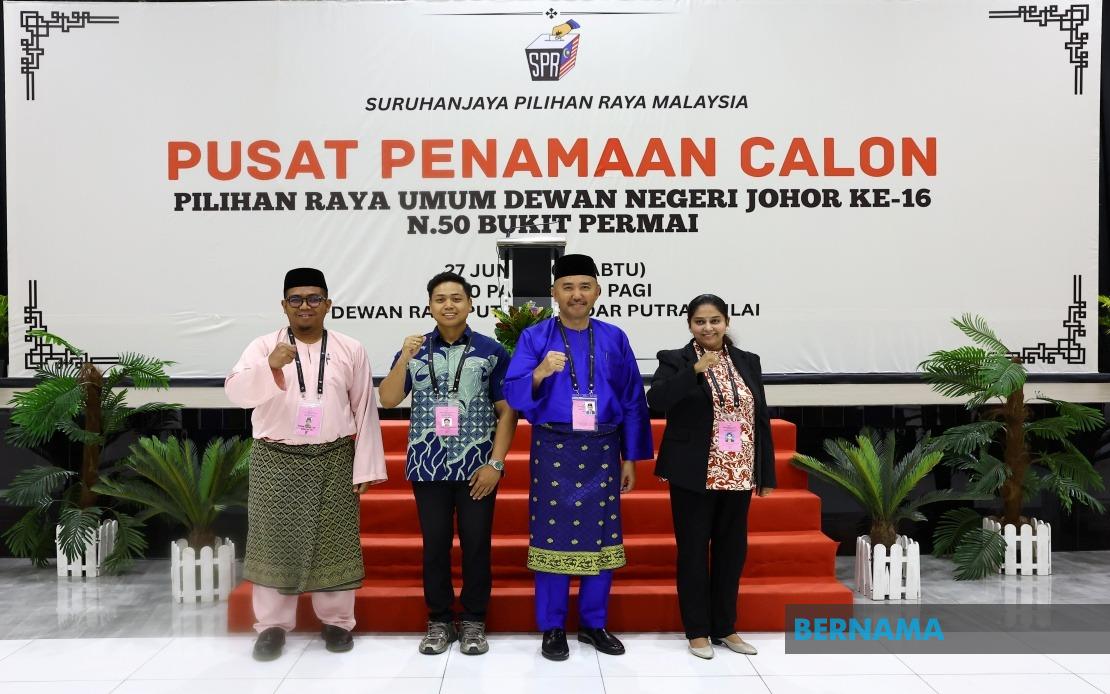
The race for Bukit Permai in Johor's upcoming state election will be closely contested, with incumbent Barisan Nasional assemblyman Datuk Mohd Jafni defending his seat against three challengers representing the major opposition coalitions and a newer political force. The candidate nominations for the 16th Johor state election closed on June 27, with returning officer Afzan Azhari officially confirming the list of contenders at the nomination centre located at Dewan Raya Putra in Bandar Putra, Batu Pahat.
Mohd Jafni will encounter formidable competition from Mohamad Shafwan Ani, who represents Pakatan Harapan, the primary opposition alliance that performed strongly in recent federal elections. His second challenger is M. Lina Manoh, fielded by Perikatan Nasional, the coalition that has been expanding its political footprint across the peninsula and has demonstrated particular strength in several Johor constituencies. A fourth candidate, Muhammad Aidil Riduan Mohd Yusof from the newer Parti Bersama Malaysia, rounds out the contest, reflecting the increasingly fractured nature of electoral competition in Malaysia.
Mohd Jafni secured the Bukit Permai seat in the 2022 state election with a respectable margin of 4,755 votes, also in a four-cornered contest. That performance provides some foundation for his re-election bid, though the electoral environment has shifted considerably in the intervening years. The presence of nearly identical contest dynamics—four candidates competing for the seat—makes direct comparison possible, yet the political landscape at both state and federal levels has undergone significant realignment since the last election.
The election campaign process began in earnest with the nomination announcements. Johor DAP chairman Teo Nie Ching's presence at the nomination centre at 8.26 am to accompany Mohamad Shafwan underscored Pakatan Harapan's investment in the constituency. The high-profile support signals that the coalition views Bukit Permai as winnable territory, part of its broader effort to reclaim ground in Johor, a state where Barisan Nasional has traditionally maintained substantial electoral advantages.
For Malaysian voters and observers tracking the 16th Johor state election, the Bukit Permai seat represents a microcosm of the broader competitive dynamics shaping state politics. The four-cornered nature of the contest reflects the current fragmentation of Malaysia's political landscape, where multiple significant players vie simultaneously for support. This fragmentation can benefit incumbents with established ground operations and name recognition, or it can create opportunities for challengers if the opposition vote becomes sufficiently concentrated around a single alternative.
The Election Commission has scheduled early voting for July 7, providing eligible voters an opportunity to cast ballots before general polling. This measure accommodates voters unable to participate on the main election day and has become a standard feature of recent Malaysian electoral exercises. The compressed campaign period between nominations and voting on July 11 means candidates and their teams have limited time to mobilize supporters and communicate their messages to the electorate.
Bukit Permai's electoral dynamics reflect broader trends visible throughout Johor's state constituencies. The state remains politically significant as Malaysia's second-largest by population and as a traditional stronghold for Barisan Nasional, though recent years have seen intensified challenges from Pakatan Harapan and increasingly from Perikatan Nasional. Each additional coalition or party fielding candidates adds complexity to the strategic calculations facing campaigns, as vote splitting becomes a material consideration.
The 2022 victory margin of 4,755 votes suggests the seat has a leaning toward Barisan Nasional, but in a fragmented field, a shift of even a portion of the opposition vote toward any single challenger could significantly alter the result. Voters in constituencies with multiple strong competitors often employ strategic voting calculations, choosing candidates they perceive as most viable alternatives rather than necessarily supporting their party preference. This phenomenon, while difficult to quantify, can produce outcomes that defy conventional expectations based on party strength.
Mohd Jafni's defence strategy will likely emphasize his track record as incumbent, highlighting any development projects or policy achievements from his tenure representing Bukit Permai residents. Barisan Nasional's traditional organizational advantages—including stronger funding and established ground networks—typically provide incumbent protection, particularly against a fragmented opposition. However, the presence of three separate challengers means opposition voters dissatisfied with the current representation have multiple avenues for expressing that discontent.
For Southeast Asian readers observing Malaysian electoral developments, the Bukit Permai race illustrates the ongoing realignment within Malaysian politics following the 2022 federal election. The presence of Parti Bersama Malaysia, founded more recently than the established coalitions, indicates continued appetite among Malaysian voters for new political options beyond the traditional Barisan Nasional-Pakatan Harapan binary that long dominated electoral competition.
The campaign period through July 11 will determine whether Mohd Jafni successfully retains his seat or whether one of his challengers seizes the opportunity created by a divided electorate. The Bukit Permai result will contribute to the overall Johor state election outcome, which in turn carries significance for federal-level politics and the stability of Malaysia's governing coalitions. Voters in the constituency will ultimately decide whether they prefer continuity through the incumbent's re-election or represent a preference for change by supporting one of the three alternatives.

