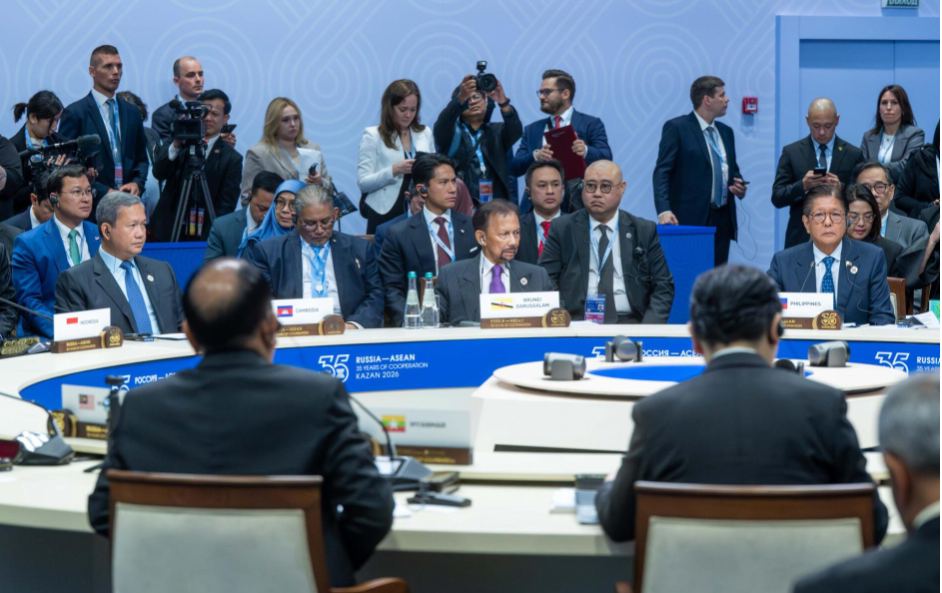
Sultan Hassanal Bolkiah travelled to the Russian city of Kazan this week to participate in a landmark summit celebrating three and a half decades of diplomatic engagement between the Association of Southeast Asian Nations and the Russian Federation. Addressing delegates at the Asean-Russia Commemorative Summit held at the Kazan Expo International Exhibition Centre on Thursday, the Brunei monarch extended his gratitude to President Vladimir Putin for hosting the event, while also acknowledging the hospitality of Tatarstan's government and the people of Kazan. The Sultan was accompanied on the journey by his Minister of Foreign Affairs, Prince 'Abdul Mateen, underscoring Brunei's commitment to the bilateral relationship. In his remarks, the Sultan also expressed condolences to Thailand's Prime Minister Anutin Charnvirakul following the recent death of Princess Bajrakitiyabha of Thailand.
The summit provided an important platform for reviewing the trajectory of the Asean-Russia Dialogue Partnership, which has grown substantially since its establishment 35 years ago. According to the Sultan's assessment, the relationship has weathered significant international changes while simultaneously becoming increasingly consequential for both parties. He characterised the partnership as demonstrating considerable resilience, with cooperation deepening across all three pillars of the Asean Community framework—the political-security, economic, and socio-cultural dimensions. This multifaceted engagement has yielded tangible outcomes and fostered genuine connections among ordinary people from both regions, contributing to broader objectives of maintaining peace, ensuring security and promoting shared prosperity across the wider Asian landscape.
As Asean charts its course towards Vision 2045, a strategic blueprint designed to guide the bloc's development for the next two decades, the Sultan underlined the necessity of sustained collaboration with Russia on issues of global consequence. The challenges facing the international community have become increasingly complex and interconnected, spanning political tensions between major powers, fragmentation of the global economy, the mounting urgency of climate change mitigation, and the disruptive pace of technological innovation. These issues transcend national borders and require coordinated responses from nations sharing common values and interests. The Sultan's emphasis reflected a pragmatic acknowledgment that neither Asean nor Russia can adequately address these multifaceted challenges in isolation, making continued partnership essential for both regional and global stability.
Particularly noteworthy in the Sultan's address was the emphasis placed on specific areas where Asean-Russia cooperation could yield immediate and substantial benefits. Energy security remains a paramount concern for Southeast Asian economies, many of which depend on imports to meet growing domestic demand. Food security similarly ranks high on the regional agenda, especially given population pressures and climate-driven agricultural uncertainties. Beyond these traditional security concerns, the Sultan highlighted the importance of collaboration on climate action, disaster management systems, and non-traditional security threats ranging from transnational crime to disease pandemics. This comprehensive framing demonstrates how Asean views its relationship with Russia not merely as a diplomatic courtesy but as a functional partnership addressing the region's most pressing developmental and security needs.
The Sultan also devoted considerable attention to the human dimension of the partnership, recognising that long-term relationships between nations are ultimately built on the strength of personal and professional connections among their peoples. He advocated for expanded education exchange programmes, specialist training initiatives and networking opportunities designed to equip the next generation of Southeast Asian and Russian leaders, entrepreneurs and professionals with the skills and cross-cultural competencies necessary to navigate an increasingly complex world. Such people-to-people engagement serves not only to deepen mutual understanding but also to create lasting bonds that transcend official government channels, ensuring the partnership remains resilient even during periods of political tension or diplomatic disagreement.
The summit concluded with the formal adoption of several significant outcome documents that will shape the relationship for years to come. The centrepiece was the Kazan Declaration 2026, framed around the theme of unity in diversity, reaffirming Asean and Russia's commitment to their 35-year dialogue partnership. Accompanying this were four additional documents: a comprehensive action plan spelling out the strategic partnership priorities for 2026 through 2030; a joint statement specifically addressing energy cooperation frameworks; and another joint statement focusing on cultural exchanges and collaboration. These instruments provide a structured roadmap for bilateral engagement, translating political statements into concrete programmes and initiatives with measurable outcomes.
The summit's agenda extended beyond the formal plenary sessions to include specialized discussions on broader regional integration processes. A working lunch session themed around integration processes in Eurasia brought together Asean leaders with senior officials from the Shanghai Cooperation Organisation and the Eurasian Economic Commission, reflecting the increasingly complex web of regional institutions and partnerships shaping contemporary Asian geopolitics. This multilayered engagement suggests that Asean views its relationship with Russia within a broader context of regional connectivity and institutional frameworks rather than as an isolated bilateral arrangement. The discussions highlighted how Asean, despite its geographic location in Southeast Asia, maintains significant interests in developments across the Eurasian continent.
Complementing the official government-level discussions was a business forum held on June 17, which brought together private sector representatives from both Asean member states and Russia. The positive reception accorded to the outcomes of this business engagement indicates growing commercial interest in deeper trade and investment ties between the two regions. For Malaysian companies and investors, such forums create opportunities to explore joint ventures, technology partnerships and market access arrangements that could diversify economic ties beyond traditional Western markets. The business community's active participation also signals confidence in the stability and durability of the Asean-Russia relationship.
From a Southeast Asian perspective, particularly relevant to Malaysia and its regional partners, the summit underscores the importance of maintaining diversified international relationships rather than concentrating political and economic engagement exclusively with Western nations. The Asean-Russia partnership, while not as intensive or economically significant as relationships with China, the United States, or European countries, provides a valuable counterweight and alternative framework for regional countries to pursue their interests. Russia's vast energy resources, technological capabilities and geopolitical influence make it a relevant actor in Southeast Asian calculations, even as the region balances competing interests and avoids exclusive alignment with any single power.
The Sultan's careful articulation of the partnership's benefits without strident political rhetoric also reflects Asean's traditional approach to diplomacy—seeking cooperation with all major powers while maintaining strategic autonomy. This stance is particularly important at a time of rising geopolitical tensions and pressure on countries to choose sides in broader great power competitions. By emphasising practical cooperation on issues like energy security, climate change and disaster management, Asean demonstrates that productive engagement with Russia remains possible and mutually beneficial, independent of broader strategic rivalries among major powers. For Malaysia, which shares Asean's commitment to centrality and non-alignment, this message carries particular weight.
Looking forward, the structured framework established through the 2026 declarations provides a foundation for expanding cooperation in areas where Asean and Russia have genuine complementary interests. Energy partnerships offer substantial potential, given Russia's hydrocarbon resources and Southeast Asia's energy demands. Educational and cultural exchanges can deepen mutual understanding and create professional networks that transcend government-to-government relations. Joint approaches to climate adaptation and disaster resilience, informed by Russia's experience with extreme weather and Asean's vulnerability to tropical cyclones and flooding, could yield practical innovations applicable across both regions. The success of these initiatives will depend on both sides maintaining political commitment and allocating adequate resources to implementation beyond the ceremonial adoption of declarations.
%22%2F%3E%3C%2Fpattern%3E%3C%2Fdefs%3E%3Crect%20width%3D%22100%25%22%20height%3D%22100%25%22%20fill%3D%22url(%23ph55801g)%22%2F%3E%3Crect%20width%3D%22100%25%22%20height%3D%22100%25%22%20fill%3D%22url(%23ph55801p)%22%2F%3E%3Ctext%20x%3D%2250%25%22%20y%3D%2250%25%22%20text-anchor%3D%22middle%22%20dominant-baseline%3D%22central%22%20fill%3D%22rgba(255%2C255%2C255%2C0.95)%22%20font-family%3D%22Georgia%2C%20'Times%20New%20Roman'%2C%20serif%22%20font-weight%3D%22700%22%20font-size%3D%22272%22%20letter-spacing%3D%22-0.02em%22%3EAnwar%3C%2Ftext%3E%3C%2Fsvg%3E)