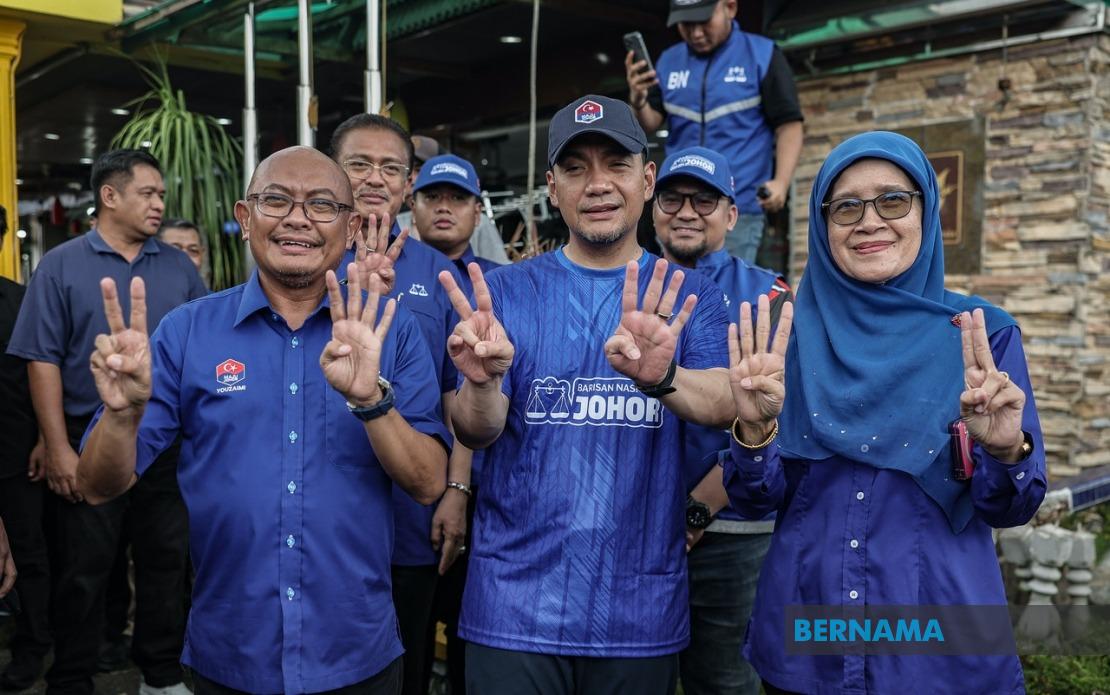
The Barisan Nasional's approach to distributing electoral contests among its component parties hinges fundamentally on a willingness to accept defeat in pursuit of broader coalition cohesion, according to Johor Menteri Besar Datuk Onn Hafiz Ghazi. Speaking at a machinery meeting in Mersing on June 29, Onn Hafiz articulated how power-sharing arrangements serve as the binding principle that sustains the coalition's political architecture, requiring both sacrifice from larger parties and unwavering commitment to collective goals regardless of electoral outcomes.
The Johor BN chairman pointed to the Tenggaroh state seat as a textbook illustration of this principle in practice. For more than four decades, UMNO has relinquished its claim to this Johor constituency to allow MIC, the Malaysian Indian Congress, to field its candidate. Despite the party's successive failures to retain or capture the seat during this extended period, UMNO's grassroots machinery has continued to mobilise support without rancour or defection, demonstrating what Onn Hafiz characterised as mature organisational discipline.
The historical record of Tenggaroh encapsulates a peculiar political bargain that has become central to how BN maintains unity across its multi-ethnic membership. UMNO, as the largest component and custodian of Malay-Muslim interests, has systematically foregone opportunities to contest seats allocated to coalition partners, even when demographic shifts or electoral momentum might have favoured success. This restraint, Onn Hafiz suggested, reflects a strategic calculation that preserving the coalition's electoral viability across diverse constituencies outweighs the short-term gains from maximising UMNO's seat count.
When describing UMNO's stewardship of the Tenggaroh arrangement, Onn Hafiz employed notably candid language. He recalled that across four decades of contested elections, UMNO had failed to secure the seat on each occasion yet deliberately chose to avoid the recriminations and internal discord that might typically follow such repeated setbacks. Instead of succumbing to what he termed "sulking," UMNO members channelled their energies into supporting their coalition partner's candidate, a discipline that Onn Hafiz credited to both party leadership and the ideological commitment of rank-and-file activists to BN's collective vision.
The demographic composition of Tenggaroh further contextualises this power-sharing arrangement. The constituency contains approximately 39,000 registered voters, of whom roughly 500 identify as Indian voters—a figure representing just 1.3 percent of the electorate. Yet Onn Hafiz stressed that this minimal representation of MIC's primary electoral base has not undermined the coalition's commitment to ceding the seat to the party. This positioning underscores how BN's multi-racial cooperation model operates not merely as electoral mathematics but as a foundational principle that transcends crude demographic calculations and seat-by-seat profitability analysis.
Seat distribution decisions within BN require intricate negotiation to accommodate the interests and aspirations of multiple parties whose support bases may be geographically scattered or numerically modest. Onn Hafiz acknowledged that such arrangements demand careful calibration to prevent resentment from festering among parties that perceive themselves as systematically disadvantaged. The continued cohesion of UMNO, MCA, and MIC within the coalition framework depends substantially on institutional mechanisms and historical precedents that establish perceived fairness in how opportunities are allocated across electoral cycles.
Looking ahead to the July 11 Johor state election, Onn Hafiz deployed the Tenggaroh arrangement not merely as historical narrative but as evidence supporting the operational efficacy of BN's power-sharing formula. He challenged party machinery to validate this principle through substantially improved electoral performance, specifically targeting a tripling of the previous winning majority in the constituency from 1,356 votes to 3,000 votes. This ambitious target reflected Onn Hafiz's conviction that the disciplined coordination enabled by the power-sharing model should yield tangible competitive advantages.
The Tenggaroh contest itself will unfold as a three-cornered fight pitting BN candidate Mohd Youzaimi Yusof against Perikatan Nasional's Muhamad Amerul Muhamad from Bersatu and Pakatan Harapan's Md Yusof Dawam representing PKR. The fragmentation of the opposition provides an opportunity for BN to demonstrate that its coalition model, despite requiring sacrifice from component parties, still delivers superior electoral outcomes compared to the fractious alternatives offered by competing blocs.
For Malaysian political observers, Onn Hafiz's emphasis on sacrifice and loyalty carries particular significance given broader trends toward party fragmentation and electoral volatility across the region. The stability of BN's multi-ethnic coalition structure, however imperfect, contrasts sharply with the volatility observed in Peninsular politics since 2018. While rival coalitions struggle with internal contradictions and partner disputes, BN's proven capacity to manage competing interests through established power-sharing conventions provides organisational advantages that transcend individual electoral cycles.
The July 11 Johor state election, with early voting scheduled for July 7, will test whether this decades-long commitment to coalitional discipline continues to resonate with voters or whether electorate preferences have shifted toward alternative political arrangements. The performance in constituencies like Tenggaroh will signal whether the sacrifice demanded by BN's power-sharing model—particularly from UMNO members who might otherwise contest these seats—generates sufficient goodwill and organisational discipline to sustain the coalition's viability in contemporary Malaysian politics.
Onn Hafiz's messaging prioritised solidarity over sectional interest, portraying BN's model not as a compromise born of weakness but as a deliberate choice reflecting political maturity. He framed loyalty to the coalition despite repeated electoral disappointment as a virtue worthy of celebration, suggesting that the alternative—a descent into inter-party recrimination or defection to rival coalitions—would prove far costlier for all stakeholders. Whether this philosophical framework can continue to constrain ambitions within BN's component parties remains among the most consequential questions in contemporary Malaysian electoral politics.

