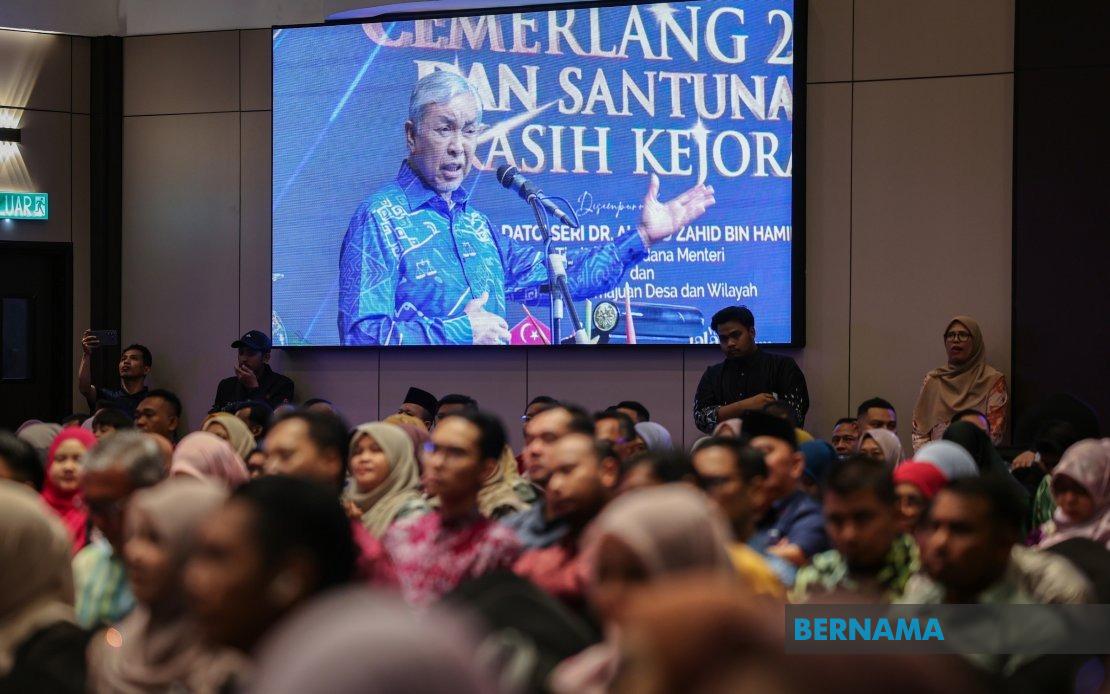
Barisan Nasional's election campaign for Johor is being conducted at full intensity despite external claims to the contrary, coalition chairman Datuk Seri Dr Ahmad Zahid Hamidi asserted at a campaign event in Kota Tinggi on Tuesday. The Deputy Prime Minister's comments represent a direct pushback against opposition narratives that the ruling coalition's groundwork lacks vigour heading into the July 11 state election, characterising such assessments as politically motivated perceptions rather than factual observations of campaign activity.
Zahid elaborated that BN's campaign machinery remains actively mobilised across the state's 56 contested seats, emphasising that other coalitions were free to interpret the campaign's intensity according to their own interests. His remarks reflected a confident posture despite mounting competition from multiple political forces vying for voter support. The BN chairman's assertion that the coalition's campaign reflects "reality on the ground" suggests internal confidence in the depth and breadth of grassroots organisation, though it also indicates awareness that public perception of campaign momentum has become a critical narrative battleground in the contest.
The broader context surrounding BN's campaign strategy reveals deeper strategic considerations about voter sentiment in Johor. The state has traditionally been a BN stronghold, yet recent electoral dynamics across Malaysia have introduced unpredictability into constituencies previously considered safe. Zahid's emphasis on professional conduct and confidence in ballot box outcomes suggests BN is betting on incumbent governance record rather than aggressive or confrontational campaigning, a tactic that appeals to voters seeking stability but may appear less energetic than rivals employing more visible mobilisation tactics.
Significantly, Zahid addressed concerns about potential voter confusion stemming from federal-level cooperation between BN and Pakatan Harapan within the Unity Government. This cooperation has emerged as a complicating factor in Johor's election narrative, with observers questioning whether traditional BN voters might feel alienated by their coalition's alignment with PH at the national level. However, Zahid argued that Johor's governance structure renders this concern moot, noting that the state government under Menteri Besar Datuk Onn Hafiz Ghazi was already established prior to the Unity Government's formation, thereby creating temporal and institutional separation between state and federal arrangements.
The distinction Zahid drew between state and federal dynamics carries importance for understanding BN's campaign messaging in Johor. By positioning the state administration as having maintained continuity and stability while navigating federal political changes, BN attempts to insulate its Johor campaign from potential backlash over federal coalitional choices. This argument requires voters to compartmentalise their assessment of BN's state-level performance separately from their views on its federal partnerships, a cognitive exercise not all voters may undertake but which appears central to BN's strategic communication.
Performance credentials form another pillar of BN's campaign position in Johor. The state government's revenue generation of RM2.26 billion in the previous year, which Zahid characterised as the highest among Peninsular Malaysian states, provides quantifiable evidence of administrative capacity and financial stewardship. This fiscal argument appeals to voters prioritising economic management and development delivery. By anchoring the campaign in concrete achievements rather than ideological positioning, BN appeals to pragmatic voters primarily concerned with which coalition can deliver tangible improvements to state services and infrastructure.
Zahid's discussion of Perikatan Nasional president Tan Sri Abdul Hadi Awang's call for voters to reject PH entirely, including in contests where PH directly opposes BN, illuminates the fragmented opposition landscape. Rather than engaging polemically with Hadi's position, Zahid adopted a measured stance emphasising professional conduct and allowing electoral outcomes to validate or refute claims. This positioning suggests BN views Hadi's aggressive approach as potentially counterproductive to coalition unity on the broader anti-PH platform, while simultaneously signalling confidence that BN's campaign can succeed on its own merits without requiring overt PAS coordination.
The electoral configuration itself underscores the complexity Johor voters face on July 11. With BN and PH each fielding complete slates of 56 candidates, Perikatan Nasional contesting 33 seats, Bersama presenting 15 candidates, alongside smaller parties and independents, the ballot presents unprecedented fragmentation. This splintered opposition presents both opportunity and risk for BN—opportunity because vote-splitting among anti-BN forces potentially benefits the ruling coalition, yet risk because voter dissatisfaction could consolidate against BN even if opposition votes scatter across multiple candidates.
Zahid's confidence in securing a strengthened mandate reflects BN's strategic objective of expanding beyond mere victory to demonstrate revitalised political dominance in a state that represents one of Malaysia's economic and political anchors. A resounding BN victory would provide the Onn Hafiz administration with enhanced political capital to implement its development agenda over the succeeding five-year term, potentially setting a template for how BN campaigns in other state elections. Conversely, a narrower or contested victory would complicate BN's national narrative about coalition cohesion and voter confidence.
The professional approach Zahid emphasised stands in contrast to more combative campaign styles visible in other Malaysian political contests. By focusing messaging on governance achievements, financial performance, and administrative stability rather than attacking opponents, BN appeals to Johor voters who prioritise competence over partisan identity. This strategy assumes voters reward proven performance, an assumption that appears increasingly contested in contemporary Malaysian politics where anti-incumbent sentiment frequently overrides satisfaction with specific policy outcomes.
For Malaysian observers and regional analysts tracking coalition politics in Southeast Asia's largest economies, the Johor election outcome carries significance beyond the state itself. The election tests whether BN's federal-level unity arrangement with PH and other partners strengthens or weakens its ability to dominate state-level contests. A convincing BN victory would validate the unity government framework as compatible with continued coalition electoral success, while a disappointing result would invite questions about whether the federal partnership confuses voters or alienates traditional supporters—an assessment applicable to other states facing elections under the unity government banner.
The July 11 voting, with early polling scheduled for July 7, will provide definitive evidence regarding whether Zahid's characterisation of a campaign operating at full intensity and reflecting ground reality proves accurate. The interval between the Deputy Prime Minister's confidence expressed at the KEJORA awards ceremony and actual ballot results will determine whether BN's professional, performance-focused approach successfully resonates with Johor voters or whether opposition narratives about campaign momentum ultimately carry greater persuasive force with the electorate.

