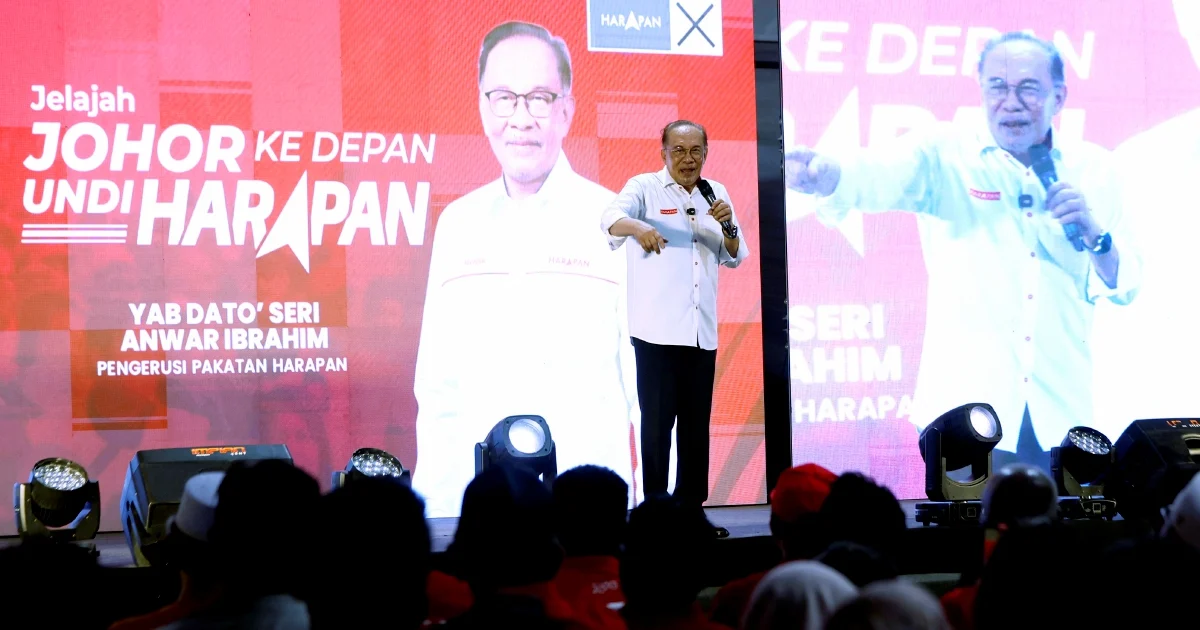
Pakatan Harapan chairman Datuk Seri Anwar Ibrahim has leveled accusations at Barisan Nasional over its decision to dissolve the Johor state assembly, asserting that the coalition's primary motivation is to reassert the hegemonic control it once exercised over the resource-rich southern state. Speaking in Tangkak, the opposition leader framed the forthcoming state election as part of a broader agenda to restore BN's former political standing rather than as a response to genuine governance concerns or public demand.
The timing of the assembly dissolution has proven politically contentious across Malaysia's party landscape. Johor, historically a BN stronghold where the coalition maintained unbroken control for decades, represents a symbolically significant battleground in the country's ongoing political realignment. The state's historical significance to BN's national constituency cannot be overstated, as it has traditionally served as a crucial revenue generator and political power base for the ruling coalition.
Anwar's remarks reflect the intensifying jostling between BN and PH as both coalitions prepare for what promises to be a closely contested electoral battle. The PH chairman's assertion suggests that the opposition views the election call as opportunistic rather than necessary, a characterization that carries weight given that Johor has maintained relative political stability since the previous state election. For Malaysian observers tracking the broader trajectory of politics in the peninsula, the dispute highlights how state-level elections have become flashpoints for testing support ahead of potential future general elections.
The political landscape in Johor has undergone significant transformation in recent years. While BN retained control of the state government, the coalition experienced notable erosion in certain constituencies, and the rise of Perikatan Nasional as a competing force has complicated the binary competition that once dominated the state. This fragmentation of the political center-right created both vulnerabilities and opportunities for BN, potentially explaining the coalition's strategic decision to call an election when demographic and political winds might still favor it.
From a governance perspective, Anwar's criticism also touches on questions about the stability of state administrations in Malaysia's federal system. When ruling coalitions dissolve assemblies ahead of full constitutional terms, they necessarily disrupt ongoing developmental projects and administrative continuity. The economic implications for Johor, which remains one of Malaysia's most industrialized states and a crucial component of the regional economy, merit consideration during campaign discussions and policy debates.
The electoral mechanics of Johor have shifted considerably since the coalition's previous overwhelming victories. Demographic changes, urbanization patterns, and the increased sophistication of voter decision-making have transformed constituencies that were once considered reliably safe. Urban centers in the Johor Bahru metropolitan area, for instance, have shown greater receptiveness to alternative political messages than their rural counterparts, a trend that applies across Malaysia generally but has particular salience in this context.
PH's strategy heading into the Johor contest will likely emphasize continuity and the dangers of regression to what the opposition characterizes as BN's discredited political model. The coalition will attempt to position itself as forward-looking and committed to institutional reform, contrasting this narrative against what it portrays as BN's nostalgia-driven restoration project. This framing has proven effective in previous electoral contests where voters have demonstrated appetite for change and accountability mechanisms.
BN's counter-narrative will emphasize stability, administrative competence, and the risks associated with political inexperience. The coalition will highlight infrastructure projects and development initiatives undertaken during its tenure, arguing that only its organizational structure and accumulated administrative expertise can effectively manage a state as complex and economically significant as Johor. Such arguments resonate particularly strongly in business communities and among voters prioritizing economic performance above other considerations.
The broader regional implications of the Johor election extend beyond state-level politics. Johor's electoral outcome will substantially influence calculations about potential timing for federal elections, which remain constitutionally due by 2023. A decisive BN victory would invigorate the coalition's national prospects, whereas a strong PH performance or hung assembly outcome would reinforce narratives about declining BN dominance and accelerating political realignment across the peninsula.
International observers and regional analysts have noted that Malaysian electoral contests increasingly reflect voter sophistication concerning bread-and-butter issues, governance quality, and institutional accountability rather than purely ethnic or religious considerations. The Johor election will test whether these evolving voter preferences have penetrated deeply into a state that has historically been more conservative in political orientation than urban-centric federal territories.
The election also occurs amid Malaysia's ongoing economic recovery from pandemic-related disruptions. Both coalitions will accordingly emphasize economic management credentials and prospective development plans. Johor's position as a gateway to Singapore and its established manufacturing and trading infrastructure make economic policy messaging particularly salient for voters concerned about employment, business conditions, and cross-border economic integration.
As campaigns intensify, the contest will reveal whether Anwar's characterization of the election as primarily motivated by BN's desire to recapture lost prestige gains traction with voters. His argument implicitly questions whether calling an election serves the public interest or instead reflects internal coalition calculations about optimal electoral timing. This framing will likely dominate opposition messaging throughout the campaign period.

