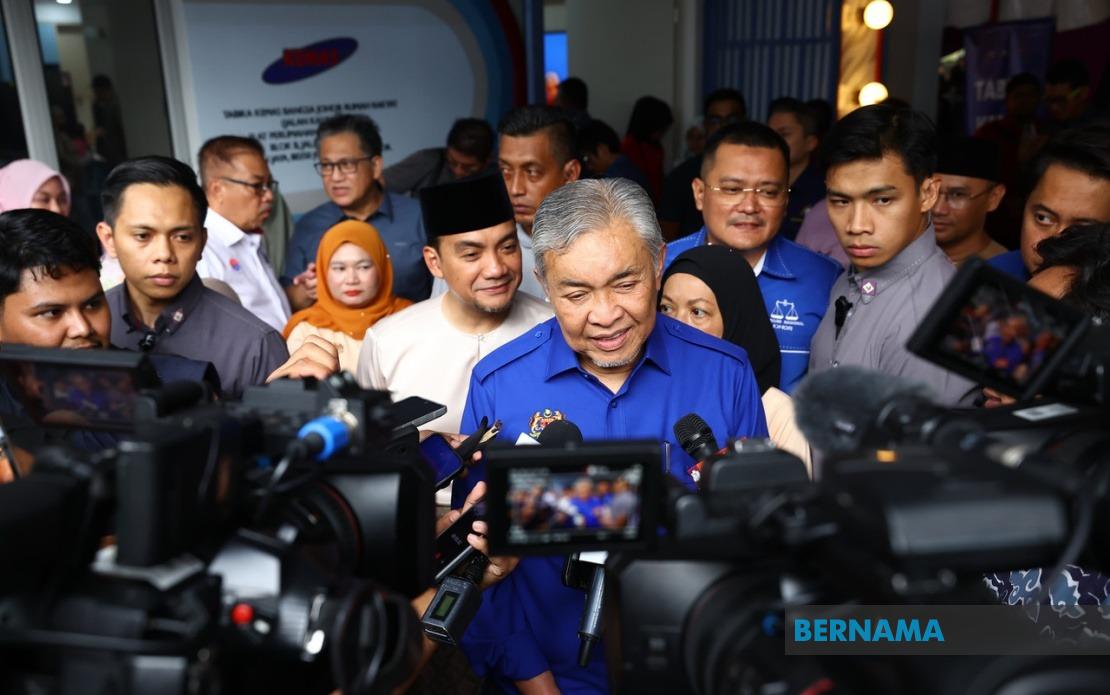
Barisan Nasional (BN) has publicly acknowledged the merits of Pakatan Harapan's (PH) policy agenda for the upcoming Johor state election, a gesture of political respect extended by coalition chairman Datuk Seri Dr Ahmad Zahid Hamidi during campaign activities in the state capital. The Deputy Prime Minister's remarks, delivered following an engagement session with parents at Larkin Court 1 flats, reflect a measured approach to competing manifestos as the electoral contest enters its final week before voters head to the polls on July 11.
Ahmad Zahid's acknowledgment of the opposition coalition's 10-point manifesto, which encompasses significant pledges ranging from subsidized healthcare to first-time homebuyer assistance and youth development funding, demonstrates the evolving tone of political discourse in Malaysian electoral campaigns. Rather than dismissing rival proposals outright, the BN chief framed his party's receptiveness as consistent with democratic principles, positioning the coalition as comfortable enough in its governance credentials to engage substantively with competing visions for the state's future. This calculated approach serves to elevate BN's standing as a mature political force willing to recognize worthy ideas regardless of their source.
The Johor Health Scheme and deposit assistance initiatives announced by PH represent attempts to address tangible quality-of-life concerns among voters, with the opposition coalition also pledging a substantial RM500 million youth development fund and education sector improvements. These concrete proposals signal PH's effort to translate electoral messaging into specific commitments rather than abstract campaign rhetoric, targeting demographic segments that have shown increasing electoral volatility in recent years. For Malaysian voters evaluating both coalitions, such detailed proposals provide a clearer basis for comparative assessment than traditional political posturing.
BN's counter-positioning hinges on a foundational claim of superior execution. Ahmad Zahid emphasized that the coalition's manifesto draws authority from demonstrable results achieved during the previous state government term, when BN fulfilled more than 90 per cent of its electoral promises. This emphasis on delivery record serves as BN's primary competitive advantage—rather than promising entirely new initiatives, the coalition presents itself as an institution with proven capacity to translate commitments into realized outcomes. For an electorate that has experienced multiple changes in state government over the past decade, such demonstrated competence carries substantial weight.
The scope of BN's proposed benefits architecture reflects an effort to present the coalition as inclusive across demographic and life-stage categories. Ahmad Zahid outlined coverage extending from expectant mothers and young children through educational phases and into working adulthood, with specific provisions for single-parent households. This comprehensive framing seeks to counter any perception that BN benefits particular constituencies while neglecting others, instead positioning the coalition as committed to universal provision across Johor's population regardless of ethnic or social background.
Central to BN's messaging is the concept of Bangsa Johor—a civic identity transcending traditional demographic categories. Ahmad Zahid's assertion that all residents of Johor qualify as members of this broader community and deserve equivalent access to state benefits represents an attempt to reframe electoral politics around shared civic belonging rather than group-specific interests. This rhetorical strategy gains particular significance in Johor, where ethnic and religious dynamics have historically shaped electoral outcomes, and where messaging centered on inclusive development potentially appeals to diverse voter segments.
The Johor election involves an extensive field of 172 candidates contesting 56 state assembly seats, creating a competitive environment where voters face meaningful choices across multiple contests rather than simply endorsing a single coalition. This fragmented candidate landscape potentially advantages the incumbent BN, whose organizational machinery and existing governance infrastructure provide structural benefits in managing such complex electoral mechanics. However, it equally creates opportunities for opposition parties to capture specific seats through targeted campaigns in constituencies where national swing dynamics prove less decisive.
Ahmad Zahid's additional assurance regarding his personal commitment to supporting Johor's development through his tenure as Rural and Regional Development Minister adds a ministerial dimension to the electoral campaign. The Deputy Prime Minister's linking of his portfolio responsibilities to state-level development signifies BN's attempt to demonstrate that coalition victory translates into priority access to federal resources and attention. For state governments competing in Malaysia's federal system, such ministerial alignment often determines differential capacity to access development funding and infrastructure support.
The election schedule, with early voting on July 7 and primary polling day on July 11, compresses the remaining campaign period into a high-intensity final week. This compressed timeline typically favors incumbents with greater media access and organizational resources, though it simultaneously limits time for opposition coalitions to fully communicate their alternative vision to all voter segments. The tight electoral calendar thus becomes a secondary structural advantage for BN, reducing opportunities for late campaign momentum shifts that might benefit challengers.
For Malaysian political observers, the BN chairman's respectful acknowledgment of PH's manifesto reflects broader maturation in competitive politics. Rather than devolving into personal attacks or dismissive rhetoric, both coalitions appear focused on substantive policy differentiation, with voters positioned to evaluate competing visions based on proposed outcomes and demonstrated track records. This elevation of campaign discourse benefits democratic accountability by encouraging detailed scrutiny of actual policy proposals rather than abstract appeals to identity or emotion.
The Johor election ultimately functions as a significant test of electoral dynamics within a major industrial state where demographic change, economic transition, and shifting social priorities create complex voter decision-making environments. Results will provide data about whether established governance credentials prove sufficient to maintain incumbent advantage, or whether voter demand for fresh approaches and new policy directions generates electoral shifts. Beyond Johor's boundaries, political analysts across Southeast Asia will examine the election results for insights into broader patterns of coalition stability and electoral preference in competitive democracies experiencing rapid social transformation.

