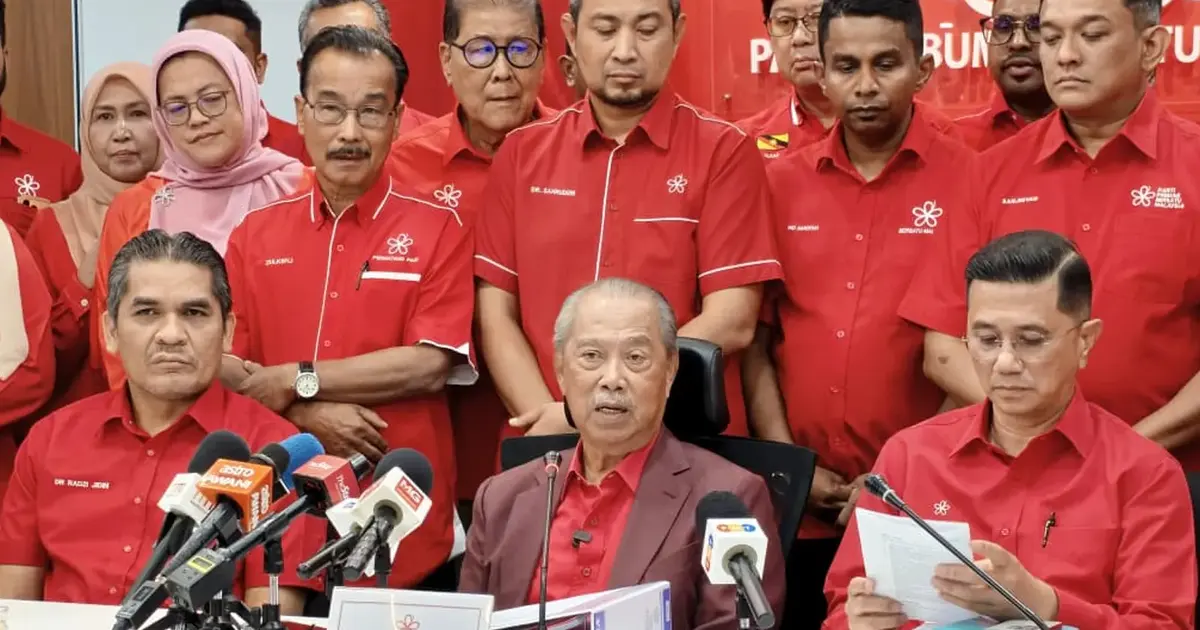
Bersatu will continue its alliance within Perikatan Nasional, according to party president Muhyiddin Yassin, who grounded the decision in what he describes as widespread public backing for the coalition arrangement. The declaration arrives at a time when Malaysian political coalitions face ongoing scrutiny and shifting voter preferences across different states and federal territories.
Muhyiddin's announcement represents a formal reaffirmation of Bersatu's commitment to the opposition coalition structure. Rather than pivot toward other political configurations or pursue an independent path, the party leadership has chosen to entrench its position within Perikatan Nasional, signaling stability within a grouping that has undergone considerable internal debate and repositioning since the previous general election.
The basis for this decision, according to Bersatu's chief, rests on grassroots acceptance of Perikatan Nasional's platform and vision among ordinary Malaysians. This framing suggests the party views its coalition membership not merely as a tactical arrangement but as aligned with demonstrated public sentiment, a narrative device that strengthens internal party unity and provides justification to potential defectors or sceptics within the membership.
For Malaysian observers tracking coalition dynamics, Bersatu's renewed commitment carries significance given the party's relatively younger history and its leaders' previous experience navigating multiple political alignments. The party emerged from internal conflicts within the original UMNO and has since positioned itself as an alternative conservative-Malay political force, competing with established players for electoral support particularly in Peninsula Malaysia.
Perikatan Nasional itself comprises multiple components with distinct constituencies and ideological orientations, ranging from PAS with its Islamic agenda to smaller parties representing regional and community interests. Bersatu's decision to remain signals confidence that the coalition structure, despite its internal complexities, continues to offer better electoral and political prospects than available alternatives.
This commitment takes on added weight considering the Malaysian political landscape's fluidity. Coalition configurations in Malaysia have historically proven unstable, with component parties frequently defecting, realigning, or reconstituting partnerships based on shifting calculations about electoral viability and resource distribution. Muhyiddin's statement therefore functions as an attempt to project steadiness and coherence at a time when voters may view coalition politics with fatigue.
The timing of this reaffirmation likely reflects broader strategic considerations. Bersatu may be positioning itself ahead of potential state-level elections, upcoming parliamentary developments, or internal party management requirements. By publicly anchoring its position within Perikatan Nasional and attributing this choice to public approval, leadership insulates itself against criticism from internal factions that might prefer different political arrangements.
From a Southeast Asian perspective, Malaysia's coalition politics represents a distinctive feature of the region's electoral systems. Unlike neighbouring Thailand or Singapore with their different political structures, Malaysia's multi-party democracy features frequent coalition negotiations and recalibrations. Bersatu's position within this ecosystem underscores how newer political entities must establish credibility and longevity despite the system's inherent instability.
The party's Malaysian base spans diverse voter demographics, though its strongest support concentrates among Malay-Muslim constituencies, particularly in certain Peninsula states. Maintaining Perikatan Nasional membership allows Bersatu to compete within a broader coalition framework that collectively appeals to broader electoral segments than the party could attract independently.
Looking forward, Bersatu's entrenchment in Perikatan Nasional will shape how opposition politics develops in Malaysia. The coalition's effectiveness in mounting electoral challenges to the ruling government depends partly on component parties like Bersatu demonstrating commitment and internal discipline. Conversely, public perception of coalition stability influences voter willingness to support opposition candidates and proposals.
Muhyiddin's invocation of public acceptance as the foundation for Bersatu's coalition loyalty represents a democratic legitimation strategy that acknowledges Malaysian voters' role in validating political choices. Whether this public support actually translates into electoral gains and sustained coalition cohesion remains to be tested through upcoming electoral cycles and the day-to-day challenges of maintaining unity across ideologically diverse partners.


%22%2F%3E%3C%2Fpattern%3E%3C%2Fdefs%3E%3Crect%20width%3D%22100%25%22%20height%3D%22100%25%22%20fill%3D%22url(%23ph40buhg)%22%2F%3E%3Crect%20width%3D%22100%25%22%20height%3D%22100%25%22%20fill%3D%22url(%23ph40buhp)%22%2F%3E%3Ctext%20x%3D%2250%25%22%20y%3D%2250%25%22%20text-anchor%3D%22middle%22%20dominant-baseline%3D%22central%22%20fill%3D%22rgba(255%2C255%2C255%2C0.95)%22%20font-family%3D%22Georgia%2C%20'Times%20New%20Roman'%2C%20serif%22%20font-weight%3D%22700%22%20font-size%3D%22320%22%20letter-spacing%3D%22-0.02em%22%3EGRS%3C%2Ftext%3E%3C%2Fsvg%3E)