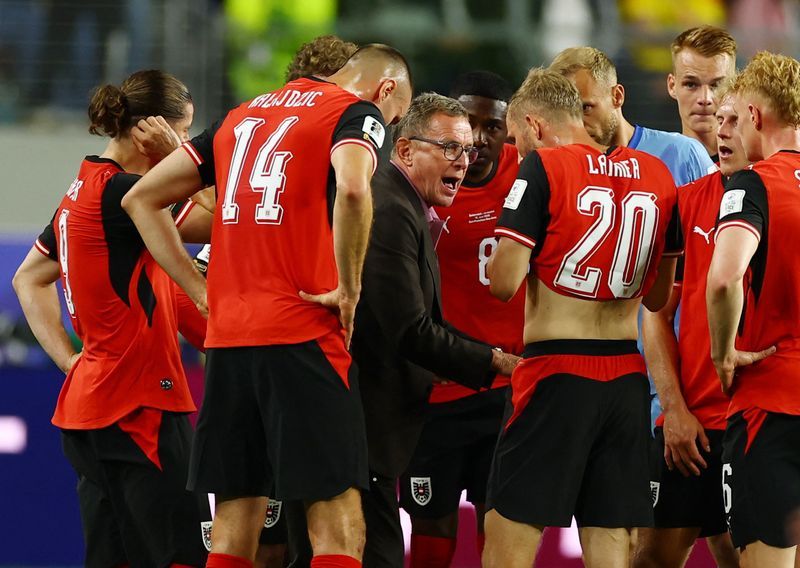
Austria's coach Ralf Rangnick extended considerable respect to Jordan following his team's narrow 3-1 victory over the World Cup debutants in Santa Clara, California on Tuesday, arguing that the quality gap between football's established powerhouses and emerging nations has narrowed considerably in recent years. The Austrian side, arriving at the tournament with elevated expectations after an impressive Euro 2024 campaign, found themselves pushed hard by opponents who delivered a far more competitive challenge than conventional wisdom might have predicted.
Jordan's inaugural World Cup appearance proved anything but ceremonial. The team competed with tactical discipline and attacking intent throughout the encounter, repeatedly catching Austria off-guard and testing their defensive resolve. Rather than folding against a theoretically superior opponent, Jordan instead mounted a sustained challenge that forced Austria to work substantially harder for victory. The decisive moment came only in the closing stages when substitute Marko Arnautovic converted a penalty during the 12th minute of second-half stoppage time, allowing Austria to finally put the contest beyond doubt.
Rangnick's assessment of the match centred on Jordan's unexpectedly spirited performance. When questioned about his team's struggles during periods of the game, the coach attributed the difficulties squarely to the opposition's quality rather than any Austrian shortcomings. He acknowledged that Jordan had executed a brave, attacking brand of football that transcended the limitations many had previously assigned to World Cup newcomers. By Rangnick's account, Jordan exceeded his own pre-match expectations, suggesting that the coaching staff had underestimated the threat posed by a nation making its debut on football's grandest stage.
The win nevertheless provided cause for concern as Austria prepared for their next fixture against Group J leaders Argentina, who had dismantled Algeria 3-0 in their corresponding match. Austria's sluggish first-half performance and tendency towards defensive vulnerabilities hinted that the momentum generated by their Euro 2024 run may have stalled. Rangnick's team now faces a considerably sterner examination against the tournament's elite, with their narrow Jordan victory potentially masking deeper issues that could prove problematic against opponents of Argentina's calibre and experience.
Rangnick proved notably philosophical about the broader implications of the expanded 48-team World Cup format. Rather than viewing the inclusion of additional nations as a dilution of tournament quality, he characterized the development as enriching for global football. The expansion has created opportunities for historically underrepresented regions and emerging football nations to test themselves at the highest level, an outcome the Austrian coach appeared to view positively from both competitive and developmental perspectives.
Crucially, Rangnick rejected any notion that the tournament's newer participants were merely making up the numbers or serving as convenient stepping stones for established football powers. He pointed to several concrete examples demonstrating that smaller nations had begun competing at substantially elevated levels. Spain's shock draw against Cape Verde, Australia's surprising upset of Turkey, and Haiti's gritty performance against Scotland all illustrated that traditional hierarchies no longer guaranteed one-sided contests. These results represented genuine competitive achievements rather than fortunate anomalies.
The Austrian coach attributed this competitive convergence to long-term structural improvements across global football. Over approximately the past 15 years, football development initiatives, improved coaching methodologies, and investment in player development have enabled emerging football nations to narrow the technical and tactical gap separating them from established powers. Rangnick observed that this evolutionary process had fundamentally transformed the tournament landscape, eliminating the concept of genuinely easy opponents at the World Cup level.
For Malaysian readers and broader Southeast Asian football observers, Rangnick's remarks carry particular relevance. The coach's assessment underscores how global football's competitive terrain continues shifting, with previously dominant nations facing increasingly serious challenges from unexpected sources. This pattern holds implications for how regional football federations approach development strategy and tournament preparation. The evidence suggests that even modest football-playing nations can compete effectively if they combine proper tactical organization with sustained player development investments.
Rangnick's perspective also challenges conventional tournament narratives that reduce smaller nations' participation to ceremonial roles. By crediting Jordan with genuine competitive quality and highlighting other surprising results, he implicitly argues that the expanded format has enhanced the tournament's overall competitive integrity. Rather than diluting standards, the inclusion of additional nations appears to have intensified competition across multiple groups, creating fewer genuine mismatches than traditional World Cup formats typically featured.
The tactical lessons from Austria's Jordan experience merit consideration within Asian football contexts. Jordan demonstrated that organized defensive structures combined with disciplined attacking transitions could trouble sides ranked substantially higher in international standings. The team's willingness to take attacking risks despite their underdog status suggested that psychological confidence and tactical clarity could partially offset inherent quality differences. These elements remain achievable for regional football programs willing to invest appropriately in coaching expertise and player preparation.
Moving forward, Austria must rediscover the form that characterized their Euro 2024 performances if they harbour serious tournament ambitions. The narrow Jordan victory, while securing three crucial points, exposed vulnerabilities that Argentina will likely attempt to exploit ruthlessly. Rangnick's generous praise for Jordan thus served a dual purpose: acknowledging genuine opponent quality while implicitly highlighting that Austria requires substantial improvement against genuinely elite opposition.


%22%2F%3E%3C%2Fpattern%3E%3C%2Fdefs%3E%3Crect%20width%3D%22100%25%22%20height%3D%22100%25%22%20fill%3D%22url(%23ph40buhg)%22%2F%3E%3Crect%20width%3D%22100%25%22%20height%3D%22100%25%22%20fill%3D%22url(%23ph40buhp)%22%2F%3E%3Ctext%20x%3D%2250%25%22%20y%3D%2250%25%22%20text-anchor%3D%22middle%22%20dominant-baseline%3D%22central%22%20fill%3D%22rgba(255%2C255%2C255%2C0.95)%22%20font-family%3D%22Georgia%2C%20'Times%20New%20Roman'%2C%20serif%22%20font-weight%3D%22700%22%20font-size%3D%22320%22%20letter-spacing%3D%22-0.02em%22%3EGRS%3C%2Ftext%3E%3C%2Fsvg%3E)