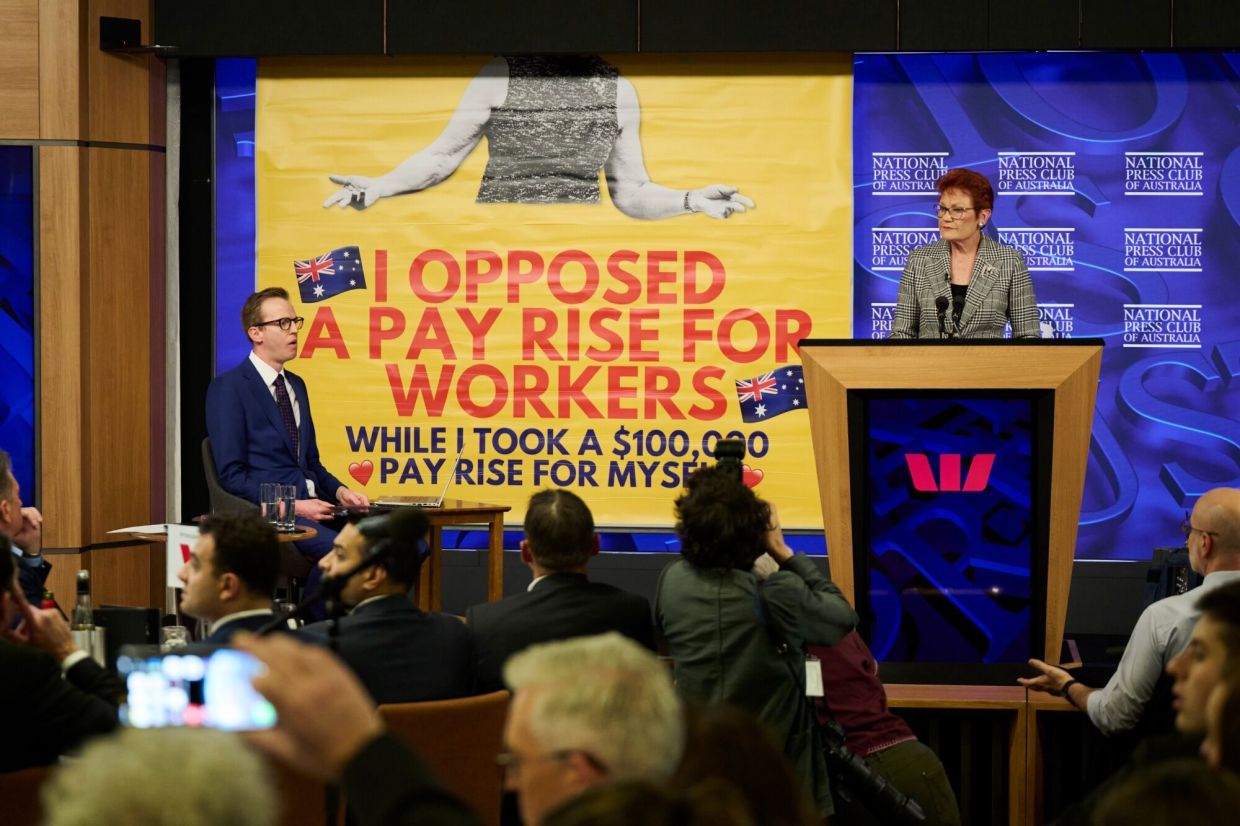
Pauline Hanson, leader of Australia's hard-right One Nation party, has launched a forceful attack on decades of multicultural policy, arguing that her country must adopt a monocultural framework to address its mounting social and economic challenges. Speaking at the National Press Club in Canberra on Wednesday, a venue she had never addressed in her three decades of political prominence, Hanson positioned the shift away from multiculturalism as central to resolving Australia's housing affordability crisis and broader cost-of-living pressures.
Hanson's framing presents a critical distinction that reveals the strategic positioning of her argument: while acknowledging Australia's multiracial composition as an irreversible demographic reality, she insists the nation must operate under a single cultural framework. "We are a multiracial society, but we must be monocultural," she declared. "Australians must live under the one cultural umbrella." This formulation allows her to avoid appearing explicitly exclusionary while still advocating for cultural homogenisation—a rhetorical device that has resonated with voters frustrated by rapid social change.
The housing crisis has become the primary lens through which Hanson frames her immigration restrictions. Rather than examining structural factors such as insufficient housing supply, land release policies, or construction industry constraints, she attributes affordability challenges directly to migration levels. This diagnosis positions immigration reduction as a straightforward solution to a complex problem, appealing to Australians experiencing genuine hardship in accessing homeownership. Her willingness to identify a single culprit for multifaceted economic problems exemplifies what Prime Minister Anthony Albanese has characterised as "simplistic grievance-based politics."
Hanson's speech reflected a careful calibration of contemporary anxieties. Beyond housing, she connected immigration to inflationary pressures, rising interest rates, and elevated fuel costs stemming from Middle Eastern geopolitical tensions. She specifically advocated for restricting entry from "places immersed in extremism like radical Islam," a formulation that conflates religious identity with extremism and appeals to security concerns that have intensified in Western nations over the past two decades. By bundling disparate economic and security grievances under the immigration umbrella, Hanson presents her policy platform as a comprehensive solution to interconnected crises.
The electoral momentum behind One Nation has intensified substantially over the preceding year, accelerating sharply following the centre-right coalition government's collapse in May of the previous year. Opinion polling has reflected growing support for Hanson's party among voters disillusioned with establishment parties and seeking alternatives that validate their frustrations. This surge occurs despite—or perhaps because of—economic conditions that have created genuine vulnerability among working and middle-class Australians.
Australia's economic landscape has deteriorated markedly in recent months. Inflation has re-emerged as a persistent challenge, interest rates have climbed, and fuel prices have spiked due to regional instability involving Iran. These conditions create fertile ground for populist messaging that identifies clear enemies—in this case, immigrants and green energy policies—responsible for household financial stress. When voters feel economically threatened, they become more receptive to narratives offering straightforward explanations and decisive action, regardless of evidence supporting alternative interpretations.
Albanese's Labor government has attempted to cushion these pressures through targeted interventions. A temporary reduction in fuel excise was implemented to provide immediate relief at the pump, while broader tax reform has been proposed to address housing affordability constraints. However, these policy responses have faced criticism as insufficient to address underlying structural problems or the psychological impact of economic insecurity on voter behaviour. When governments struggle to demonstrate tangible improvement in living standards, opposition voices advocating systemic rupture gain credibility, even if their proposed solutions lack empirical foundation.
The embrace of monocultural ideology represents a significant rhetorical escalation in Australian politics, marking a departure from the multicultural consensus that has structured national identity and policy for several decades. While One Nation and Hanson have always positioned themselves outside mainstream political consensus, articulating monoculturalism as an explicit policy objective—rather than merely criticising multiculturalism in abstract terms—represents a more confrontational stance. This shift may indicate confidence that public sentiment has shifted sufficiently to permit such positioning without immediate electoral penalty.
For Southeast Asia and Malaysia specifically, developments in Australian politics carry particular resonance. Australia remains a significant regional economic and security partner, and shifts in Australian policy towards immigration and cultural pluralism can influence regional dynamics, investment flows, and diplomatic relationships. A more restrictive Australian immigration stance targeting particular regions or religions could affect skilled worker flows and student enrolments, both historically important components of Australia-Southeast Asia engagement. Additionally, if monocultural framing gains traction in Australian political discourse, it may influence regional conversations about identity, integration, and belonging, particularly in nations with significant minority populations navigating questions of national cohesion.
Hanson's willingness to explicitly advocate monoculturalism also reflects a broader global trend where populist leaders have found electoral success by rejecting post-national or multicultural frameworks in favour of essentialist identity politics. From Europe to North America, variations of this argument—that successful societies require cultural homogeneity—have gained political traction despite historical and contemporary evidence suggesting plural societies can function effectively. The Australian case demonstrates how economic anxiety, when adequately mobilised through identity-based messaging, can revive ideological frameworks that seemed relegated to historical memory.

%22%2F%3E%3C%2Fpattern%3E%3C%2Fdefs%3E%3Crect%20width%3D%22100%25%22%20height%3D%22100%25%22%20fill%3D%22url(%23ph40buhg)%22%2F%3E%3Crect%20width%3D%22100%25%22%20height%3D%22100%25%22%20fill%3D%22url(%23ph40buhp)%22%2F%3E%3Ctext%20x%3D%2250%25%22%20y%3D%2250%25%22%20text-anchor%3D%22middle%22%20dominant-baseline%3D%22central%22%20fill%3D%22rgba(255%2C255%2C255%2C0.95)%22%20font-family%3D%22Georgia%2C%20'Times%20New%20Roman'%2C%20serif%22%20font-weight%3D%22700%22%20font-size%3D%22320%22%20letter-spacing%3D%22-0.02em%22%3EGRS%3C%2Ftext%3E%3C%2Fsvg%3E)