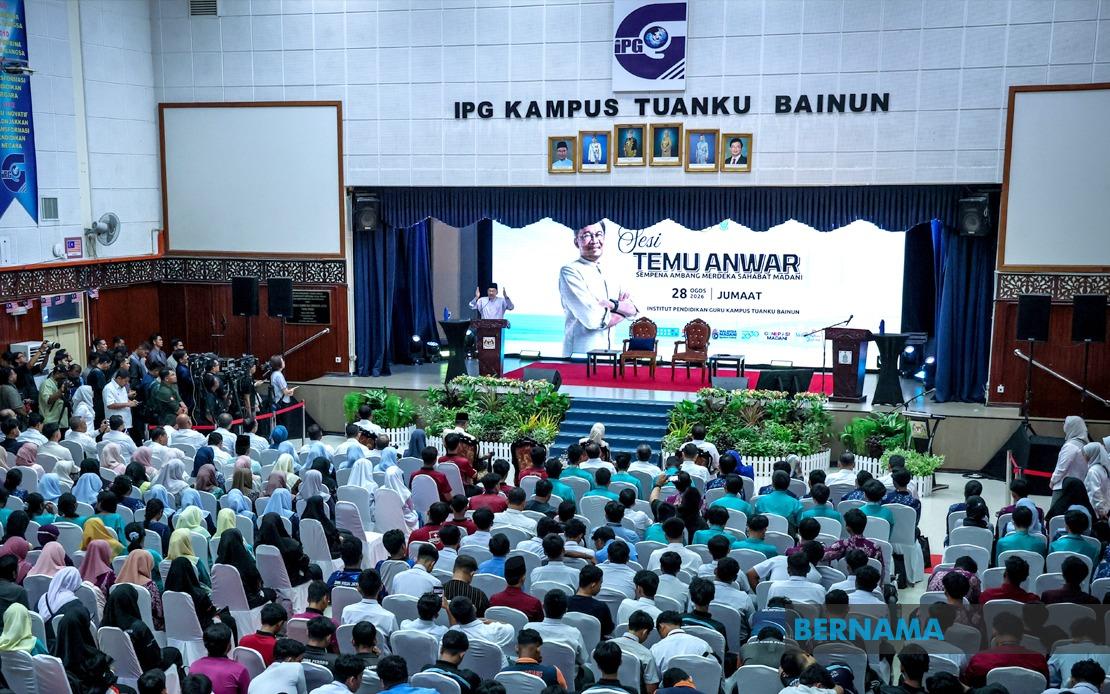
Prime Minister Datuk Seri Anwar Ibrahim has justified the government's decision to entirely abolish the Universities and University Colleges Act 1971 (AUKU) as a necessary step to grant tertiary-level learners greater autonomy in expressing their views and engaging with ideas. Speaking during a Temu Anwar session in Bukit Mertajam attended by Education Minister Datuk Seri Fadhlina Sidek, Anwar emphasised that the legislative change creates space for young Malaysians to develop intellectual independence while navigating the complexities of contemporary society.
The Prime Minister's remarks underscore a fundamental shift in Malaysia's approach to university governance and student engagement. Anwar highlighted the temporal disconnect between the 1971 legislation and present-day circumstances, noting that students who have reached voting age—typically 18 years old under Malaysian electoral law—possess sufficient maturity to participate in political discourse without statutory restraint. This logic reflects broader international trends where democracies have recognised the developmental capacity of late adolescents to form reasoned positions on matters of public concern.
Centrally, Anwar framed the AUKU repeal not merely as a removal of restrictions but as an affirmative investment in national intellectual capacity. He stressed that creativity, discernment, and the ability to think analytically emerge through practice—specifically through the active articulation of viewpoints, exposure to opposing arguments, and the iterative refinement of positions through debate. Universities, in this conceptualisation, function as laboratories where future leaders, professionals, and citizens hone their reasoning faculties before assuming roles in civil society and the economy.
The Prime Minister acknowledged an important caveat: student opinions need not invariably prove correct. This nuance is pedagogically significant. Rather than suggesting that AUKU's repeal endorses all student positions as equally valid, Anwar indicated that the learning process depends on students venturing interpretations, encountering counterarguments, and adjusting their understanding accordingly. Such intellectual maturation cannot occur within an environment where speech itself is curtailed by law, regardless of content merit.
For Malaysian higher education, the AUKU abolition carries substantial implications. Historically, the Act constrained student political organising, campus publications, and public comment on governance matters. Its removal potentially transforms campuses into more vibrant arenas for ideological exchange, student journalism, and organised advocacy. However, this expansion of permissible speech does not operate in a vacuum; universities retain disciplinary mechanisms, institutional policies, and the criminal law itself—including sedition and defamation statutes—to address conduct that transgresses beyond expression into unlawful territory.
The timing of Anwar's comments reflects political calculations within Malaysia's current coalition government. Younger voters, particularly first-time tertiary-level entrants, have demonstrated increasing engagement with electoral politics and policy debates. By positioning his administration as a liberaliser of campus speech, Anwar appeals to youth demographics while simultaneously demonstrating responsiveness to longstanding complaints from civil society and opposition movements that viewed AUKU as anachronistic and oppressive.
Regionally, Malaysia's move aligns with broader democratisation patterns observed in other Southeast Asian contexts, where education authorities have gradually relaxed restrictions on student activism and campus expression. Thailand, Indonesia, and the Philippines have each navigated transitions toward permitting greater student political participation, albeit with varying degrees of stability and occasional reversals. Malaysia's deliberate, government-sanctioned dismantling of AUKU positions the country within this trajectory, though questions persist regarding enforcement and institutional implementation across the diverse landscape of public and private institutions.
The presence of Fadhlina Sidek at the Bukit Mertajam event signalled ministerial alignment with the Prime Minister's position. The Education Ministry's endorsement carries weight in translating legislative repeal into concrete changes in campus administration, student handbooks, and faculty guidance. Without coordinated messaging from education authorities, confusion and resistance at institutional levels could undermine the stated intent of the AUKU abolition.
Critiques of the repeal have emerged from conservative quarters and some administrative officials concerned that unfettered student organising could destabilise campuses or promote ideologies deemed antithetical to national stability. Anwar's framing—emphasising the maturity of voting-age students and the developmental necessity of intellectual freedom—represents a counterargument rooted in democratic theory and educational philosophy rather than pure political expedience, though critics might dispute this characterisation.
Looking forward, the practical effectiveness of AUKU's repeal depends on implementation. Universities must revise policies, train administrators, and establish new norms that protect student speech while maintaining institutional order. Student organisations must exercise their newfound freedoms responsibly, recognising that freedom of expression entails corresponding obligations to engage respectfully and truthfully. The national conversation surrounding these issues will likely shape how successive governments in Malaysia approach the tension between civil liberty and institutional governance in the tertiary education sector.

