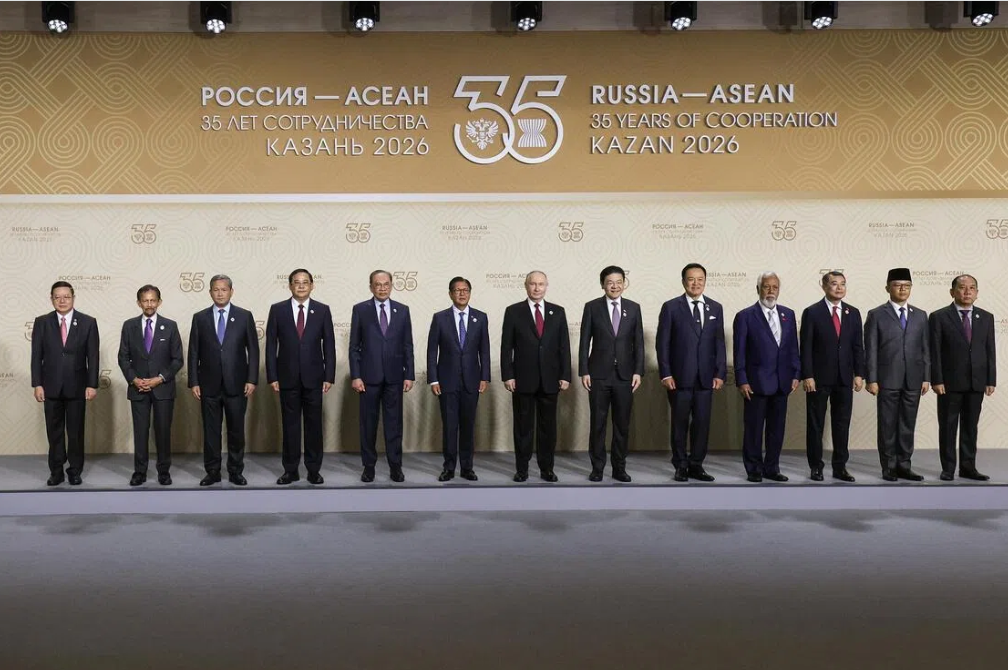
Asean and Russia have renewed their commitment to expanding bilateral cooperation across multiple strategic sectors, with both sides adopting a comprehensive roadmap for the next five years at a commemorative summit held in Russia's Kazan region in mid-June. The gathering, which brought together leaders from across Southeast Asia and Russian President Vladimir Putin, underscored the enduring importance of the relationship between the ten-nation bloc and Moscow, even as broader geopolitical tensions continue to reshape international alignments in the region and beyond.
The Asean-Russia Commemorative Summit marked a significant milestone in the relationship between the two actors, celebrating three and a half decades of diplomatic engagement and three decades specifically of structured dialogue partnership. The occasion prompted both sides to take stock of progress achieved and to establish clearer priorities for the future. Among the formal outputs was the adoption of the Kazan Declaration, a substantial document that reviews the trajectory of Asean-Russia ties since the relationship's inception and outlines an ambitious agenda for the coming years. This declaration identifies several areas deemed critical for deepened cooperation, including maritime affairs, commerce and investment flows, energy security, regional connectivity infrastructure, military and security matters, educational partnerships, and cultural exchange programmes.
Beyond the overarching declaration, participating nations signed additional instruments designed to strengthen specific dimensions of the relationship. A Joint Statement on Cultural Cooperation emphasises the importance of people-to-people engagement and expanded cultural exchanges, recognising that sustained diplomatic ties require deep social and cultural foundations. Perhaps most significantly for the practical implementation of collaborative efforts, both sides endorsed the Asean-Russia Comprehensive Plan of Action covering the 2026-2030 period, a detailed framework that translates broad diplomatic objectives into concrete initiatives and measurable outcomes across various sectors.
Singapore's Prime Minister Lawrence Wong, representing the bloc at the summit, articulated a vision of pragmatic cooperation grounded in converging interests rather than comprehensive alignment. His remarks reflected Asean's traditional approach to external relations, which emphasises working with multiple partners while maintaining the principle of non-interference and constructive engagement even with nations where disagreements exist. Wong specifically highlighted areas where Asean and Russia could find common ground, including disaster management capacities and joint efforts to address transnational drug trafficking—challenges that affect both Southeast Asia and Russia's Far Eastern regions.
Educational and cultural dimensions featured prominently in Singapore's diplomatic approach to the summit. Wong noted the ongoing participation of Russian officials in civil service training programmes conducted across Asean member states, including Singapore itself, demonstrating that people-to-people connectivity extends beyond tourism and cultural festivals to include professional development and knowledge transfer. This emphasis on educational ties reflects recognition among Asean leaders that sustained strategic partnerships require investments in human capital and institutional relationships that transcend any single political cycle or diplomatic incident.
The summit occurred against a backdrop of significant geopolitical volatility that has prompted Asean nations to carefully recalibrate their foreign policy approaches. Wong emphasised that Asean's dual strategy of deepening internal integration while simultaneously expanding partnerships with major powers becomes increasingly vital in an environment characterised by unpredictability and shifting alignments. This framing suggests that engagement with Russia, despite significant differences over Ukraine and other matters, serves Asean's broader objective of maintaining strategic autonomy and avoiding the need to choose sides in great power competitions.
Wong's remarks on international law and rules-based order revealed the careful balance Asean attempts to maintain on contentious geopolitical issues. While Singapore has been explicit in condemning Russia's military actions in Ukraine as violations of international law and has maintained sanctions imposed in 2022, the country simultaneously seeks to preserve channels of dialogue and cooperation with Moscow. This nuanced position reflects Singapore's view that engagement with Russia remains beneficial for regional stability and that isolating major powers counterproductively reduces opportunities for diplomatic influence. Wong specifically reiterated Singapore's position on Ukraine as grounded in principle rather than alignment, emphasising commitment to sovereignty and territorial integrity as universal concepts rather than selective applications.
The summit also witnessed bilateral meetings between Singapore's Prime Minister and Russian President Putin, occurring at Moscow's initiative. These discussions covered bilateral relations as well as broader regional and international developments, providing opportunities for leaders to explain their countries' positions on contested matters and to identify areas where productive cooperation remains possible. Wong's subsequent statement via social media highlighted the value of dialogue even amid disagreement, a message clearly aimed at domestic audiences concerned about Singapore's engagement with a country subject to Western sanctions, as well as international observers questioning Asean's approach to Russia.
Looking ahead, Singapore's assumption of Asean's rotating chairmanship in 2027 will create further opportunities for engagement with Russia. Wong expressed his government's expectation that Russia will participate in the East Asia Summit and Asean Regional Forum, both mechanisms through which Russia engages in multilateral discussions on Asia-Pacific security matters. This forward-looking dimension suggests that both Asean and Russia view the relationship as sufficiently important to weather current strains and to build toward expanded cooperation in coming years.
Additionally, Prime Minister Wong met with Rustam Minnikhanov, the leader of the Russian Republic of Tatarstan, reflecting the complex federalism of the Russian state and the existence of significant regional actors with autonomous international engagement capacity. Singapore and Tatarstan have maintained separate relations since a 2007 visit by then-Minister Mentor Lee Kuan Yew, demonstrating that Asean nations have cultivated relationships with Russia's constituent republics as well as with the federal government. These sub-national connections diversify Singapore's engagement with Russia and create alternative channels for cooperation that can continue even when federal-level relations face tensions.
The summit's outcomes reflect Asean's broader strategy of maintaining ties with all major powers while refusing to be drawn into exclusive alignments or great power competition frameworks. For Southeast Asian states, Russia represents an important energy supplier, military technology provider, and permanent member of the United Nations Security Council whose voice matters on regional security questions. The maintenance of functional diplomatic relationships with Moscow, even while disagreeing on fundamental issues, aligns with Asean's institutional interests and with individual member states' strategic calculations.
The five-year comprehensive plan and accompanying documents adopted at Kazan provide a framework for managing the relationship with greater clarity and structure. By specifying priority areas and establishing timelines, both sides create expectations for progress that can be assessed and adjusted as circumstances evolve. This institutionalisation of cooperation helps insulate some aspects of the relationship from the worst effects of periodic crises or sharp disagreements on other matters.