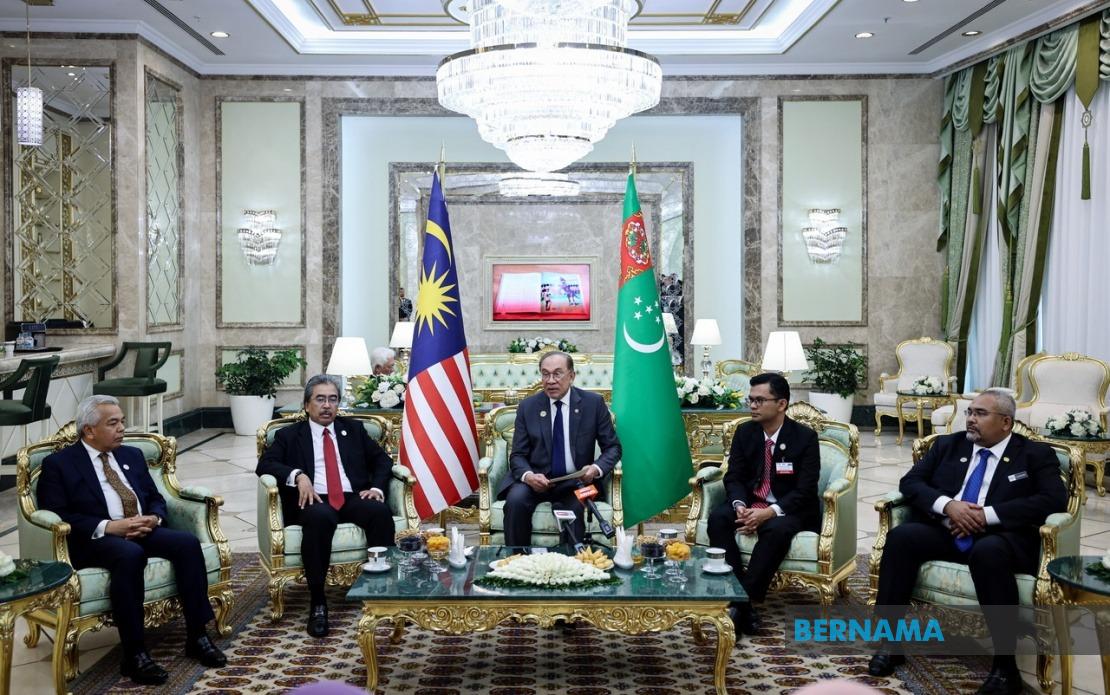
Prime Minister Datuk Seri Anwar Ibrahim has declared his official working visit to Turkmenistan a success, highlighting concrete gains in bilateral relations and the potential for deeper strategic engagement between Malaysia and the Central Asian nation. The visit, which commenced on June 18 as an invitation from Turkmenistan President Serdar Berdimuhamedov, represents the first such high-level trip by Anwar to the country since he assumed office as Malaysia's 10th prime minister in November 2022.
Anwar's delegation comprised a substantial team reflecting the visit's significance for Malaysian business and diplomatic interests. Minister of Investment, Trade and Industry Datuk Seri Johari Abdul Ghani and Minister of Economy Akmal Nasrullah Mohd Nasir travelled alongside the Prime Minister, joined by representatives from the Prime Minister's Office and the Foreign Ministry. This composition underscores Malaysia's intent to pursue substantive economic and diplomatic outcomes rather than ceremonial exchanges, positioning the trip within a broader framework of Southeast Asian engagement with Central Asian partners.
The Prime Minister particularly emphasised the energy sector as a cornerstone of expanded cooperation between the two nations. Turkmenistan's vast natural gas reserves and Malaysia's experience in energy extraction, processing, and commercialisation create complementary opportunities for partnership. By explicitly highlighting energy's "great potential to be explored and leveraged," Anwar signalled Malaysia's interest in diversifying its energy portfolio and exploring alternative sources beyond its traditional regional suppliers. This strategic dimension is particularly relevant as Malaysia navigates global energy transitions and seeks to secure long-term supply security.
The presence of PETRONAS officials within the delegation underscores the commercial dimension of these discussions. Malaysia's national petroleum company represents the country's technical capacity and international experience in energy ventures, making it a natural participant in negotiations regarding potential energy cooperation agreements. Such institutional involvement suggests concrete negotiations occurred rather than merely symbolic diplomatic courtesy, with technical feasibility studies and partnership frameworks likely forming part of the dialogue.
Anwar's public acknowledgment of Turkmenistan President Serdar Berdimuhamedov's hospitality reflects diplomatic protocol while reinforcing the friendly tenor established during the visit. Central Asian nations, mindful of their geographic and political circumstances, typically welcome high-level engagement from Southeast Asian democracies as it provides diplomatic diversification and demonstrates international recognition. Malaysia's willingness to elevate bilateral relations through a prime ministerial visit reciprocates such openness and positions both countries as valuable partners within their respective regions.
The characterisation of the visit as opening "a new chapter" in bilateral cooperation suggests previous engagement frameworks have been modest or episodic. Malaysia and Turkmenistan have not historically maintained especially prominent diplomatic or commercial relationships, making this visit a potential inflection point in their ties. For Malaysian policymakers, Central Asian engagement offers several strategic advantages: access to energy resources, involvement in transcontinental trade corridors, and presence in an increasingly geopolitically significant region where influence contests between major powers continue to intensify.
The Prime Minister's commendation of the Malaysian Embassy in Ashgabat, security personnel, and media representatives reflects the operational complexity of high-level visits to countries with less frequent Malaysian official engagement. Ashgabat's distance from Malaysia's main diplomatic hubs and the need to coordinate across multiple government agencies and state enterprises necessitated comprehensive advance planning. Such organisational acknowledgment, while routine in diplomatic communications, indicates the visit received priority treatment and sustained institutional support.
From a Southeast Asian perspective, Malaysia's outreach to Central Asia exemplifies a broader regional strategy of geographic diversification. Rather than concentrating exclusively on traditional engagement patterns within ASEAN, East Asia, or established trade partners, Malaysia is systematically cultivating relationships across less-explored regions. This approach aligns with principles of strategic autonomy and reduces dependency on any single region or power structure, though it requires sustained commitment rather than episodic diplomatic visits.
The bilateral cooperation framework that Anwar referenced likely encompasses not merely energy but also potential avenues in trade, investment, technology transfer, and people-to-people exchanges. Turkmenistan's position along historic Silk Road routes and modern Belt and Road Initiative corridors creates opportunities for Malaysian businesses seeking Central Asian market access. Conversely, Malaysian expertise in manufacturing, finance, and services represents potential value-add for Turkmenistan's economic diversification efforts beyond hydrocarbon extraction.
For Malaysian businesses, particularly those in energy, petrochemicals, and engineering services, successful government-level engagement creates pathways for commercial opportunities. State visits typically precede specific business agreements, joint ventures, or preferential trading arrangements. The presence of investment and trade ministers suggests Malaysia anticipates tangible commercial outcomes and institutional frameworks to facilitate private sector participation beyond governmental relations.
The timing of this visit occurs amid Malaysia's broader foreign policy recalibration under Anwar's leadership. His administration has emphasised balanced engagement with major powers, strengthened ASEAN centrality, and pursued selective partnerships with emerging economies. The Turkmenistan visit fits this pattern while addressing Malaysia's long-term energy security concerns and demonstrating active diplomatic engagement across multiple continents and civilisational zones.
Moving forward, the success of this inaugural prime ministerial visit likely hinges on translating diplomatic warmth into concrete institutional arrangements, commercial agreements, and regular high-level engagement. Bilateral relations often plateau after initial ceremonial visits unless supported by active working mechanisms, regular consultation forums, and demonstrable mutual benefits. Malaysian policymakers will need to ensure sustained follow-up through ministerial visits, business delegations, and technical working groups to consolidate momentum generated by Anwar's journey.
The visit ultimately represents Malaysia's recognition that 21st-century strategic positioning requires engagement beyond traditional geographic and civilisational proximities. Turkmenistan and Central Asia, while historically peripheral to Malaysian foreign policy, increasingly warrant attention as energy sources, trade partners, and components of multipolar international systems. Anwar's successful visit establishes diplomatic foundations upon which Malaysia can construct longer-term partnerships aligned with its evolving economic and strategic interests.