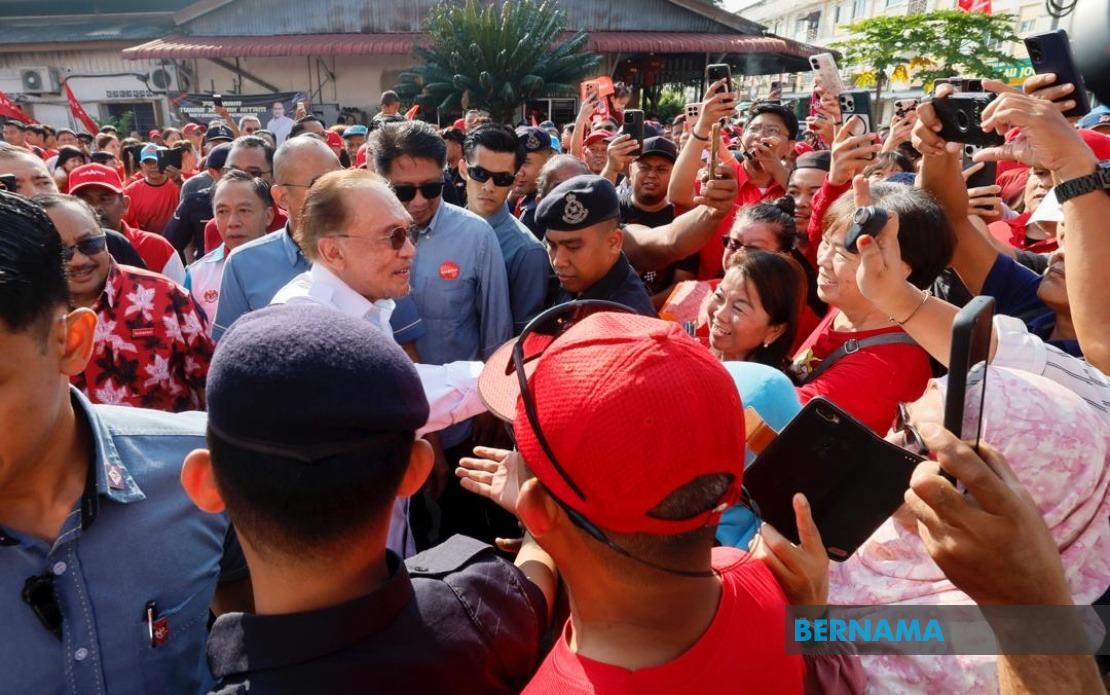
Prime Minister Datuk Seri Anwar Ibrahim's intervention in Johor's ongoing state election campaign has delivered a significant uplift to Pakatan Harapan's organisational energy and volunteer morale, particularly across the Machap and Layang-Layang constituencies as the coalition prepares for polling on July 11. The high-profile visit during the ninth day of campaigning underscored the importance PH places on retaining influence in one of Malaysia's most pivotal states, and the direct engagement with grassroots supporters demonstrated a commitment to door-to-door voter outreach in the final push toward election day.
Machap's PH candidate, Nur Hafiz Roslan, described the Prime Minister's presence as transformative for campaign morale, noting that Anwar's remarks had crystallised the coalition's underlying mission around service delivery and community welfare rather than divisive partisan positioning. During the engagement, Anwar, who simultaneously holds the PKR presidency, emphasised the importance of performing righteous deeds—a phrase laden with religious and moral weight in Malaysia's Muslim-majority context—while working to protect the interests of ordinary citizens. This framing proved effective in resetting the tone of what had otherwise become a competitive and occasionally tense electoral contest.
The candidate's account reveals a deliberate strategic message from the PH leadership: the coalition's presence in constituencies like Simpang Renggam, Machap, and Layang-Layang exists fundamentally to serve the population without sectarian bias or animosity toward rival political groups. Nur Hafiz emphasised that his campaign would operate without prejudice, a subtle but important assurance in a political environment where religious and communal sensitivities regularly feature in electoral discourse. The visit thus functioned not merely as a morale-boosting photo opportunity but as a leadership signal designed to reorient campaign workers toward substantive community engagement.
Layang-Layang's PH candidate, Guna Balakrishnan, similarly characterised the Prime Minister's visit as instrumental in deepening his direct outreach to residents across his constituency. Despite reporting strong grassroots enthusiasm for his candidacy, Guna acknowledged that intensifying voter contact remained essential and could not be approached casually. Anwar's instruction to Guna—that electoral victory would obligate him to tangible development work and targeted support for the local community—reinforced the implicit contract between candidates and voters: a mandate carries responsibility for concrete improvement in residents' lives, not merely political representation in a state assembly.
The 'PMX Santai Sarapan Bersama Masyarakat' programme, held in Simpang Renggam, drew more than 1,000 residents and functioned as both a public event and an opportunity for face-to-face constituent contact. Such gatherings serve multiple purposes in Malaysian electoral campaigns: they generate visible crowd energy useful for media documentation and social media amplification, they provide ordinary voters a rare opportunity to interact directly with national leadership, and they signal to campaign volunteers that their efforts enjoy backing from the highest levels of party hierarchy. The informal atmosphere—characterised as relaxed and approachable—appeared designed to distinguish PH's campaign style from more hierarchical or rigid approaches associated with rival parties.
Resident testimonies from the event underscore the emotional and psychological dimensions of such campaign visits. Chuan Chee Mei, a 48-year-old voter, reported that observing Anwar's personal commitment to PH candidates and willingness to engage directly with ordinary people substantially strengthened her intention to cast her ballot for the coalition. This sentiment echoes findings from political behavioural research across Southeast Asia: direct personal engagement by high-ranking politicians often proves more persuasive than impersonal media messaging or institutional endorsements. The visibility of a sitting Prime Minister participating in casual breakfast gatherings conveys respect for constituent dignity and a commitment to accessibility that voters find compelling.
Noor Takiyudin Salleh, 38, expressed similar appreciation for the approachable manner in which Anwar conducted the programme, emphasising the informal setting and substantial crowd attendance as evidence of genuine public interest rather than manufactured spectacle. The ability to present electoral engagement as organic and spontaneous rather than choreographed represents a significant communications asset, particularly in an era of heightened social media scrutiny. Malaysian voters, much like populations elsewhere, remain alert to overly managed or stage-managed political events; authentic-seeming interaction thus carries disproportionate persuasive weight.
The timing of this visit carries strategic significance within the broader Johor electoral context. With 172 candidates competing for 56 state seats and polling day approaching, campaigns enter their critical final phase where undecided voters typically make their decisions. The Prime Minister's personal presence indicates that PH leadership views Johor as winnable and strategically worth the investment of Anwar's limited time and political capital. Conversely, the deployment of a sitting Prime Minister to campaign in state elections—rather than reserving his energies solely for federal politics—reflects the structural importance of Johor within Malaysian federalism and PH's ambition to recapture or consolidate state-level power.
From a wider Southeast Asian perspective, the Johor election illustrates how Malaysian electoral competition, despite being formally domestic and subnational, incorporates elements of succession politics, factional jockeying within ruling coalitions, and leadership legitimacy questions that extend far beyond individual constituencies. The state election functions as a referendum on the Anwar-led federal government's performance and public confidence in his administration's direction. A strong PH showing in Johor would validate Anwar's leadership within his own coalition and burnish his credentials ahead of the next federal election; conversely, setbacks would embolden rival factions and potentially destabilise the PH coalition's internal cohesion.
Early voting commenced on July 7, with election day scheduled for July 11, compressed the already intense campaign timeline and heightened the importance of final get-out-the-vote operations. PH's ground machinery in Machap and Layang-Layang, energised by Anwar's visit and the morale boost it provided, faced the practical challenge of translating heightened volunteer enthusiasm into actual voter turnout across diverse communities. The public breakfast programme thus represented not merely symbolic theatre but a final organisational push designed to activate supporters and communicate PH's commitment to substantive governance once the election concluded.
For Malaysian political observers, the Johor state election and the campaign dynamics surrounding it illuminate broader questions about the stability of the current political settlement, the durability of PH's internal coalition cohesion, and the trajectory of electoral competition in post-2018 Malaysia. The Prime Minister's personal intervention, though presented in informal and approachable terms, fundamentally underscored the magnitude of what Johor voters would determine on polling day and the stakes inherent in their electoral choice.

