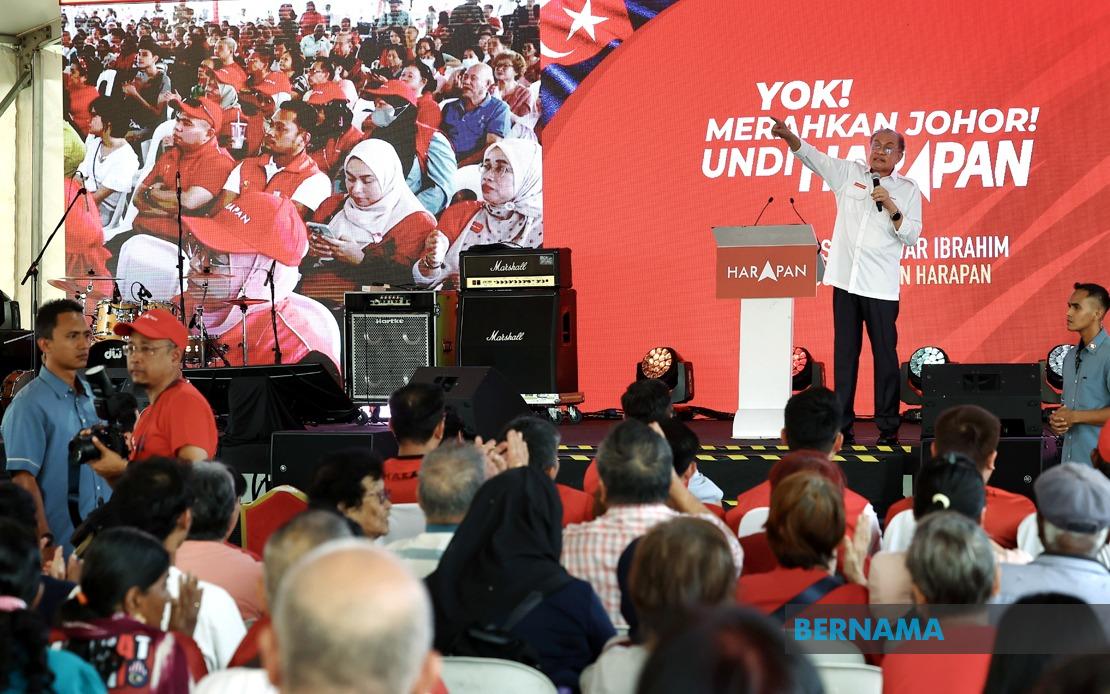
Prime Minister Datuk Seri Anwar Ibrahim has made a direct appeal to political parties competing in the forthcoming Johor state election to abandon efforts to capitalise on the imprisonment of former premier Datuk Seri Najib Razak. Speaking during a campaign event in Kulai, Anwar argued that continued references to Najib's detention represent a distraction from substantive governance priorities that ought to dominate electoral discourse. The remarks suggest mounting concern within the federal leadership that opposition movements may attempt to leverage public sentiment surrounding Najib's incarceration as a mobilising strategy in the state contest.
Anwar's intervention reflects a broader strategic calculation by the ruling Pakatan Harapan coalition. Rather than permit the Najib narrative to dominate campaign messaging, the Prime Minister has essentially signalled that the matter should be treated as closed and off-limits for electoral advantage. His statement that "Najib is now in prison, so leave him alone" and "enough is enough" conveys a desire to shift the political conversation away from matters of past accountability and towards contemporary economic management. This repositioning is particularly significant given that the 1MDB scandal remains deeply embedded in Malaysian political consciousness and continues to shape voter attitudes across demographic groups.
Crucially, Anwar acknowledged the ongoing financial burden imposed by the 1MDB matter, quantifying the outstanding debt at RM51 billion. Rather than leverage this figure as campaign ammunition against rivals, the Prime Minister reframed it as a collective national problem requiring concentrated governmental attention. By emphasising that resources consumed by debt servicing represent funds unavailable for social investment—including schools, hospitals, roadways, and poverty alleviation—Anwar attempted to redirect public frustration from political recrimination towards policy outcomes. This rhetorical manoeuvre essentially asks voters to look forward rather than backward, evaluating the government on its capacity to address present difficulties rather than on its handling of historical grievances.
The timing of Anwar's statement carries particular weight in the context of Johor electoral dynamics. Johor represents a crucial political battleground where UMNO, historically the state's dominant political force, retains substantial organisational capacity and grassroots support networks. Any opposition campaign that succeeds in weaponising discontent over Najib's imprisonment risks crystallising voter resentment that could advantage opposition-aligned parties. Anwar's request that competitors refrain from such tactics may therefore reflect recognition that continued politicisation of the Najib issue could prove counterproductive to Pakatan Harapan's electoral objectives in the state.
The campaign event itself, branded "Yok! Merahkan Johor! Undi Harapan," featured representation from multiple Pakatan Harapan constituents, including the PKR Youth contingent and associated federal ministers. The presence of Youth and Sports Minister Mohammed Taufiq Johari, Deputy Investment, Trade and Industry Minister Sim Tze Tzin, and PKR Youth chief Muhammad Kamil Abdul Munim underscored the coalition's determination to present a unified, forward-looking campaign message. The inclusion of Arthur Chiong Sen Sern, the Pakatan Harapan nominee for the Bukit Batu seat, similarly illustrated the coalition's commitment to competitive ground-level engagement with voters.
Anwar's comments must also be understood within the framework of Malaysia's broader political reconciliation efforts. Since coming to power, the Pakatan Harapan government has navigated complex negotiations regarding approaches to previous administrations' legacies and personalities. By publicly calling for restraint in the use of Najib-related messaging, Anwar positioned himself as a statesman capable of transcending partisan advantage in favour of institutional stability and forward momentum. Such positioning appeals to a segment of the electorate, particularly among older or more conservative voters, who may harbour reservations about sustained political turbulence centred on historical grievances.
The financial dimension outlined by Anwar provides substantive grounding for his plea. The RM51 billion 1MDB debt obligation represents approximately 2.2 per cent of Malaysia's annual federal revenue, a considerable allocation. Every ringgit directed towards servicing this debt constitutes funds foreclosed from alternative uses—whether capital investment in infrastructure, expansion of social safety nets, or enhancement of public service delivery. For a government managing the fiscal pressures of post-pandemic economic recovery and seeking to demonstrate tangible improvement in living standards, this constraint creates genuine policy complications. By elevating the debt burden as a central consideration in electoral messaging, Anwar transformed it from a vehicle for retrospective blame into a contemporary challenge requiring unified national response.
However, the request that election competitors cease politicising the Najib issue operates within a complex political ecology. While Anwar's rhetorical authority as Prime Minister carries considerable weight, the sentiment reflects aspirations rather than enforceable constraints. Opposition parties, particularly those seeking to mobilise anti-establishment sentiment or to recapture voters previously aligned with UMNO and its traditional coalition partners, may calculate that the electoral dividends of addressing Najib-related grievances outweigh the costs of appearing to contravene the Prime Minister's preferences. The degree to which Johor campaign participants respect Anwar's request will provide a revealing indicator of contemporary political norms and the residual appeal of accountability narratives in Malaysian electoral competition.
The appeal also illuminates evolving tensions within the ruling coalition regarding how best to navigate the legacies of previous administrations. While some within Pakatan Harapan may harbour preferences for continued accountability efforts, the practical challenges of governing whilst simultaneously pursuing extensive legal and investigative actions against predecessors create centrifugal pressures. Anwar's intervention in the Johor campaign suggests a deliberate pivot towards emphasising forward-looking governance narratives rather than backward-looking accountability mechanisms as the preferred electoral positioning for the coalition.
For Malaysian voters, particularly those in Johor, Anwar's statement carries implicit messaging about the government's confidence in its record on economic and social management. By requesting that the Najib issue be shelved, the Prime Minister essentially stakes his electoral fortunes on the coalition's perceived competence in contemporary governance rather than on public resentment of past mismanagement. This represents a calculated risk, betting that voters will judge the government primarily on its present and future performance rather than remaining preoccupied with historical grievances, however serious those grievances may be.

