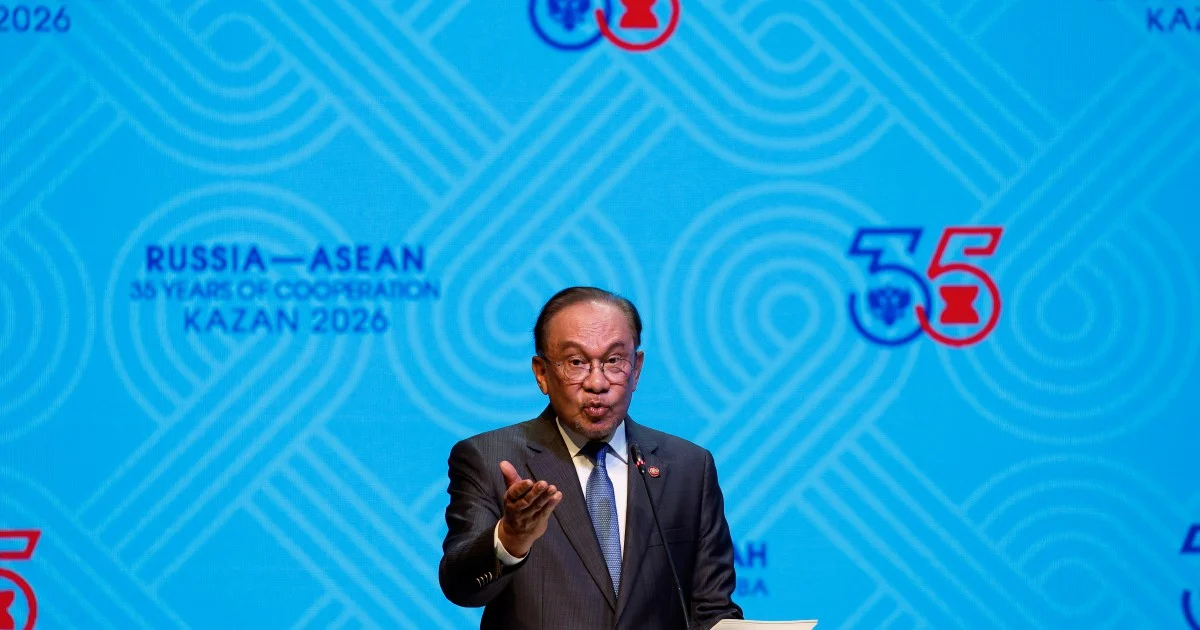
Prime Minister Datuk Seri Anwar Ibrahim has described the completion of the Asean-Russia Strategic Programme on Trade and Investment Cooperation 2026-2035 as an important milestone in strengthening economic relations between the regional bloc and Moscow. Speaking in Kazan, Anwar characterised the finalisation of this long-term partnership framework as a catalytic moment that could propel bilateral trade ties to new heights and create fresh opportunities for member states to engage with the Russian Federation across multiple sectors.
The 10-year strategic programme represents a significant commitment from both Asean and Russia to deepen their commercial and investment relationships at a time of shifting global economic dynamics. For Malaysia and other member states, the roadmap provides a structured pathway for identifying priority areas of cooperation and establishing concrete mechanisms to facilitate increased business activity. The framework's completion signals that despite geopolitical tensions affecting other regions, Southeast Asia remains committed to maintaining pragmatic economic ties with major powers including Russia.
Anwar's remarks underscore Asean's balancing approach to international relations, where the bloc seeks to maintain engagement with multiple global players while preserving its strategic autonomy. The Prime Minister's cautious optimism reflects an understanding that formal agreements alone do not guarantee commercial success—the actual expansion of trade volumes and investment flows will depend heavily on how well both sides can translate strategic intent into operational reality.
A critical element highlighted by Anwar is the necessity of creating an enabling environment for the programme's objectives to materialise. This encompasses everything from harmonising regulatory frameworks and simplifying customs procedures to building mutual confidence in business practices and ensuring predictable policy conditions. For Malaysian businesses particularly, clarity on trade regulations, intellectual property protection, and dispute resolution mechanisms will be essential for capitalising on new opportunities in the Russian market.
The timing of this agreement's finalisation carries significance for Asean's broader economic agenda. With several member states seeking to diversify their trading partnerships and reduce dependency on traditional markets, the Russian market offers potential outlets for agricultural products, manufacturing goods, and technology services. Simultaneously, access to Russian raw materials, energy resources, and industrial goods could benefit regional supply chains that have become increasingly fragile following recent global disruptions.
For Malaysia specifically, the trade roadmap opens possibilities in sectors where the country holds competitive advantages. Malaysian palm oil, rubber products, and petrochemical exports could find growing demand in Russia and associated markets. Conversely, Malaysian investors may explore opportunities in Russian infrastructure, mining, and manufacturing sectors, though they will need to navigate international sanctions regimes and financing complexities that currently constrain such activities.
The strategic programme's 10-year horizon allows participating nations to plan long-term investments and develop industrial capacity with confidence that market access will remain stable. This extended timeframe contrasts with short-term trade agreements and may prove particularly valuable for sectors requiring substantial capital investment or lengthy development cycles. The framework also provides a platform for addressing non-tariff barriers and technical standards that frequently impede trade between developed and developing economies.
However, Anwar's emphasis on the importance of an enabling environment implicitly acknowledges real obstacles that must be overcome. Current geopolitical tensions affect the broader context within which Asean-Russia relations operate, and several member states maintain complex diplomatic balancing acts. International sanctions regimes affecting Russian entities create complications for financial transactions and investment flows. Additionally, differences in business practices, regulatory philosophies, and dispute resolution preferences between Southeast Asian and Russian actors require careful management.
The programme's success will also depend on adequate business participation and genuine demand for expanded trade. While government-to-government agreements create frameworks, actual commercial growth requires private sector companies to identify profitable opportunities and make investment decisions. Building sufficient trust and market knowledge among Southeast Asian business communities regarding Russian opportunities will require sustained promotional efforts and perhaps government support mechanisms such as trade financing or market intelligence services.
Asean's engagement with Russia through this strategic programme reflects the bloc's commitment to maintaining a rules-based international order while preserving independent foreign policy options. Rather than aligning strictly with any major power, Asean continues pursuing its longstanding policy of engaging all significant actors in ways that serve regional interests. This approach has enabled Southeast Asia to benefit from relationships with multiple powers despite global polarisation.
The Prime Minister's characterisation of the trade roadmap as a good starting point rather than a complete solution suggests realistic expectations about what such agreements can achieve. Implementation challenges, market dynamics, and geopolitical factors will ultimately determine whether the framework translates into substantially increased bilateral trade and investment flows. Nevertheless, formalising strategic intent and creating institutional structures for cooperation represents genuine progress in Asean-Russia relations.

%22%2F%3E%3C%2Fpattern%3E%3C%2Fdefs%3E%3Crect%20width%3D%22100%25%22%20height%3D%22100%25%22%20fill%3D%22url(%23ph40buhg)%22%2F%3E%3Crect%20width%3D%22100%25%22%20height%3D%22100%25%22%20fill%3D%22url(%23ph40buhp)%22%2F%3E%3Ctext%20x%3D%2250%25%22%20y%3D%2250%25%22%20text-anchor%3D%22middle%22%20dominant-baseline%3D%22central%22%20fill%3D%22rgba(255%2C255%2C255%2C0.95)%22%20font-family%3D%22Georgia%2C%20'Times%20New%20Roman'%2C%20serif%22%20font-weight%3D%22700%22%20font-size%3D%22320%22%20letter-spacing%3D%22-0.02em%22%3EGRS%3C%2Ftext%3E%3C%2Fsvg%3E)