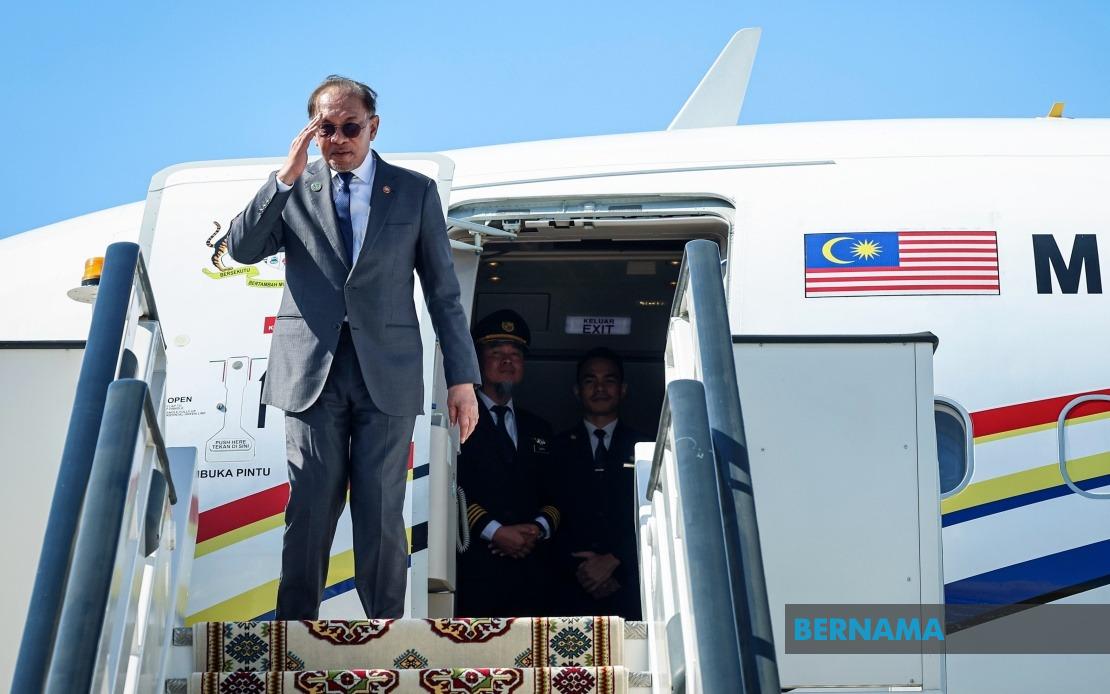
Prime Minister Datuk Seri Anwar Ibrahim touched down in Penang today after concluding a two-day official visit to Turkmenistan, the first such trip since he assumed office as Malaysia's 10th Prime Minister in November 2022. The high-energy itinerary reflects the government's simultaneous focus on foreign relations and domestic economic initiatives, underscoring how top-level diplomacy now runs parallel to regional development commitments. Anwar, who also holds the Finance Ministry portfolio, arrived having departed Ashgabat International Airport at 4.45 pm local time, transitioning seamlessly from Central Asian bilateral discussions to Penang's industrial and media landscapes.
The Prime Minister's Turkmenistan engagement, undertaken at the invitation of President Serdar Berdimuhamedov, followed his attendance at the 35th ASEAN-Russia Commemorative Summit in Kazan, Russia, where he was joined by Investment, Trade and Industry Minister Datuk Seri Johari Abdul Ghani and Economy Minister Akmal Nasrullah Mohd Nasir. This extended diplomatic circuit signals Malaysia's renewed engagement with non-traditional partners beyond ASEAN, potentially opening new avenues for trade, energy cooperation, and technological exchange. Turkmenistan's position as a major energy producer holds particular significance for Malaysia's long-term economic planning, especially as the country navigates energy transitions and seeks diversified supply chains beyond conventional regional sources.
Back on Malaysian soil, Anwar's packed Penang agenda commenced with the 11 am official opening of MKS Instruments Malaysia Sdn Bhd at Bandar Cassia Technology Park in Batu Kawan. The facility represents a significant investment in Malaysia's semiconductor and advanced instrumentation sector, industries that form critical components of the country's manufacturing and technology roadmap. Bandar Cassia Technology Park itself has emerged as a major hub for precision engineering and high-tech manufacturing, attracting multinational corporations seeking to establish or expand Southeast Asian operations. The government's emphasis on personally inaugurating such facilities underscores the strategic importance of attracting and retaining advanced manufacturing capabilities within Malaysia's industrial ecosystem.
Following the technology park opening, Anwar proceeded to Bandar Setia Fontaines in Kepala Batas at 1 pm for the groundbreaking ceremony of Setia Fontaines Industrial Park. This development, anchored within a larger township initiative, represents a comprehensive approach to industrial estate development that integrates manufacturing facilities with residential and commercial infrastructure. The project reflects Setia's stated long-term commitment to Penang's economic diversification and supports broader Northern Corridor development objectives. Beyond the primary groundbreaking, Setia announced two additional strategic collaborations within the Setia Fontaines township, suggesting coordinated investment and partnership expansion that could generate substantial employment and attract supply-chain integration across sectors.
The afternoon's centrepiece was Anwar's attendance at the HAWANA 2026 Grand Finale at PICCA Convention Centre @ Butterworth Arena, where approximately 1,000 media practitioners from Malaysia and international partners gathered. The National Journalists' Day programme, officially known as HAWANA, functions as Malaysia's premier recognition platform for journalism excellence and media professionalism. Organised by the Communications Ministry with Bernama, the Malaysian National News Agency, as implementing partner, the event celebrates contributions to public discourse and journalistic standards. In an era of information fragmentation and content proliferation, government-sponsored recognition of journalistic integrity carries particular weight, signalling institutional commitment to professional media standards and public-interest reporting.
During the HAWANA ceremony, Anwar presented both the HAWANA Award and Special HAWANA Award to individuals whose work has significantly advanced journalism and shaped public thought across Malaysia. These accolades serve multiple purposes: recognising individual excellence, reinforcing professional norms within the media industry, and demonstrating government engagement with independent voices. Alongside individual awards, the Prime Minister also presented contributions from Tabung Kasih@HAWANA to media practitioners facing financial hardship. This welfare component addresses economic vulnerabilities within the profession, acknowledging that journalism increasingly struggles with sustainable business models across Southeast Asia and globally.
The HAWANA platform itself has gained prominence as Malaysia's media landscape confronts simultaneous challenges: digital disruption eroding traditional revenue streams, misinformation proliferation complicating fact-based reporting, and evolving audience consumption patterns fragmenting news audiences. By convening 1,000 practitioners in a single venue, HAWANA creates rare opportunities for professional networking, peer recognition, and collective reflection on journalism's role in democratic governance. For Malaysia specifically, where media diversity and editorial independence remain contested terrain, public affirmation of journalistic values carries symbolic significance beyond ceremonial function.
Anwar's one-day Penang visit exemplifies how Malaysian political leadership now operates across multiple simultaneous registers: bilateral diplomacy in Central Asia, industrial investment attraction and ribbon-cutting in economic zones, and substantive engagement with professional communities and civil society. This condensed schedule, while operationally demanding, reflects modern governance expectations where prime ministerial presence signals institutional priority and attracts media attention that amplifies policy visibility. The progression from technology park opening through industrial park groundbreaking to media awards ceremony demonstrates interconnected thinking about economic competitiveness, industrial capability, and knowledge-worker ecosystems that depend on quality information and professional institutions.
The timing and sequencing also reveal calibrated messaging: foreign investment and industrial development appear as complementary rather than competing priorities, alongside government support for professional journalism. For regional investors and multinational corporations monitoring Malaysia's governance direction, simultaneous signals about infrastructure investment, technology sector openness, and media professionalism collectively constitute reassurance about institutional stability and predictable business environments. Penang's specific positioning within these narratives—as technology hub, industrial estate location, and venue for high-profile national events—reinforces the state's economic trajectory and competitiveness within Northern Corridor development frameworks.
Following his Penang engagements, Anwar remained in motion, scheduled to attend the Himpunan Pertubuhan Lima Generasi (PLG) Malaysia dinner in Negeri Sembilan the same evening. This relentless pace, spanning multiple states and diverse constituencies within a single calendar day, reflects the administrative intensity of contemporary prime ministerial responsibilities. Whether such intensity enhances or compromises governance quality remains a legitimate policy question, though Malaysian political culture has normalised such peripatetic leadership models as demonstrations of commitment and accessibility. The cumulative effect across such visits constructs a political narrative of active engagement, economic promotion, and investment in institutional health across multiple domains simultaneously.