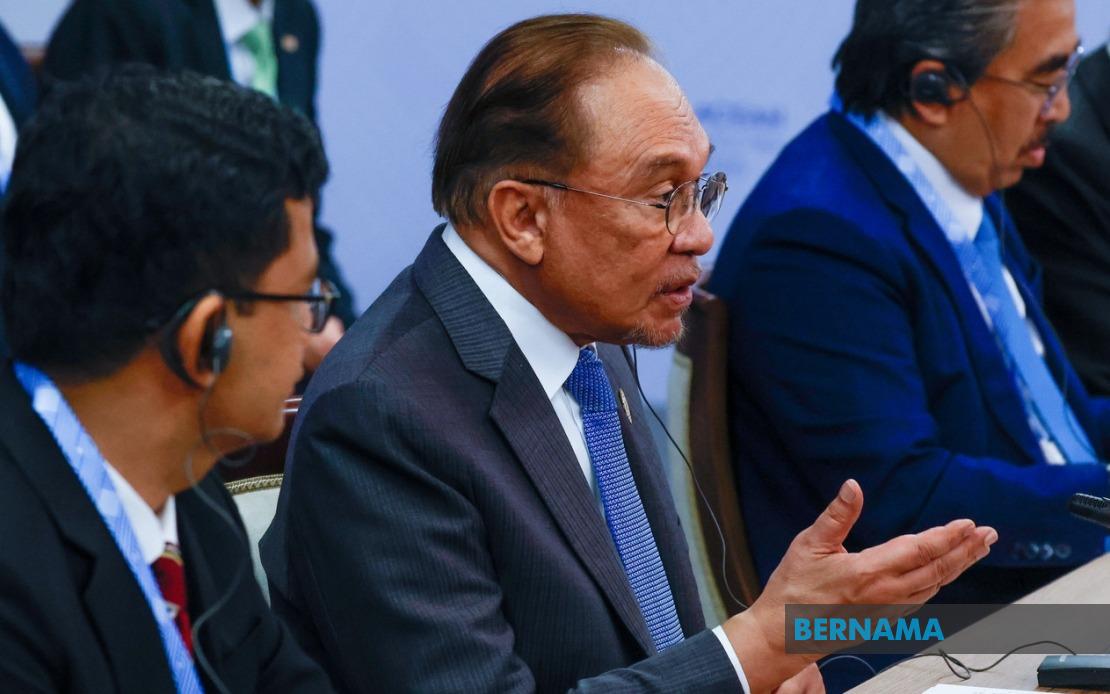
Malaysian Prime Minister Datuk Seri Anwar Ibrahim travelled to Kazan on Wednesday to meet Russian President Vladimir Putin, where he publicly praised Moscow's unwavering approach to two of the most consequential geopolitical flashpoints affecting the wider region. During their bilateral discussion, Anwar emphasised the significance of Russia's consistency in addressing both the Palestinian-Israeli conflict and the broader Iranian question, framing these positions as principled rather than merely tactical or reactive.
Anwar's remarks reflected Malaysia's broader diplomatic calculation regarding major power alignment in an increasingly multipolar world. By explicitly thanking Putin for Russia's stance on Gaza, the Malaysian leader signalled that Kuala Lumpur values Moscow's advocacy for Palestinian humanitarian interests and its calls for diplomatic resolution. Simultaneously, his reference to Iran suggested Malaysia views Russia's maintenance of dialogue channels with Tehran—despite Western sanctions and isolation efforts—as a stabilising force in regional affairs.
The Prime Minister articulated that Malaysians and many others across the global south admire Putin's consistency and conviction in maintaining these positions. This phrasing carried particular weight, as it positioned Malaysia within a broader coalition of nations that reject what they perceive as selective or hypocritical application of international principles by Western powers. For Malaysian domestic audiences, such remarks demonstrate the government's commitment to independent foreign policy and solidarity with developing nations on matters of principle.
Russia's position on Gaza has centred on repeated calls for humanitarian access corridors for Palestinian civilians, consistent demands for ceasefire agreements, and opposition to what Moscow characterises as disproportionate civilian casualties. Rather than engaging in the detailed diplomatic mechanics that some international mediators pursue, Russia has maintained a publicly sympathetic stance toward Palestinian grievances while simultaneously engaging in dialogue with all relevant parties. This approach has resonated with countries like Malaysia that maintain significant Muslim populations and face domestic pressure to demonstrate solidarity with Palestinian causes.
Moscow's relationship with Iran represents another dimension that attracted Anwar's commendation. Despite intense international pressure, particularly from the United States, Russia has preserved diplomatic and economic engagement with Tehran while publicly opposing military escalation in the region. Russia has advocated for negotiated solutions and dialogue mechanisms rather than confrontational approaches, viewing itself as a responsible power broker in regional security arrangements. For Malaysia and other Southeast Asian nations concerned about wider conflict spreading, Russia's restraint and diplomatic orientation offers reassurance.
Geopolitically, both Gaza and Iran occupy central positions in Middle Eastern dynamics that extend their influence beyond the region itself. These issues attract constant attention from major powers including the United States, Russia, and China, each pursuing distinct strategic interests. The Palestinian question remains symbolically significant across the Muslim world, while Iran's regional role intersects with shipping lanes, energy markets, and security arrangements affecting countries far beyond the Middle East, including those in Southeast Asia dependent on stable international commerce.
Anwar's visit to Kazan and his public endorsement of Russian positions also merit examination within Malaysia's broader strategic recalibration. Over recent years, Malaysia has sought to develop substantive relationships across multiple power centres—maintaining established ties with the West while deepening engagement with Russia, China, and regional powers. This multilateral approach reflects Kuala Lumpur's assessment that no single power will dominate the global order, and that smaller nations must preserve flexibility and avoid exclusive alignment blocs.
The bilateral meeting itself occurred against a backdrop of complex great power competition where middle powers like Malaysia face subtle pressure to choose sides on key issues. By publicly praising Russia's principled stance while simultaneously hosting a Russian President, Anwar demonstrated Malaysia's determination to maintain independent diplomatic agency. Such gestures carry domestic political value as well, reinforcing the government's narrative of protecting national sovereignty and advancing Malaysian interests on the international stage.
Russia's consistency on these issues has indeed been notable in international forums, where Moscow has repeatedly voted against or abstained from resolutions that it considers one-sided regarding Gaza, while simultaneously maintaining that dialogue rather than isolation represents the appropriate response to Iran. Whether such positioning influences actual outcomes on the ground remains debatable, but it has cemented Russia's standing among nations—particularly in the global south—that view Western-led international consensus with scepticism.
For Malaysia specifically, Anwar's public commendation of Russian positions serves multiple purposes: it reinforces Malaysia's independent foreign policy credentials domestically, signals to regional partners that Kuala Lumpur will not automatically align with Western positions on contested issues, and strengthens bilateral relations with an energy-rich nation with whom Malaysia maintains growing economic and security interests. The diplomatic emphasis on principled positions rather than strategic interests also allows Malaysian leadership to address domestic constituencies concerned about international justice and Palestinian rights.
Looking forward, such high-level endorsements of Russian foreign policy positions may encourage deeper Malaysia-Russia cooperation across diplomatic, economic, and security domains. The meeting underscores how countries across Asia and beyond are constructing foreign policies that resist simple categorisation as pro-West or pro-China, instead pursuing tailored engagements based on perceived national interests and alignment on specific issues.

%22%2F%3E%3C%2Fpattern%3E%3C%2Fdefs%3E%3Crect%20width%3D%22100%25%22%20height%3D%22100%25%22%20fill%3D%22url(%23ph40buhg)%22%2F%3E%3Crect%20width%3D%22100%25%22%20height%3D%22100%25%22%20fill%3D%22url(%23ph40buhp)%22%2F%3E%3Ctext%20x%3D%2250%25%22%20y%3D%2250%25%22%20text-anchor%3D%22middle%22%20dominant-baseline%3D%22central%22%20fill%3D%22rgba(255%2C255%2C255%2C0.95)%22%20font-family%3D%22Georgia%2C%20'Times%20New%20Roman'%2C%20serif%22%20font-weight%3D%22700%22%20font-size%3D%22320%22%20letter-spacing%3D%22-0.02em%22%3EGRS%3C%2Ftext%3E%3C%2Fsvg%3E)