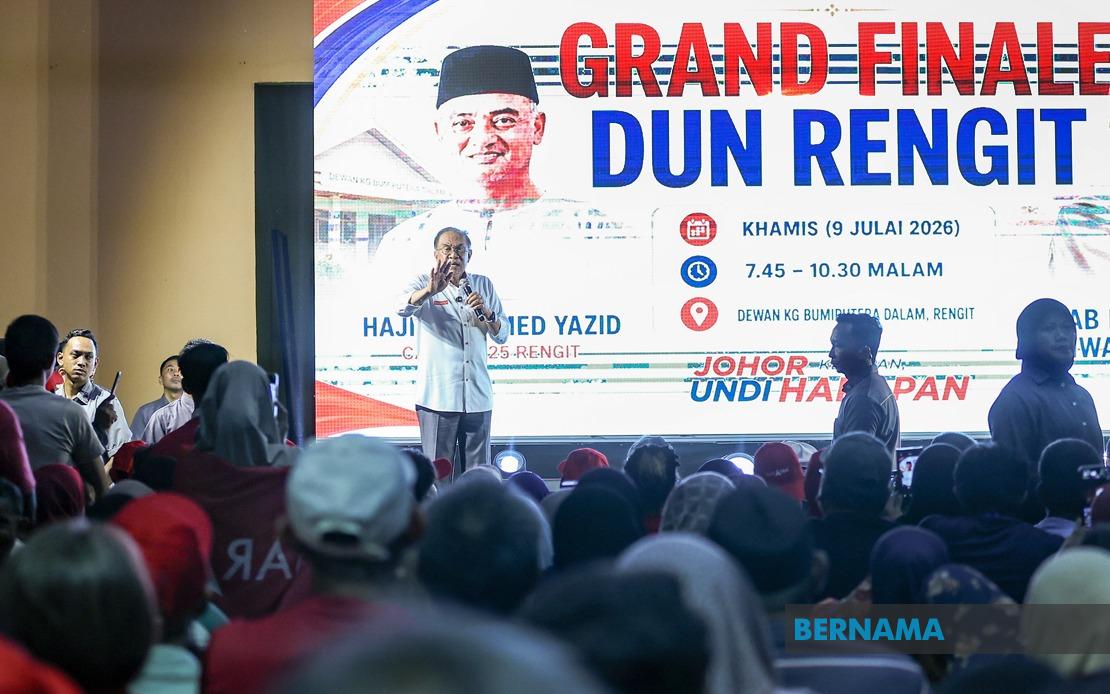
Prime Minister Datuk Seri Anwar Ibrahim has made sweeping commitments to tackle entrenched infrastructure failures in Rengit, declaring that the constituency's health and water crises demand immediate resolution. Speaking at a Pakatan Harapan campaign rally in Batu Pahat on Wednesday evening, Anwar positioned the upgrade of basic services as non-negotiable if Johor is to fulfil its status as a developed Malaysian state. The remarks underscored how fundamental amenities—often taken for granted in urban centres—remain contested political territory in less well-served communities.
The prime minister articulated a broader philosophy about state responsibility, arguing that clinics should serve the health needs of residents rather than themselves requiring repair. This reframing of infrastructure quality as a basic human right reflects the coalition's strategy of anchoring its campaign messaging on tangible service delivery rather than abstract political platforms. Anwar's intervention also signals federal government investment may follow a PH victory in Saturday's election, a calculation not lost on voters evaluating alignment with Kuala Lumpur's power structure.
Rengit's water supply disruptions and the condition of its health facilities represent chronic grievances that have festered across multiple election cycles. These are not marginal complaints but reflect systemic underinvestment in rural and secondary urban areas that state governments have historically deprioritised in favour of metropolitan zones. The fact that such elementary services require prime ministerial pledging suggests inadequate resource allocation or administrative capacity at the state level—questions that will haunt whoever assumes office after Saturday's polling.
Anwar's appearance in Rengit formed part of a intensive three-event canvassing schedule across Johor on the same evening, illustrating how federal leadership has become embedded in state-level campaigns. The presence of Sri Gading MP and Johor Amanah chairman Aminolhuda Hassan, alongside local PH candidate Yazid Abu Bakar, created a hierarchical political tableau designed to convey that voting PH would create direct pipelines to federal resources and attention. Such choreography has become standard in Malaysian electoral contests, yet its effectiveness depends on whether previous promises to similar constituencies have been honoured.
The Johor state election presents a particular test case for PH's governance record. The coalition is contesting all 56 state seats with a slate comprising 20 PKR candidates, 19 from Amanah, and 17 from DAP—a distribution that attempts to balance party interests while maintaining campaign unity. This broad contestation across every seat represents either confidence or desperation, depending on internal polling data not publicly disclosed. The cumulative field of 172 candidates across all parties will fragment voter choice, potentially creating opportunities for tight races where marginal mobilisation efforts yield outsized returns.
Anwar's framing of infrastructure as a rights-based issue carries particular resonance in Johor, where perceptions of development unevenness persist despite the state's relative prosperity compared to other Malaysian regions. Rural constituencies within Johor have experienced less dramatic transformation than urban manufacturing and port zones, generating legitimate grievances about resource distribution. The prime minister's statement that water, housing, education, and healthcare must remain government priorities reads as both aspirational and implicitly critical of previous neglect—whether at state or federal level remains deliberately ambiguous.
The campaign rally also included what amounted to an anti-corruption sermon directed at government officials and community leaders, with Anwar warning against position abuse for personal enrichment. This messaging serves a dual purpose: it reinforces PH's self-positioning as an anti-establishment force despite being the incumbent federal government, while simultaneously inoculating the coalition against accusations of cronyism that regularly surface in Malaysian political discourse. Such rhetoric works best when targeted at opposition-controlled institutions, though Johor's political landscape has shifted significantly since the previous state election.
The timing of these commitments—delivered days before voting—naturally invites scrutiny about implementation timelines and resource commitment. Malaysian voters have witnessed numerous pre-election promises regarding infrastructure that subsequently encountered bureaucratic delays, budget reallocations, or changes in political circumstances. The credibility of Anwar's pledges depends partly on PH's track record in delivering similar commitments elsewhere, a mixed historical record that includes both achievements and notable shortfalls. Rengit residents will be evaluating not just the promise but the likelihood of follow-through based on patterns they have observed.
For Johor more broadly, the state election represents a significant realignment opportunity. The political landscape has become considerably more fluid since 2018, with shifting coalitions and unexpected reversals creating uncertainty about which political forces will ultimately control the state apparatus. Anwar's personal intervention in campaign rallies suggests the federal government views Johor as strategically vital, particularly given the state's economic importance and its role as a political bellwether for broader national trends. A strong PH showing would consolidate federal government control and enable coordinated policy implementation across multiple governance levels.
The Rengit campaign stop exemplifies how Malaysian electoral contests have become increasingly nationalised, with prime ministerial presence and federal government promises shaping state-level races. This centralisation of campaign messaging around infrastructure and service delivery reflects genuine voter concerns about basic amenities but also reveals how state governments have struggled to independently address fundamental service provision. Whether Saturday's election produces substantive improvements in Rengit's water and health infrastructure will ultimately determine whether voters regard such campaign pledges as credible commitments or routine political theatre.

