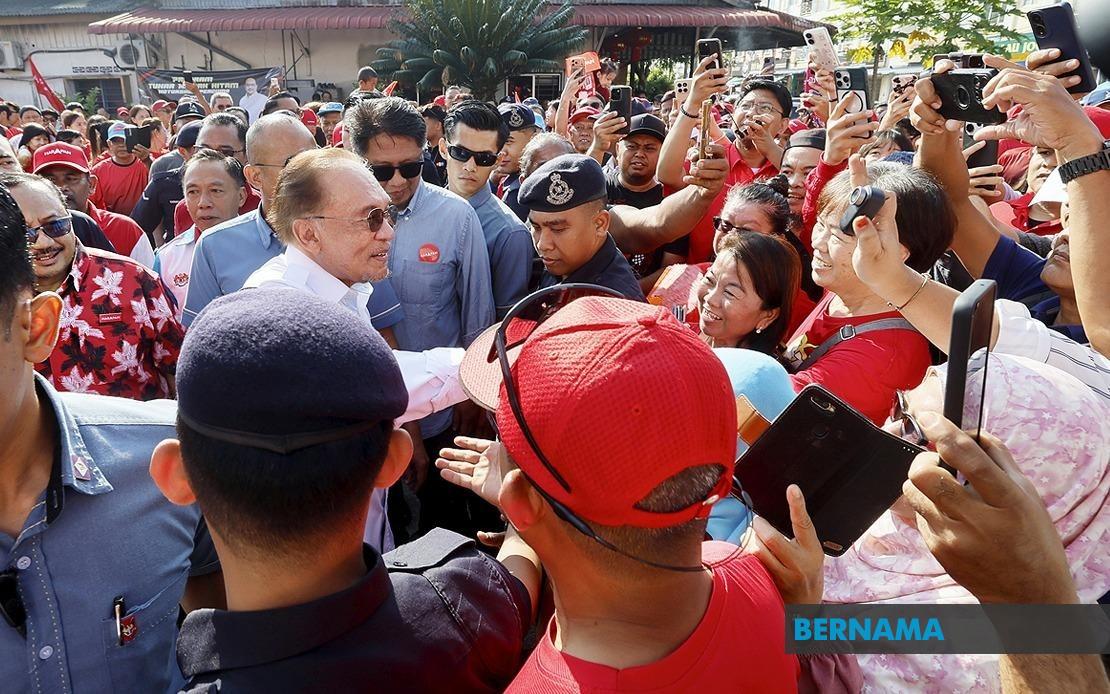
Prime Minister Datuk Seri Anwar Ibrahim has sought to dispel concerns about regional disparities in federal support, asserting that his administration provides assistance to all states on an equal footing without regard for their political complexion. Speaking at a campaign event in Batu Pahat on July 9, Anwar underscored the government's track record of implementing development initiatives and major infrastructure undertakings throughout the nation, demonstrating a commitment to nationwide prosperity rather than partisan advantage.
The assertion comes at a particularly significant juncture, as the Federal Government navigates the delicate politics of intergovernmental relations across Malaysia's demographically and politically diverse landscape. State governments controlled by opposition parties have historically expressed concerns about receiving proportionate allocations from the centre, a grievance that Anwar's remarks appear designed to address. By explicitly referencing projects in states of varying political composition—Johor, Kelantan, and Kedah—the Prime Minister sought to construct a narrative of impartial governance.
The Johor-Singapore Special Economic Zone represents a flagship project showcasing federal investment in critical economic infrastructure. This cross-border initiative carries substantial strategic importance for Malaysia's broader regional trade objectives and long-term economic positioning within Southeast Asia. The project's advancement reflects Anwar's stated priority of leveraging bilateral partnerships for shared prosperity, a theme he has repeatedly emphasised throughout his tenure.
Beyond economic zones, Anwar highlighted substantial federal commitments to flood mitigation infrastructure, specifically in Segamat and Muar, towns that have faced recurrent flooding challenges. These allocations, described as running into billions of ringgit, address a fundamental governance concern: public safety and disaster resilience. Flood management has emerged as an increasingly pressing issue across Malaysia, particularly in states vulnerable to seasonal inundation, making such investments politically and socially significant indicators of federal responsiveness to genuine community needs.
Anwar's comments carry particular weight given the upcoming 16th Johor state election, for which the campaign event was conducted. The timing and content suggest an effort to persuade Johor voters that a Federal Government led by Pakatan Harapan will not discriminate against states based on electoral outcomes. This messaging proves crucial in a state where political dynamics remain fluid, with voters evaluating whether their interests are genuinely served by the incumbent federal coalition.
The Prime Minister explicitly contrasted his administration's approach with what he characterised as the traditional pattern of electoral-cycle politics, wherein governments offer assistance primarily during campaign seasons before withdrawing engagement. By claiming to have undertaken genuine development initiatives across states since assuming office, Anwar attempted to differentiate his tenure as delivering substantive, sustained benefits rather than performative gestures timed to electoral calendars.
Anwar's dual roles as Prime Minister and Pakatan Harapan chairman add complexity to such pronouncements. While his statement emphasises non-partisan governance, his participation in state election campaigning inherently involves partisan activity. This duality reflects the broader challenge facing any ruling coalition: balancing the principles of equitable federalism with the practical imperatives of electoral competition. For Malaysian voters, particularly those in opposition-controlled states, assessing the credibility of such pledges requires examining concrete outcomes rather than rhetorical commitments.
The presence of Communications Minister Datuk Fahmi Fadzil at the event, alongside parliamentary candidates for three Johor constituencies, underscored the calibre of attention the Federal Government is directing toward the state election. Johor's political significance extends beyond its electoral weight; it represents a crucial manufacturing and logistics hub whose economic trajectory influences broader regional prosperity. Federal investments in Johor thus carry implications extending beyond state boundaries.
For Malaysia's political economy more broadly, questions of resource distribution between federal and state governments remain contentious. States governed by opposition parties sometimes report experiencing constraints in accessing development grants or federal cooperation, though causation remains disputed. Anwar's statements suggest an attempt to reset expectations and establish a framework wherein state political affiliation should prove irrelevant to federal responsiveness. Whether this translates into measurable policy changes and resource allocation patterns will ultimately determine the credibility of such assurances among voters and opposition-led administrations.
The underlying tension that Anwar's remarks address reflects Malaysia's constitutional arrangements, which vest significant autonomy in state governments whilst concentrating revenue-collection capacity at the federal level. This structural imbalance creates recurring friction over resource transfers and development prioritisation. How effectively the current federal administration navigates these dynamics will influence both its electoral prospects and the quality of centre-state relations throughout its tenure.
Looking forward, the credibility of Anwar's equity pledge will be tested through observable metrics: the pace and scale of project implementation across politically diverse states, the transparency of fund allocation mechanisms, and the responsiveness of federal agencies to state-level requests regardless of political composition. Malaysian voters, increasingly sophisticated in demanding accountability, will likely assess performance against promises in evaluating the Federal Government's future electoral prospects.

