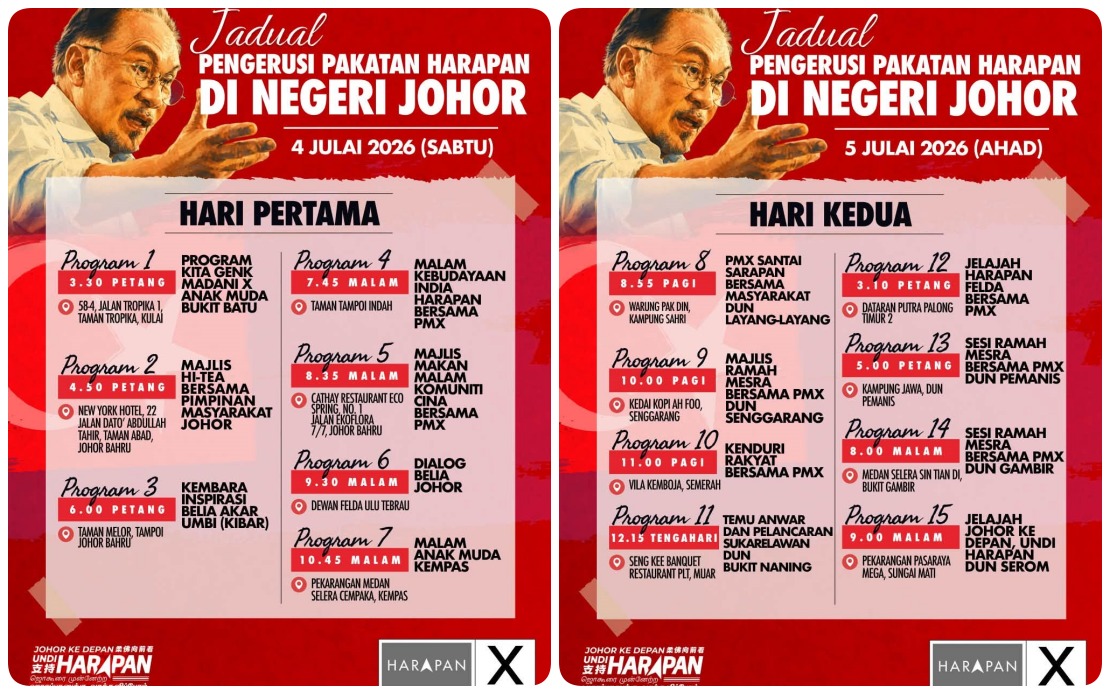
Prime Minister Datuk Seri Anwar Ibrahim is throwing the full weight of Pakatan Harapan's campaign machinery behind the coalition's bid to retain control of Johor, embarking on an intensive two-day schedule featuring fifteen separate campaign events across the state. The seven programmes scheduled for July 4 represent a strategic geographical spread designed to maximise grassroots contact and rebuild momentum heading into the final week before polling day on July 11.
Anwar's campaign itinerary, as posted on his official Facebook page, reflects the sophisticated voter targeting approach that has become increasingly important in Malaysian state elections. The morning session begins with direct voter engagement at a community venue, establishing the personal connection that polling data consistently shows influences undecided voters in state contests. This ground-level approach contrasts sharply with the more formal, stage-managed rallies that often characterise national campaigns, allowing the Prime Minister to project an accessible image whilst simultaneously demonstrating his party's organisational capacity.
The afternoon programme includes a high tea reception with Johor community leaders at a Johor Bahru hotel at 4:50 pm, an event designed to consolidate support among the state's professional classes, business owners, and established civic figures. These intimate gatherings serve multiple purposes within campaign strategy: they generate favourable media coverage, allow leadership to address specific sectoral concerns, and reinforce perceptions of stability and broad-based support. The deliberately diverse guest list signals Pakatan Harapan's intention to present itself as a coalition governing for all communities, not merely its traditional base.
Youth engagement represents a critical component of this campaign phase, with a dedicated Johor Youth Dialogue scheduled for 9:30 pm at Felda Ulu Tebrau Hall. This programming choice reflects lessons learned from previous Malaysian elections where younger voters have proven simultaneously critical to victory yet notoriously difficult to mobilise. By dedicating specific events to this demographic rather than expecting youth attendance at general rallies, Pakatan Harapan signals organisational sophistication and genuine commitment to addressing youth concerns—employment, education accessibility, housing affordability—that consistently rank as priorities in voter surveys across Malaysia.
The intensity of this campaign phase cannot be separated from the electoral mathematics of the 16th Johor state election. Pakatan Harapan is contesting all 56 state assembly seats, committing resources across the entire state rather than concentrating narrowly on winnable constituencies. The coalition's candidate distribution—20 from PKR, 19 from Amanah, and 17 from DAP—reflects carefully negotiated seat-sharing arrangements that have historically proven contentious within the three-party alliance. These arrangements become publicly visible during campaigns, and Anwar's high-profile personal involvement serves to reinforce the public narrative that leadership fully supports agreed allocations and expects party grassroots to deliver.
The broader competitive environment shapes campaign strategy considerably. A total of 172 candidates are contesting across the 56 seats, indicating that most constituencies feature four-cornered contests at minimum. This fragmentation of the opposition vote theoretically benefits the governing coalition, but only if its machinery can convert voter sympathy into actual ballot-box turnout. The scheduling of seven events in a single day, with eight additional programmes following, demonstrates the coalition's conviction that superior organisational resources and leadership visibility can translate into victory.
Logistical and strategic considerations underpin this compressed campaign schedule. Early voting commences on July 7, meaning three days separate the peak campaign activity from the commencement of voting. Malaysian electoral dynamics increasingly demonstrate that voter decisions crystallise relatively late in campaigns, making the final week critical for addressing undecided voters and reinforcing support among the party base. The concentration of Anwar's personal schedule into this period reflects calculations about maximising impact when voter attention reaches peak levels.
Anwar's personal involvement in state-level campaigns carries distinct symbolic weight in contemporary Malaysian politics. As Prime Minister leading a coalition government, his presence legitimises local candidates, signals federal support for state governance, and demonstrates that the party hierarchy considers Johor sufficiently important to warrant top-leadership attention. This becomes particularly significant given Johor's status as Malaysia's second-largest state by population and its historical importance within Malay-Muslim politics and Malaysian federalism more broadly.
The itinerary's careful temporal distribution—morning voter engagement, afternoon community leadership reception, evening youth dialogue—reflects professional campaign management principles aimed at maximising reach across distinct voter segments. Rather than concentrating events during traditional evening rally hours when working-age voters face constraints, this schedule attempts to capture engagement windows when different demographic groups remain accessible. The inclusion of a Felda-focused youth session specifically targets rural and semi-rural younger voters, communities that historically have received less direct campaign attention from national party leadership.
Looking beyond the immediate two-day campaign blitz, Anwar's personal presence sets the template for how lower-tier party leaders should structure their own campaign activities. When top leadership demonstrates commitment to ground-level voter contact, grassroots machinery typically responds with corresponding intensification. This cascading effect multiplies the impact of the Prime Minister's schedule across the broader party structure, transforming his personal seven events into touchstones for hundreds of concurrent party activities happening simultaneously across constituencies.
The psychological dimension of campaign scheduling warrants consideration. Visible, intensive personal campaigning by the Prime Minister conveys confidence in electoral prospects and commitment to victory. Conversely, reduced leadership visibility might signal internal doubts or resource constraints. By flooding the campaign terrain with high-profile events, Pakatan Harapan broadcasts organisational vitality and leadership determination, messages that influence voter perception of momentum and electoral likelihood beyond the specific policy content discussed at individual events.
For Malaysian voters observing state elections through the prism of national politics, Anwar's Johor campaign intensity carries implications beyond the 56 contested seats. Strong state-level performance reinforces the Prime Minister's political narrative of revitalised governance and expanded coalition support. Conversely, setbacks in Johor would complicate his authority within a Pakatan Harapan coalition that has historically proven faction-prone. This explains why the Prime Minister's personal campaign calendar reflects not merely pragmatic considerations about voter contact, but deeper strategic stakes about coalition stability and political renewal under his leadership.

