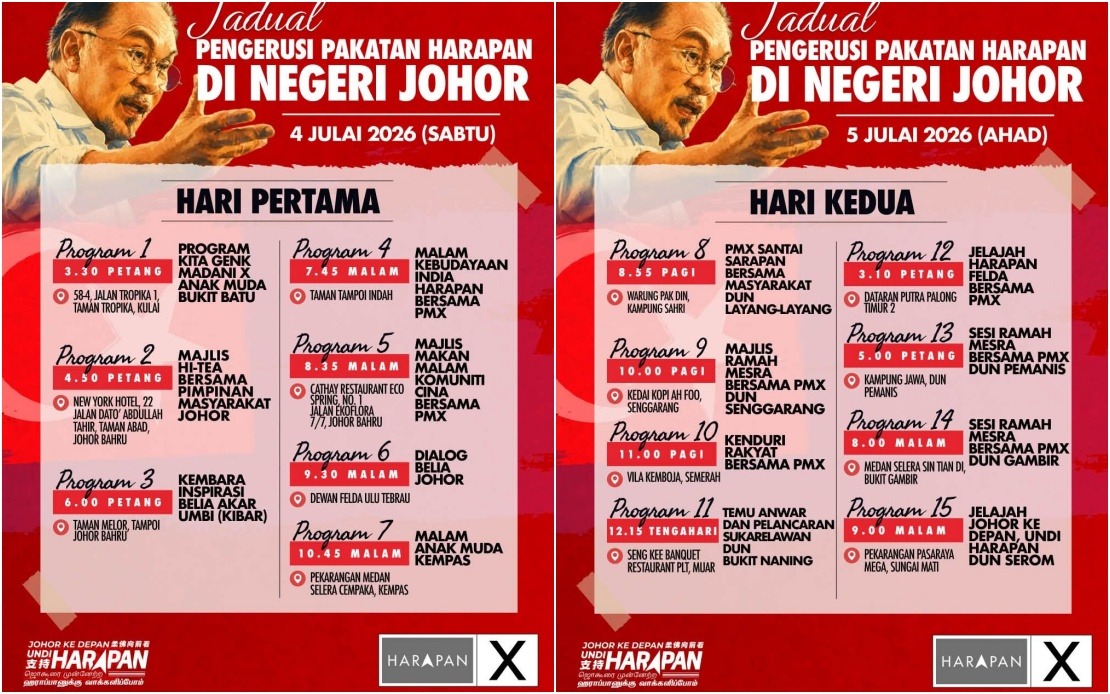
Pakatan Harapan chairman Datuk Seri Anwar Ibrahim is throwing his full political weight behind the coalition's campaign in Johor, planning to conduct 15 separate campaign events across the state over this coming weekend. The intensive schedule underscores the coalition's determination to retain control of one of Malaysia's most politically consequential states, where 56 PH candidates will contest in the 16th state election. Through a Facebook announcement, Anwar has invited all Johor voters to participate in the weekend programmes, signalling a broad-based mobilisation effort ahead of the July 11 polling day.
The scope of Anwar's itinerary reveals a carefully choreographed campaign strategy targeting multiple demographic constituencies across Johor's diverse communities. His Saturday schedule begins in Kulai with the Kita Genk MADANI x Anak Muda Bukit Batu event at 3.30 pm, immediately followed by a hi-tea gathering with community leaders in the afternoon. This opening salvo establishes a pattern of combining grassroots engagement with structured community interaction, a proven mechanism for broadening PH's appeal beyond core supporters. The programme then transitions into evening activities, where cultural and community-specific events take centre stage.
The evening sessions reflect PH's deliberate strategy to engage Johor's multicultural fabric. A cultural night event held at Taman Tampoi Indah at 7.45 pm targets the Indian community, whilst a separate Chinese community dinner scheduled for 8.35 pm demonstrates the coalition's commitment to maintaining support among both communities. These ethnically-focused gatherings have become standard campaign practice in Johor, where retaining minority community backing has historically proven decisive in tight electoral contests. The inclusion of youth-oriented programming, including a youth dialogue at Dewan Felda Ulu Tebrau and a dedicated young voters' event in Kempas at 10.45 pm, underscores PH's recognition that generational engagement remains critical to consolidating electoral support.
Sunday's schedule maintains similar intensity whilst shifting emphasis towards grassroots constituency work. A breakfast gathering in the Layang-Layang constituency at Warung Pak Din represents a return to informal, community-level campaigning that builds personal connections between senior party leadership and ordinary voters. This approach contrasts sharply with formal rally politics, instead prioritising intimate engagement that allows voters to articulate local concerns directly to party leadership. The meet-and-greet at Dewan Undangan Negeri Senggarang and the kenduri rakyat at Semerah continue this template, creating multiple touchpoints for voter interaction across different constituencies.
The breadth of Anwar's weekend campaign across constituencies including Senggarang, Semerah, Bukit Naning, Pemanis, Gambir, and Serom demonstrates PH's strategic prioritisation of specific battleground areas. These constituencies likely represent marginal seats where the coalition believes intensive leadership presence can move voter sentiment, or alternatively, seats where consolidating existing support has become paramount. The scheduling pattern—with morning events commencing at breakfast and continuing throughout the day until late evening—suggests an exhausting but comprehensive approach designed to maximise media coverage and voter exposure across the broadest possible timeframe.
The inclusion of FELDA-related events and the specific focus on rural constituencies indicates PH's awareness of the Orang Asli and rural settler vote's continued importance in Johor elections. FELDA settlements have historically represented swing constituencies where federal policies directly affect voter livelihoods, making these communities particularly receptive to direct engagement from national party leadership. Anwar's attendance at multiple FELDA-connected events suggests the coalition is mounting a determined effort to neutralise any perception that it neglects agricultural constituencies in favour of urban-centric policies.
From a broader campaign perspective, Anwar's personal participation across 15 separate events within a two-day window demonstrates the strategic calculation that the PH chairman's presence carries tangible electoral value in Johor. Unlike some coalition members who might delegate campaign responsibilities to state-level leaders, Anwar's presence signals national importance and reinforces the narrative that Johor's election carries consequences for federal politics. This approach also allows PH to generate multiple media hooks across different constituencies, maximising campaign visibility in what remains a fiercely competitive electoral marketplace.
The timing of this campaign blitz—conducted just over a week before the July 11 polling day—positions these events as the final mobilisation push designed to convert undecided voters and ensure maximum turnout among PH supporters. Early voting on July 7 adds urgency to the weekend campaign, as voters eligible for advance balloting might make their decisions based on campaign momentum and messaging received during this period. The concentration of events suggests PH strategists believe this final intensive push can move voter behaviour at critical junctures in the campaign calendar.
For Malaysian political observers, Anwar's weekend campaign exemplifies the personalised leadership approach that has become characteristic of contemporary Malaysian electoral politics. Rather than relying solely on institutional party machinery, senior political figures now routinely undertake physically demanding campaign schedules that test their stamina and commitment. This practice, whilst potentially gruelling, generates authentic political theatre that resonates with voters who increasingly expect direct personal engagement from their leaders. Anwar's willingness to commit two consecutive days entirely to Johor campaign events sends a powerful symbolic message about PH's seriousness regarding state-level electoral performance.
The Johor election holds particular significance within Malaysia's broader political landscape, as the state's coalition preferences have frequently foreshadowed national electoral trends. A strong PH performance would reinforce the coalition's legitimacy at the federal level and potentially influence voter calculations in other remaining state elections. Conversely, any significant erosion of PH support in Johor could trigger strategic recalculations among coalition members and embolden opposition forces nationwide. Against this backdrop, Anwar's intensive personal campaign investment reflects the electoral stakes that extend far beyond Johor's borders.
The coordination of 15 distinct campaign events also requires substantial logistical resources, reflecting the organisational capacity that PH maintains across Johor's sprawling geography. Managing transportation, security, crowd coordination, and media presence for such an intensive schedule demands sophisticated operational planning. The involvement of local party machinery, community organisations, and volunteer networks alongside national party leadership creates an integrated campaign apparatus that demonstrates PH's structural advantages in Johor despite whatever electoral headwinds it might face nationally. This bottom-up and top-down coordination has become a defining feature of competitive state elections in Malaysia, where electoral competition increasingly depends on demonstrating superior organisational prowess alongside policy substance.

