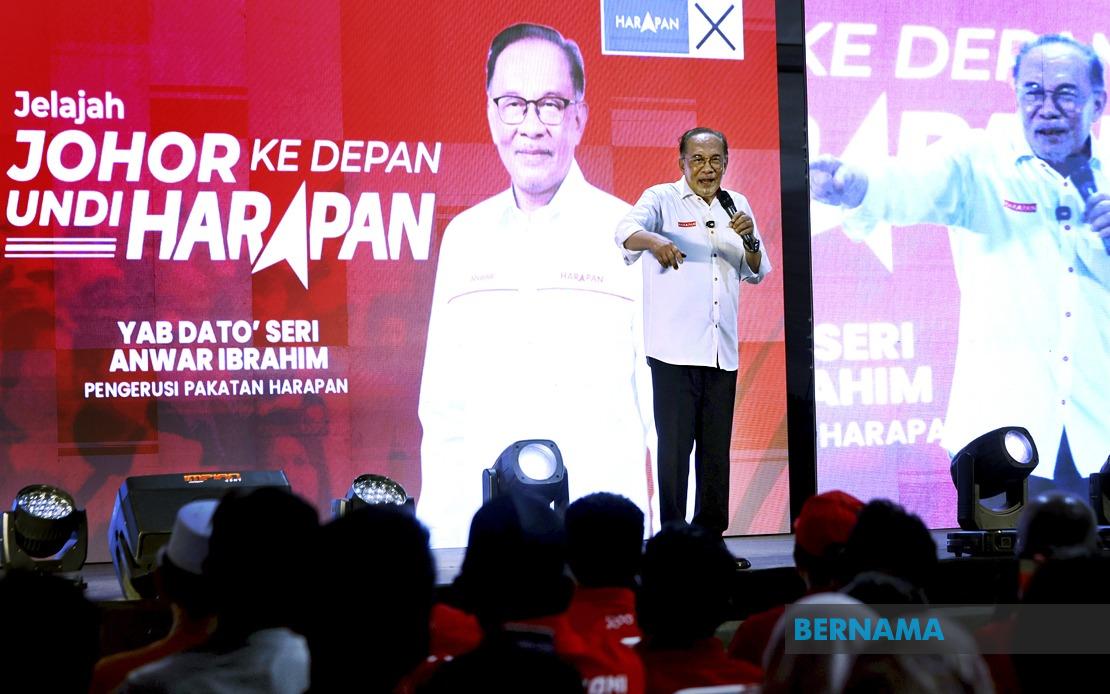
Prime Minister Datuk Seri Anwar Ibrahim has drawn a clear line under Malaysia's past, declaring that the era of systematic corruption and politically-motivated enrichment is finished. Speaking at a campaign event in Sungai Mati during the Johor State Election drive, Anwar outlined his MADANI Government's resolve to fundamentally reshape the nation's governance culture by removing the institutional rot that allowed well-connected individuals to plunder state resources with impunity. The remarks underscore a defining theme of his administration: that restoring public trust depends entirely on demonstrating that accountability applies uniformly, without exemptions for the powerful or well-connected.
The Prime Minister's emphasis on administrative cleanup reflects recognition that Malaysia's development trajectory has been undermined by endemic corruption that distorted resource allocation and eroded institutional integrity. By framing the fight against graft as essential to national progress, Anwar positioned anti-corruption not merely as a moral imperative but as a practical necessity for Malaysia to maintain global competitiveness and investor confidence. This framing carries particular weight given Malaysia's standing in international corruption indices and the persistent perception among foreign observers that cronyism remains embedded in procurement and licensing decisions.
Anwar's statement that he wants "Malays who are good, honest and not corrupt to become leaders" and similarly "Chinese who are good and not corrupt to become leaders" attempts to reframe leadership selection around merit and integrity rather than communal identity. This approach directly challenges the narrative promoted by certain opposition figures who exploit ethnic sensitivities to mobilise voters. By insisting that character transcends racial categories, the Prime Minister signals that the MADANI Government rejects the zero-sum ethnic politics that have historically enabled corrupt figures to escape accountability by claiming victimhood or portraying scrutiny as communal targeting.
The specific indictment of family enrichment through government contracts—the practice of directing business opportunities to relatives or awarding deals to spouses—points to patterns documented during previous administrations. Anwar's explicit renunciation of such arrangements suggests that any similar conduct within the current government would face swift consequences, setting a standard that predecessors largely ignored. For Malaysian voters, particularly younger cohorts skeptical of traditional politics, such declarations matter primarily insofar as they are followed by demonstrable action against cabinet members or senior officials implicated in malfeasance.
Anwar's assertion that opposition pressure is driven by personal interest in regaining federal control, rather than principled concern for governance standards, reflects the intense political competition surrounding anti-corruption messaging. Both government and opposition claim to champion integrity, yet voters struggle to distinguish rhetoric from genuine commitment. The upcoming Johor State Election, in which 172 candidates contest 56 seats with polling scheduled for July 11, provides a near-term test of whether voters believe the MADANI Government's anti-corruption platform. Johor, as Malaysia's second-largest state economically, historically reflects broader national sentiment and carries outsized weight in determining the government's political trajectory.
The Prime Minister's guarantee that no individual will receive state protection if found corrupt is necessarily a pledge about systemic behaviour rather than isolated promises. Institutional anti-corruption frameworks—independent prosecution authorities, transparent procurement processes, merit-based civil service advancement, and rigorous asset declaration enforcement—ultimately determine whether such assurances translate into practice. Malaysia's recent history shows that political commitment alone proves insufficient without structural mechanisms that constrain discretionary decision-making and create genuine consequences for violations.
For Southeast Asian observers, Anwar's emphasis on cleaning administrative systems reflects a regional pattern in which new governments inherit bureaucratic structures compromised by predecessors' patronage networks. The challenge across the region lies in dismantling entrenched networks of mutual obligation and benefit-sharing without simultaneously destabilizing state capacity or triggering political backlash from beneficiaries of existing arrangements. Malaysia's experience will likely influence how other governments in the region approach similar transitions, particularly given Malaysia's relative institutional sophistication and regional prominence.
The context of the Johor campaign itself matters significantly. By making anti-corruption a central campaign message across 15 engagements over two days, with support from Penang Chief Minister Chow Kon Yeow and Ledang MP Syed Ibrahim Syed Noh, Anwar signals that Pakatan Harapan views clean governance as its competitive advantage against potential challengers. This strategy assumes voters prioritize integrity over other considerations—a bet that polling trends may validate or undermine as campaign messaging continues through the state election.
Anwar's framing of the corruption fight as necessary for Malaysia to "continue progressing and earn global respect" acknowledges that international perceptions shape investment decisions, technology transfers, and diplomatic influence. Countries perceived as systemically corrupt face higher borrowing costs, reduced foreign direct investment, and diminished soft power. This economic dimension extends beyond moral philosophy to national interest, making anti-corruption policy central rather than peripheral to development strategy.
The practical implications for Malaysian governance remain to be seen. Corruption cases already in the pipeline—involving former officials and members of previous administrations—will test whether the government's anti-corruption commitment withstands political pressure, bureaucratic resistance, or legal complexity. Simultaneously, maintaining public service effectiveness while purging corrupt elements requires careful management; overly aggressive purges risk destabilizing state capacity, whilst insufficient action reinforces skepticism about the government's sincerity.
For voters in Johor and across Malaysia, distinguishing genuine reform from political positioning depends on sustained monitoring of specific outcomes: conviction rates, recovered assets, transparent procurement outcomes, and civil service performance metrics. Anwar's statements provide the benchmark against which his government will ultimately be judged. Whether the MADANI administration translates current pledges into irreversible institutional change will determine not only its political legacy but also Malaysia's trajectory toward the transparent, merit-based governance necessary for sustained development and regional leadership.

