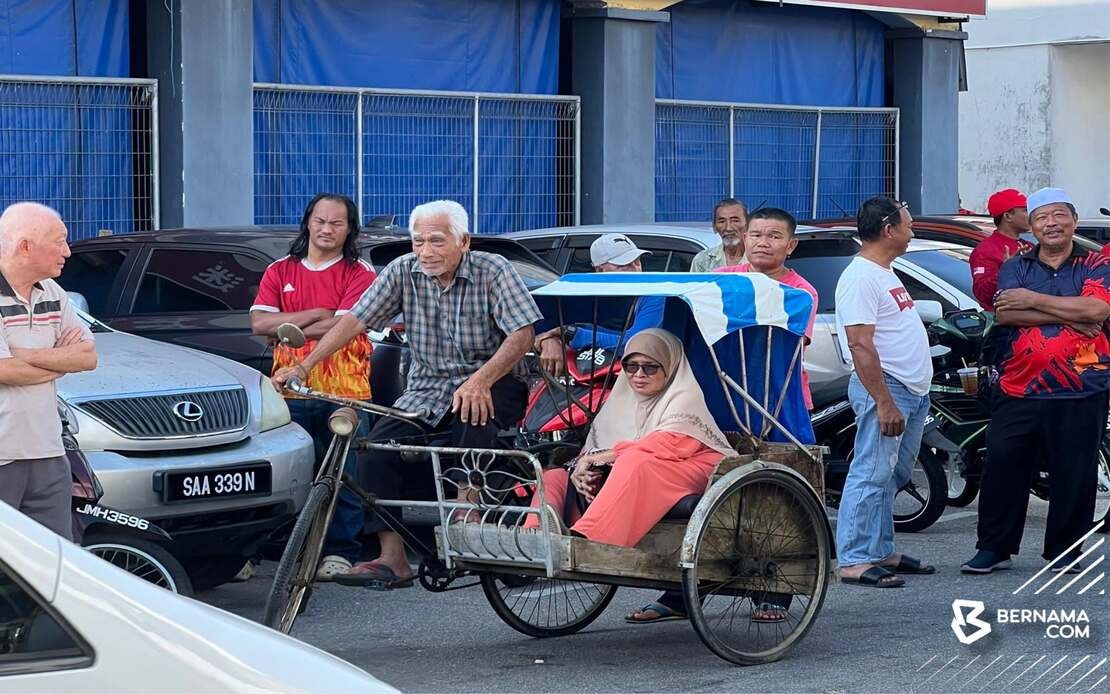
Prime Minister Datuk Seri Anwar Ibrahim has publicly acknowledged the touching gesture of an elderly couple who went to considerable lengths to see him during his recent campaign appearance in Johor. In a social media statement, Anwar expressed profound gratitude towards Abdul Razak Pelangga, 86, who made the decision to transport his wife by trishaw from their village home to meet the nation's leader, though circumstances prevented a face-to-face encounter on the day.
The couple's journey took them from Kampung Parit Bugis to Kedai Kopi Hailam Sri Medan in Senggarang, Batu Pahat, covering nearly a kilometre by human-powered vehicle after Abdul Razak learned of Anwar's scheduled breakfast stop during a meet-and-greet programme. The decision to use a trishaw rather than alternative transport options reflects both the couple's determination and their practical considerations about the logistics of the visit.
According to the imam of Masjid Raudhatul Jannah Parit Bugis, Abdul Razak had deliberately chosen the trishaw over driving a car or riding a motorcycle, reasoning that avoiding potential parking difficulties justified the more laborious but ultimately simpler mode of transport. This choice underscores how ordinary Malaysians sometimes navigate the trade-offs between convenience and certainty, particularly when motivated by an opportunity to demonstrate support for political leadership.
Anwar's response, conveyed through a Facebook post, struck a tone of genuine regret at missing the opportunity to greet the couple in person during his time at the eatery. His message included an apology for the missed encounter and an expression of hope that future circumstances would permit a proper meeting between them. The prime minister's public acknowledgment of their effort suggests recognition of the significance attached by constituents to direct engagement with national leaders.
The encounter occurred during Anwar's visit to the Senggarang state constituency, part of broader campaign activities connected to the Johor State Election. The prime minister spent approximately 50 minutes at the breakfast venue engaging with local residents through a structured meet-and-greet format, allowing him to connect with constituents across various demographics and backgrounds during the election period.
For Malaysian readers, this incident captures a broader pattern in the country's political culture whereby citizens demonstrate commitment to their preferred leaders through personal gestures and significant effort. The couple's journey, undertaken by an octogenarian, highlights the emotional dimensions of political engagement beyond voting and formal participation. Such moments resonate particularly in smaller towns and rural constituencies where direct access to national figures remains relatively uncommon.
The story also reflects the enduring role of traditional transport in Malaysian communities, particularly in smaller towns like Batu Pahat where trishaws remain functional vehicles rather than purely touristic attractions. The couple's choice to use this mode of transport, while unusual in the context of modern Malaysian infrastructure, demonstrates its continued relevance in daily life outside major urban centres.
Anwar's response, framed through invocations of Islamic sentiment with phrases invoking divine blessing, demonstrates the integration of religious language into Malaysian political communication. His prayer for the couple's health and prosperity reflects conventions of political discourse in Malaysia where spiritual and secular concerns are routinely woven together in public statements.
From a broader Southeast Asian perspective, this incident illustrates how direct engagement with political leadership remains highly valued across the region, despite technological advances that enable remote communication. The human desire to witness leaders in person continues to motivate significant personal effort, suggesting that politics at the grassroots level retains its fundamentally personal character even in contemporary Malaysia.
The missed meeting, while disappointing for all involved, became significant precisely because it was publicly acknowledged and addressed by the prime minister. This transformation of a missed encounter into a meaningful public exchange demonstrates how modern communication tools enable politicians to extend their reach beyond immediate physical presence, converting logistical failures into opportunities for broader connection with constituents.

