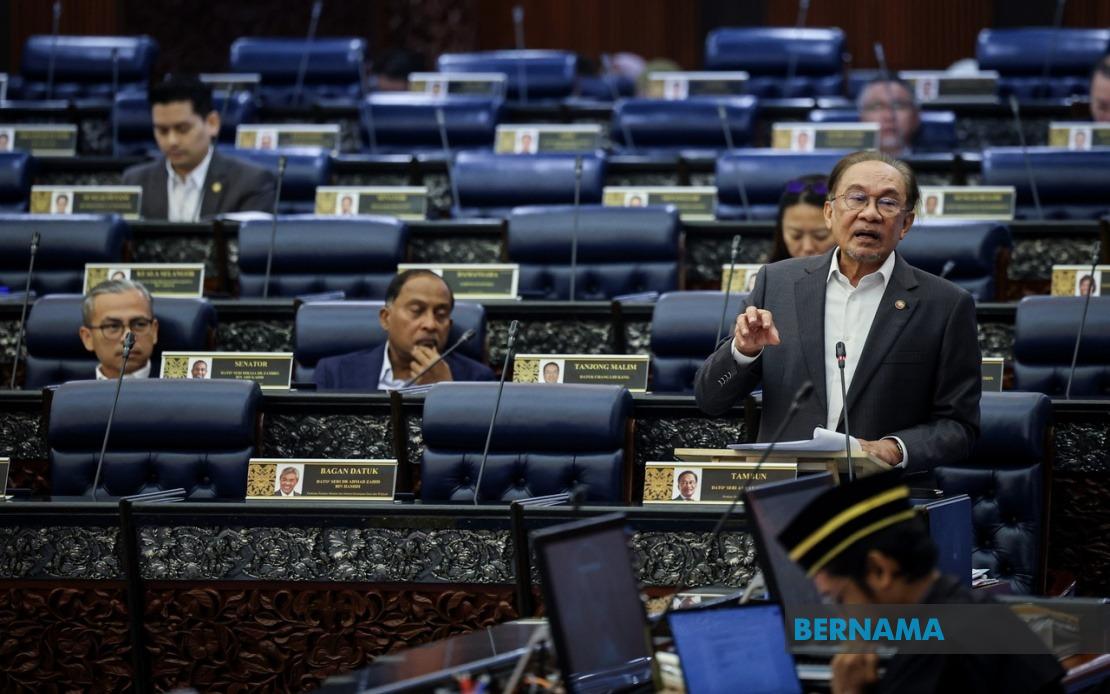
Prime Minister Datuk Seri Anwar Ibrahim moved to distance himself from suggestions he had sought to sway the Election Commission's determination of polling dates for the Johor state election, insisting his publicly aired preferences reflected nothing more than a private viewpoint aimed at maximising democratic participation. Speaking during parliamentary question time, he underscored the electoral body's institutional autonomy while acknowledging his stated belief that conducting polling on Sunday rather than Saturday would accommodate Malaysian workers based across the border in Singapore more effectively.
The clarification emerged in response to parliamentary queries touching on his campaign-trail comments about the scheduling of the Johor election. Ahmad Fadhli Shaari, representing Pasir Mas under Perikatan Nasional, had sought to establish whether the Prime Minister's public statements on the matter constituted improper influence over a constitutionally independent institution responsible for managing Malaysia's electoral processes. Anwar's response sought to reframe his remarks within the bounds of personal observation rather than official direction or pressure.
Centralto the Prime Minister's position is his assertion that the Election Commission retains sole authority to determine when voting should occur, with no role for political executives in that determination. He noted that many Malaysians employed in Singapore maintain work arrangements that permit them to return home on Sundays more conveniently than Saturdays, since half-day Saturday shifts remain common in the island republic. This practical observation, he suggested, informed his preference without implying criticism of whatever timetable the Commission ultimately selected. The distinction Anwar drew reflects constitutional sensitivities around executive deference to independent bodies overseeing elections, a principle Malaysia's political system has increasingly emphasised in recent years.
The Prime Minister's framing carries particular weight given Malaysia's historical experience with electoral governance and the ongoing importance placed on institutional separation of powers. By explicitly stating that had he intended to interfere, "it would be a different matter," Anwar appeared to acknowledge the serious nature such interference would represent, while simultaneously positioning his earlier comments as falling well short of that threshold. This rhetorical move serves to protect both his own standing and the perceived independence of the Commission itself, an institution whose credibility depends partly on insulation from perceived political pressure.
Another parliamentary interjection, this time from Mohd Sany Hamzan of Hulu Langat representing Pakatan Harapan, suggested that Malaysia might formally engage Singapore's government to facilitate returning voters' travel arrangements. Anwar rejected this approach, reaffirming Malaysia's commitment to non-interference in other nations' internal affairs while asserting that electoral matters remained strictly domestic concerns. This response underscores how cross-border labour mobility in the Johor-Singapore corridor intersects with voting rights and democratic logistics, creating practical challenges that transcend neat borders between private corporate arrangements and public policy.
Despite his demurral from official diplomatic engagement with Singapore's Prime Minister Lawrence Wong, Anwar acknowledged that private companies operating in Singapore had been kept informed about Malaysian elections and encouraged to facilitate employee participation. This distinction between informal corporate coordination and formal governmental engagement reveals the pragmatic middle ground Malaysian authorities navigate when addressing diaspora voting without appearing to subordinate electoral sovereignty to external powers. The approach reflects how globalised workforces complicate traditional notions of voting populations neatly contained within national boundaries.
The episode illuminates broader tensions within Malaysia's political ecosystem regarding the proper relationship between executive leadership and independent institutions. While the Election Commission's legal independence is constitutionally guaranteed, the informal influence that senior politicians can exercise through public commentary remains a persistent feature of Malaysian politics. By pre-emptively clarifying his intent and disclaiming any effort to direct the Commission's decisions, Anwar positioned himself as respecting institutional boundaries even while raising substantive questions about polling arrangements that the Commission would ultimately address.
For Malaysian voters in Singapore, estimated to number several hundred thousand, such scheduling decisions carry tangible implications for ballot participation. The logistics of returning to Malaysia to vote necessarily factor into decisions about whether to exercise franchise rights, particularly for those in occupations permitting flexible or half-day weekend arrangements. Anwar's observation about Saturday work patterns, while framed as personal commentary, touches on a genuine friction point between employment practices and electoral accessibility that transcends individual political preferences.
The broader context involves how Southeast Asia's major economies manage cross-border labour movements while maintaining electoral integrity and participation. Singapore's tight labour market and Malaysia's substantial workforce contributions to the island republic create conditions whereby voting accessibility becomes genuinely intertwined with employment circumstances. Malaysia's approach, balancing respect for election administration independence with practical facilitation of diaspora voting through corporate channels, reflects pragmatism rather than formal institutional coordination.
Anwar's carefully calibrated responses also reflect his positioning as Prime Minister navigating between respecting institutional boundaries and addressing the legitimate concerns of constituents whose working lives span borders. By distinguishing between personal observations aimed at encouraging turnout and improper interference with Commission decision-making, he sought to occupy middle ground that acknowledges voter convenience without overstepping into executive direction of electoral processes. This rhetorical strategy, while transparent in its intent, speaks to ongoing adjustments within Malaysian governance regarding how political leaders interact with ostensibly independent bodies.
The incident underscores how election administration increasingly intersects with labour mobility, corporate policy, and transnational logistics in economically integrated regions. Malaysia's experience managing electoral participation among workers in Singapore provides instructive precedent for how democracies can facilitate diaspora voting without compromising institutional independence or appearing to subordinate electoral sovereignty to external interests. As cross-border employment in Southeast Asia continues expanding, such practical arrangements will likely become increasingly salient to democratic participation patterns throughout the region.

