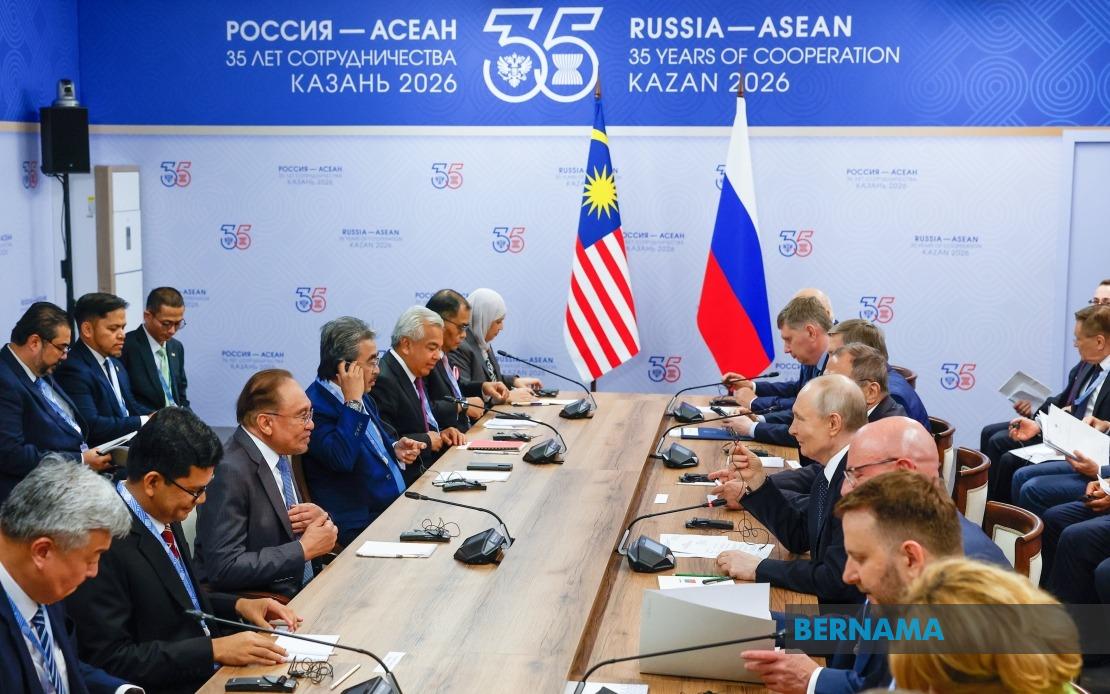
Prime Minister Datuk Seri Anwar Ibrahim has publicly commended Russian President Vladimir Putin and Chinese President Xi Jinping for their advocacy of peace and their condemnation of atrocities inflicted on the people of Gaza, Iran and Lebanon. Speaking during an exclusive interview with the Russian state television network RT, Anwar emphasised that Malaysia appreciates the principled positions adopted by both leaders on these critical regional issues, reflecting Kuala Lumpur's own commitment to seeking fair resolution to the ongoing Middle Eastern conflicts.
Anwar made these remarks while on an official visit to Kazan, Russia, where he participated in a commemorative summit celebrating the 35th anniversary of ASEAN-Russia relations. The timing of his statements underscores Malaysia's active engagement in diplomatic efforts across the region, particularly as tensions continue to escalate across the Middle East. His comments also signal Kuala Lumpur's willingness to work closely with major powers that align with its principles of peace and humanitarian concern, even as the nation maintains its independence from any single superpower or ideological bloc.
The Malaysian leader articulated a nuanced distinction between neutrality and centrality, a concept that has become increasingly important in ASEAN's approach to international affairs. Rather than claiming neutrality—a position he rejected as intellectually dishonest—Anwar stressed that Malaysia and the broader ASEAN community adopt a stance of centrality, meaning they maintain their own principles without being bound to any particular superpower or ideological framework. This approach allows the region to address human rights violations, atrocities against minorities, and breaches of international law without appearing to serve the interests of any major power.
Anwar detailed Malaysia's multifaceted diplomatic engagement on Middle Eastern issues, noting that he has consulted extensively with leaders from the Gulf states, Pakistan, Türkiye and Iran in his search for a comprehensive and equitable solution to the conflict. This intensive engagement reflects Malaysia's view that sustainable peace requires dialogue with all relevant stakeholders, not merely alignment with any single geopolitical faction. The Prime Minister expressed optimism that these diplomatic channels might eventually yield a resolution that addresses the legitimate concerns of all affected parties.
Criticising what he termed Western hypocrisy, Anwar questioned how the international community could condemn certain nations for their actions while appearing to overlook or condone comparable behaviour by others. He specifically referenced Israel's military operations and the support these actions receive from the United States, arguing that such selective application of principles undermines the credibility of the international system. According to Anwar, this inconsistency extends to how the global community responds to different nations' defensive actions, creating a double standard that damages international relations and perpetuates conflict.
The Prime Minister highlighted the broader implications of Middle Eastern tensions for regional stability, noting that the repercussions of the conflict extend throughout the Gulf region and affect the entire international community. He moved beyond purely economic arguments about the costs of war to focus on fundamental principles of sovereignty, international law and the protection of civilian populations. Anwar argued that these core values should guide international responses to conflict, rather than strategic interests or alliance politics that privilege some nations over others.
Anwar acknowledged that while some might criticise Iran's responses to external pressures, this should not result in international silence regarding aggression directed at Iran. He pointed out the contradiction inherent in condemning certain actions while remaining mute on comparable conduct directed at other nations. This asymmetry in international attention, he suggested, represents a form of hypocrisy that the modern, supposedly civilised international community should actively work to eliminate through more consistent application of universal principles.
Parliamentary support for Malaysia's Middle East stance demonstrates broad domestic backing for the government's foreign policy approach on this issue. The bipartisan consensus in the Malaysian Parliament reflects public concern about regional stability and the humanitarian dimensions of the conflict. This domestic unity allows the government to speak with greater authority on the international stage, presenting Malaysia not merely as representing executive preferences but as expressing the considered views of the nation's elected representatives.
Malaysia's independent diplomatic posture on Middle Eastern questions reflects its historical experience as a non-aligned nation and its position within ASEAN, which has consistently sought to maintain strategic autonomy. For Southeast Asian readers, Anwar's statements underscore how Malaysia navigates the complex terrain of great power competition by articulating clear principles rather than simply aligning with any single bloc. This approach has allowed the nation to maintain relationships with diverse partners while retaining credibility on human rights and international law matters that resonate throughout the developing world.
The emphasis on engagement with both Western and non-Western powers positions Malaysia as a bridge-builder in an increasingly polarised international environment. Anwar's willingness to praise Russian and Chinese positions while maintaining dialogue with Western nations demonstrates that this is not a zero-sum competition. Rather, Malaysia seeks to encourage all major powers to adopt more principled positions on humanitarian and legal questions, regardless of strategic considerations. This diplomatic philosophy, if successfully implemented, could offer valuable lessons for other regional powers seeking to navigate between great power blocs.

%22%2F%3E%3C%2Fpattern%3E%3C%2Fdefs%3E%3Crect%20width%3D%22100%25%22%20height%3D%22100%25%22%20fill%3D%22url(%23ph40buhg)%22%2F%3E%3Crect%20width%3D%22100%25%22%20height%3D%22100%25%22%20fill%3D%22url(%23ph40buhp)%22%2F%3E%3Ctext%20x%3D%2250%25%22%20y%3D%2250%25%22%20text-anchor%3D%22middle%22%20dominant-baseline%3D%22central%22%20fill%3D%22rgba(255%2C255%2C255%2C0.95)%22%20font-family%3D%22Georgia%2C%20'Times%20New%20Roman'%2C%20serif%22%20font-weight%3D%22700%22%20font-size%3D%22320%22%20letter-spacing%3D%22-0.02em%22%3EGRS%3C%2Ftext%3E%3C%2Fsvg%3E)