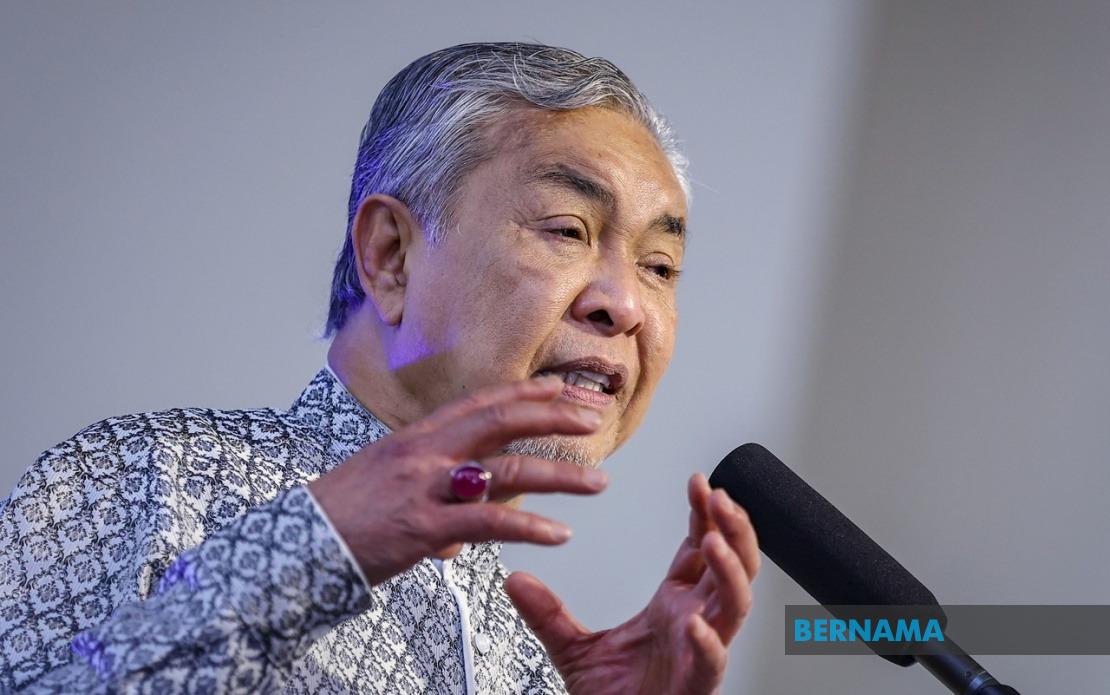
The Johor state election campaign should prioritize substantive policy discussion over historical recriminations, according to Barisan Nasional chairman Datuk Seri Dr Ahmad Zahid Hamidi, who made the appeal during a community event in the Kempas constituency on July 3. The Deputy Prime Minister's intervention reflects growing concern that the 16th Johor state election, scheduled for polling on July 11 with early voting on July 7, could become mired in divisive disputes that undermine the collaborative relationships several competing parties maintain at the federal government level.
Ahmad Zahid's remarks acknowledge the awkward political reality facing Malaysia's coalition governments: multiple parties and factions that compete fiercely in state contests simultaneously shoulder ministerial responsibilities and cabinet-level cooperation at the national level. This peculiar arrangement, while enabling broader representation, creates tension when state-level campaigns resurrect old controversies or personal disputes. By appealing for a measured approach to the Johor contest, Ahmad Zahid attempted to establish a boundary between federal partnership and state-level competition, effectively arguing that participating parties ought to compartmentalize their rivalry.
The BN chairman specifically noted that certain individuals and organizations have been directing attacks toward UMNO and Barisan Nasional by invoking unresolved historical issues. Rather than reciprocating with counterattacks rooted in past disputes, Ahmad Zahid signaled that BN intends to maintain the high ground by declining to engage in such exchanges. He expressed concern that permitting such disputes to dominate campaign discourse would create unnecessary awkwardness when coalition partners encounter each other in cabinet meetings and other official forums, effectively poisoning the collaborative working relationships necessary for federal governance.
This emphasis on restraint and professionalism reflects a broader strategic calculation by BN ahead of a state election that carries significance beyond Johor's borders. The party approaches the contest from a position of relative vulnerability rather than strength, despite controlling the state government. Ahmad Zahid explicitly rejected characterizations of BN overconfidence, insisting instead that the coalition views itself as an underdog facing substantial headwinds. The political landscape in Johor has shifted considerably since the last state election, he explained, requiring BN to demonstrate renewed vigor and compelling reasons for voters to maintain their support.
Demographic trends present particular challenges for BN's campaign strategy. More than half of registered voters in Johor are now young people, a constituency whose priorities, political socialization, and voting patterns differ substantially from earlier generations. This generational shift requires campaigns to address specific concerns regarding employment pathways, economic opportunity, and skills development rather than relying on traditional appeals or historical narratives. BN's acknowledgment of this reality informs its campaign approach and explains the centrality of youth-focused initiatives in its electoral messaging.
Barisan Nasional's manifesto for the Johor election, presented by Menteri Besar Datuk Onn Hafiz Ghazi, deliberately emphasizes youth-oriented policies including employment generation and technical skills training. The coalition is promoting Technical and Vocational Education and Training (TVET) programs as mechanisms through which young Johoreans can develop capabilities demanded by modern labor markets. This emphasis reflects recognition that formal academic credentials alone no longer guarantee entry into stable, remunerative employment, and that vocational expertise increasingly commands premium wages across manufacturing, construction, digital, and service sectors.
Ahmad Zahid highlighted the national unemployment rate's decline to 2.9 percent as evidence of improving macroeconomic conditions, yet he simultaneously acknowledged that aggregate statistics mask persistent disparities in job quality. Young workers particularly value access to positions offering genuine advancement, competitive compensation, and skill-building opportunities rather than underemployment in service roles offering minimal career progression. BN's campaign messaging attempts to position itself as the coalition most seriously committed to bridging the gap between job availability and job quality through systematic investment in technical education infrastructure and employer partnerships.
The appeal to young voters carries particular weight given their apparent growing electoral importance. Younger constituencies have demonstrated greater volatility in recent Malaysian electoral cycles, showing willingness to shift allegiances when persuaded that alternative parties better address their specific concerns. BN cannot rely on intergenerational party loyalty among voters who came of political age in the turbulent 2018-2020 period or later, necessitating affirmative cases for BN's relevance to contemporary youth challenges. The manifesto's emphasis on skills training and employment pathways represents BN's attempt to construct such a case through concrete, tangible commitments rather than abstract appeals to political continuity.
Barisan Nasional is contesting all 56 seats in the Johor state election, representing a comprehensive commitment of organizational resources and candidate recruitment. This total engagement across the electoral map signals confidence in the party's ability to compete competitively across diverse constituencies, from urban centers to rural areas. The performance target established by Ahmad Zahid reflects realistic assessment of contemporary political conditions: BN captured 40 seats in the previous state election, and improving substantially on that result would constitute a genuine victory given the enhanced electoral competitiveness Malaysian states have experienced in recent years.
The timing and tone of Ahmad Zahid's intervention suggest deliberate effort to shape campaign norms before the contest intensifies. By publicly calling for restraint and emphasizing the need to maintain professional relationships among federal coalition partners, the BN chairman created a public framework against which future campaign conduct can be evaluated. Should opposing parties subsequently engage in attacks rooted in historical grievances, BN can point to Ahmad Zahid's earlier call for mature political discourse, potentially positioning itself as the principled protagonist in any resulting controversy. This rhetorical positioning serves multiple strategic functions: it constrains potential opposition tactics, establishes the intellectual terrain on which campaign debates occur, and reinforces BN's claimed commitment to responsible governance.
For Malaysian politics more broadly, Ahmad Zahid's appeal reflects ongoing tensions inherent in coalition governance structures that simultaneously require cooperation at the national level and competition at state levels. The extent to which parties honor his call for restraint will indicate whether Malaysia's political actors have internalized norms of professional separation between different tiers of government or whether state-level rivalry continues to contaminate federal relationships. The Johor election therefore offers a test case for Malaysian democracy's capacity to maintain institutional functionality while accommodating genuine political competition, a challenge that will recur whenever major state elections occur and coalition partners simultaneously occupy federal positions.

