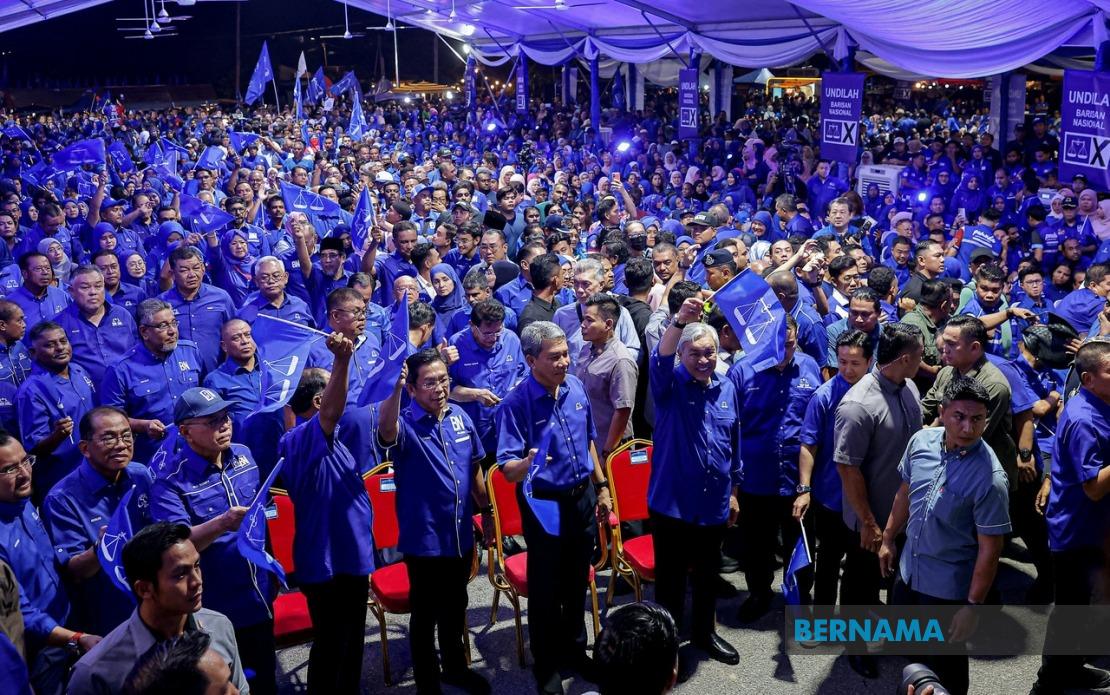
Barisan Nasional's commanding performance in the recent Johor state election should provide momentum for the coalition to pursue an equally decisive victory in Negeri Sembilan, according to BN chairman Datuk Seri Dr Ahmad Zahid Hamidi. Speaking at an election machinery launch and candidate announcement ceremony in Seremban on July 15, Ahmad Zahid framed the Johor result as evidence of voter confidence in BN's capacity to deliver stable governance and economic progress, setting a template the coalition should replicate across state boundaries.
The Johor outcome delivered a particularly strong mandate. BN secured 48 of the 56 state seats and captured nearly 60 per cent of the popular vote, marking the largest electoral victory in Johor's history. For a coalition that has faced significant electoral headwinds in recent years, this result carries symbolic weight beyond the state itself, signalling potential resurgence at a moment when political confidence in BN remains fragile across much of Malaysia. Ahmad Zahid presented this success not merely as a local achievement but as validation of the coalition's broader political model and organizational capacity.
Internal cohesion formed the cornerstone of Ahmad Zahid's analysis of Johor's success. He attributed the victory to unified action within the BN family, with member parties and grassroots workers operating as a coordinated force, maintaining trust across factional lines, and pooling their respective organizational strengths. This framing carries particular relevance for Negeri Sembilan, a state where internal coalition tensions have periodically surfaced and where the competition from opposition parties remains competitive. The prescription Ahmad Zahid offered—setting aside differences, shelving grievances, and consolidating behind a single banner—reflected recognition that Negeri Sembilan's political terrain differs from Johor's in ways that demand renewed emphasis on organizational discipline.
The BN leader called on party machinery to commence intensive ground operations immediately. His emphasis on door-to-door canvassing and direct voter engagement underscores the granular nature of modern state elections, where individual constituency dynamics often determine outcomes independent of national trends. In Negeri Sembilan particularly, where BN won only 14 of 36 seats in the 2023 state election, expanding the voter contact operation represents a fundamental requirement for achieving substantial gains. Ahmad Zahid's directive suggested recognition that momentum from Johor, while valuable, requires active translation into local campaign intensity to yield tangible results.
A significant portion of Ahmad Zahid's remarks addressed the recurrent problem of internal candidate disputes overshadowing broader coalition objectives. He cautioned party members against excessive preoccupation with candidacy selection, warning that such focus could distract from the fundamental mission of securing electoral victory. This tension between aspirant candidates' personal ambitions and organizational discipline has periodically weakened BN campaign efforts in previous elections. By foregrounding the imperative of unified action regardless of candidate selection outcomes, Ahmad Zahid sought to establish a hierarchy of priorities where coalition victory supersedes individual advancement.
The Deputy Prime Minister's comments reflected pragmatic awareness that candidate dissatisfaction, left unmanaged, can generate internal friction that manifests as reduced campaign effort in constituencies where particular candidates felt overlooked or poorly treated. His appeal for members to discharge their organizational responsibilities faithfully regardless of candidacy outcomes attempted to decouple campaign intensity from selection disappointments. Whether such appeals prove effective depends substantially on perceived fairness of the selection process itself and the leadership's credibility in maintaining internal accountability.
In comparative terms, Ahmad Zahid's framing positions Negeri Sembilan as a winnable state whose 2023 underperformance reflected organizational rather than structural disadvantages. The 14-seat outcome in 2023 provided a baseline from which significant gains appeared achievable, particularly if BN could consolidate its existing support and recover floating voters. Ahmad Zahid's confidence in achieving improved performance rested implicitly on the assumption that Johor's successful organizational formula could transfer effectively to Negeri Sembilan's distinct political environment, where local constituencies, incumbent strengths, and opposition positioning present different challenges.
The Election Commission's timeline established clear urgency for campaign operations. With nomination day scheduled for July 20, early voting on July 28, and polling on August 1, the campaign period compressed considerably compared to typical state election cycles. This compressed timeline meant that ground mobilization required immediate initiation to establish voter contact patterns before the formal campaign period concluded. Ahmad Zahid's emphasis on immediate action reflected this temporal constraint and the reality that inadequate preparation time could prove particularly disadvantageous for BN if opposition parties had already commenced sustained organizing.
For Malaysian political observers, Ahmad Zahid's remarks illustrated how single major electoral victories become narratives that dominate coalition thinking and strategic planning. The Johor result, though significant, carries limited automatic transferability to other states where local dynamics, incumbent positioning, and opposition strength differ materially. The risk for BN involves over-relying on the Johor narrative as a strategic model without adequately accounting for Negeri Sembilan's specific political configuration. The state's smaller size, different demographic composition, and recent experience with BN governance present distinct challenges that require tailored strategy beyond generic application of a successful formula from another state.

