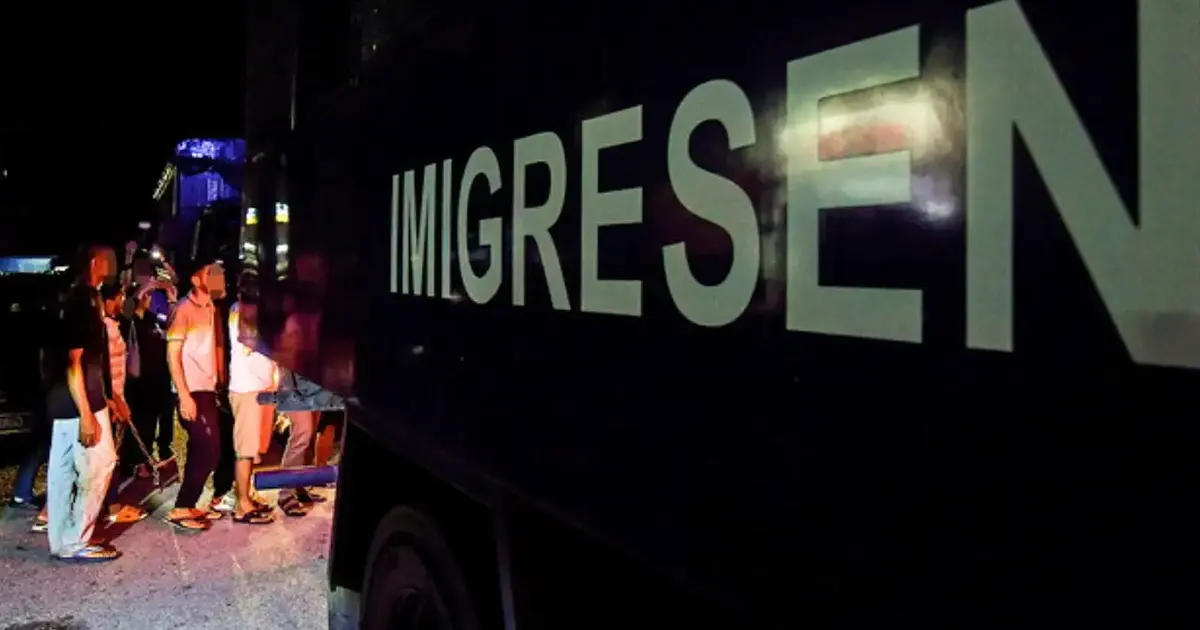
Malaysian immigration enforcement officers mounted a substantial overnight operation in Pudu, detaining 186 foreign nationals suspected of residing in the country illegally. The coordinated raid, conducted after midnight, resulted in mass arrests as authorities zeroed in on locations believed to harbour undocumented workers and visitors who had exceeded the terms of their entry permits. This latest crackdown underscores the ongoing pressure immigration authorities face in managing Malaysia's significant irregular migration challenge, particularly in urban centres like Kuala Lumpur where transient populations concentrate in affordable residential areas.
The detainees are currently in custody pending investigation into multiple immigration violations. Authorities suspect the majority overstayed their permitted duration in Malaysia, a common infraction among foreign workers seeking extended employment beyond their visa validity. Additionally, investigating officers are examining whether the individuals possessed authentic travel documents or entered the country through irregular channels that circumvented official border checkpoints. Such operations typically reveal a mixture of circumstances—some overstayers lost employment and delayed departure due to financial constraints, while others deliberately ignored departure deadlines hoping to secure further work arrangements.
Pudu, situated in the heart of Kuala Lumpur's central business district and commercial zones, has emerged as a focal point for migration enforcement activities. The area's dense urban landscape, characterised by older shophouse buildings, budget accommodation facilities, and mixed commercial-residential spaces, creates environments where undocumented populations find affordable shelter and maintain informal support networks. Labour-intensive sectors operating nearby—restaurants, construction sites, and cleaning services—provide employment opportunities that attract irregular migrants seeking income despite their dubious legal status. Immigration authorities have intensified surveillance in such neighbourhoods, recognising that concentrated migrant populations facilitate coordination of enforcement campaigns.
The scale of this operation reflects broader national concerns regarding irregular migration and its implications for public order, labour market integrity, and national security. Malaysia continues to grapple with managing one of Southeast Asia's largest migrant populations, with millions of documented foreign workers legally residing in the country. However, parallel communities of undocumented individuals operate outside formal regulatory frameworks, creating challenges for authorities responsible for maintaining order and protecting citizens. Each enforcement action generates data informing policy refinement, though critics contend that raids alone address symptoms rather than underlying structural factors driving irregular migration patterns.
Investigation procedures following such arrests typically involve documentation verification, immigration record checks, and interviews regarding employment circumstances and accommodation arrangements. Authorities cross-reference detainee information against departure records and visa databases to establish timeline violations. For individuals without identifiable documentation, the process becomes considerably more complex, often requiring liaison with foreign missions for nationality confirmation. Malaysian authorities maintain bilateral cooperation frameworks with major migrant-origin countries, facilitating expedited processing for certain nationalities, though diplomatic complexities sometimes delay repatriation outcomes.
The consequences for detainees vary significantly depending on investigation findings and individual circumstances. Those confirmed as simple overstayers typically face administrative processing leading to deportation, though penalties may include fines or brief detention periods preceding removal. Individuals discovered entering through irregular means face more serious allegations potentially involving criminal charges beyond administrative immigration violations. Undocumented workers employed in specific sectors sometimes face employer sanctions alongside personal penalties, theoretically incentivising compliance with recruitment regulations, though enforcement remains inconsistent across industries.
From Malaysia's economic perspective, irregular migration presents persistent paradoxes. Certain labour-dependent sectors—construction, hospitality, domestic work, and agricultural production—rely substantially on undocumented workers willing to accept conditions documented migrants might refuse. Enforcement actions create temporary labour disruptions, potentially affecting project timelines and service delivery. Conversely, allowing unchecked irregular migration undermines compliance incentives for legitimate employers, distorts wage conditions affecting documented workers, and generates revenue loss through tax avoidance by informal employment arrangements. Policymakers continuously calibrate enforcement intensity against economic considerations.
The midnight timing of such operations reflects deliberate tactical planning. Darkness provides operational advantages—reduced visibility limiting advance warning, reduced street activity facilitating suspect movement control, and accommodation-focused raids catching individuals at residence locations rather than dispersed throughout daily employment sites. Immigration authorities coordinate with local police, occasionally involving specialized units for complex scenarios. Such operational sequencing has evolved from experience—successful raids require precise intelligence regarding suspect locations and adequate personnel deployment preventing escape during initial contact phases.
Regional security frameworks increasingly emphasise migration management coordination. Southeast Asian nations share intelligence regarding smuggling networks, document fraud operations, and trafficking patterns affecting multiple countries. Malaysia participates in ASEAN initiatives addressing irregular migration, recognising that transnational dimensions—involving transit routes, recruitment networks, and destination-country exploitation—require collaborative responses transcending individual national capacity. Nonetheless, asylum claims, protracted displacement situations, and humanitarian considerations add complexity to purely enforcement-focused approaches, occasionally creating tensions between security imperatives and humanitarian obligations.
Beyond immediate enforcement outcomes, such operations generate broader impacts on migrant communities. Fear of detention influences migration decisions—some individuals accelerate departures, others further embed within informal support networks, and vulnerable populations become increasingly exploited by traffickers offering circumvention routes. Workers facing deportation fears accept exploitative wages and conditions, fearing employer reporting to authorities. This dynamic sometimes perpetuates vulnerability cycles where enforcement paradoxically strengthens conditions enabling human rights abuses within irregular migration systems.
Looking forward, Malaysia's immigration authorities acknowledge that enforcement operations represent necessary but insufficient responses to irregular migration. Policymakers increasingly recognise that comprehensive solutions require addressing employment market demand driving irregular hiring, strengthening employer compliance mechanisms, improving detection of document fraud, and calibrating visa policies enabling legitimate temporary migration. The Pudu operation reflects current enforcement capacity and priorities, yet long-term irregular migration reduction depends on multifaceted approaches integrating law enforcement with regulatory reform and regional cooperation mechanisms addressing migration's underlying drivers.

%22%2F%3E%3C%2Fpattern%3E%3C%2Fdefs%3E%3Crect%20width%3D%22100%25%22%20height%3D%22100%25%22%20fill%3D%22url(%23ph2z7t1g)%22%2F%3E%3Crect%20width%3D%22100%25%22%20height%3D%22100%25%22%20fill%3D%22url(%23ph2z7t1p)%22%2F%3E%3Ctext%20x%3D%2250%25%22%20y%3D%2250%25%22%20text-anchor%3D%22middle%22%20dominant-baseline%3D%22central%22%20fill%3D%22rgba(255%2C255%2C255%2C0.95)%22%20font-family%3D%22Georgia%2C%20'Times%20New%20Roman'%2C%20serif%22%20font-weight%3D%22700%22%20font-size%3D%22272%22%20letter-spacing%3D%22-0.02em%22%3EAnwar%3C%2Ftext%3E%3C%2Fsvg%3E)