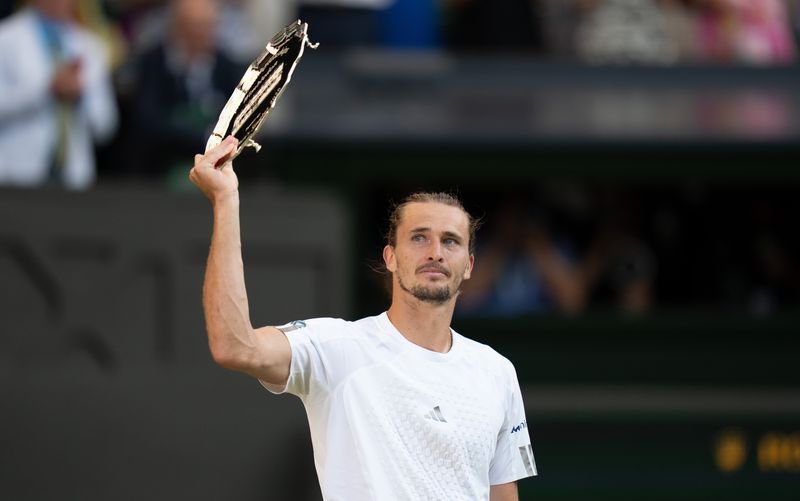
Alexander Zverev will ascend to second in the ATP rankings on Monday following his Wimbledon final appearance, but the German tennis star remains acutely aware that Jannik Sinner and Carlos Alcaraz currently occupy an elevated tier in men's professional tennis. Despite losing to Sinner 6-7(7) 7-6(2) 6-3 6-4 on Centre Court, Zverev is convinced that his recently refined aggressive playing style offers a pathway to compete for major titles against the sport's current elite.
The 29-year-old faced the world number one in a competitive contest that contrasted sharply with his previous encounters against the Italian. This represented Zverev's tenth consecutive loss to Sinner, yet the quality and closeness of the match demonstrated a marked improvement. Remarkably, Zverev had lost 14 consecutive sets to Sinner before this final, underlining just how dominant the Italian has become. The German came tantalizingly close to upset victory, particularly in the third set where a fortuitous fall at 3-3 on his only break point opportunity may have altered the tournament's outcome.
The significance of Zverev's presence in the final cannot be overstated for his career trajectory. Had he prevailed, he would have become the first German man to claim the Wimbledon singles crown since Michael Stich achieved that feat in 1991, a drought stretching over three decades. This Wimbledon run represents his most impressive performance at the grasscourt Grand Slam, marking tangible progress in his quest to establish himself among tennis's elite winners.
Zverev's confidence stems partly from his French Open breakthrough achieved just weeks earlier. That inaugural Grand Slam victory came at his 41st major attempt, a milestone that carried mixed messaging—while validating his potential, some observers noted that Sinner had exited in the second round whilst Alcaraz remained sidelined with a persistent wrist injury. Nevertheless, this maiden Grand Slam triumph fundamentally shifted Zverev's psychological outlook heading into Wimbledon.
The German has deliberately implemented a more aggressive tactical framework throughout this season, particularly emphasizing forehand aggression where he previously exhibited passivity. This strategic evolution became evident at Wimbledon, where Zverev maintained an exceptionally high first serve percentage hovering around 80% throughout the final and deployed his forehand with destructive precision to unsettle Sinner repeatedly. Such tactical adjustments represent a deliberate philosophical shift rather than spontaneous changes.
When discussing his revised approach, Zverev demonstrated unwavering commitment to this attacking methodology. He acknowledged that adapting to this playing style created challenges during the campaign's earlier stages, yet he persisted with disciplined consistency. Zverev emphasized that his Paris triumph and Wimbledon final appearance prove that something fundamental within his game has successfully evolved. He articulated that witnessing immediate Grand Slam and major final success validates the approach he committed to implementing from year's beginning.
Regarding his tactical execution, Zverev explained that when opportunities arise, he commits fully to aggressive shot-making without reservation. Whether such attempts succeed or fail depends upon daily form and circumstances, but the fundamental principle remains unchanged—he pursues opportunities rather than retreating into conservative baseline rallies. This philosophy extends beyond the current season; Zverev explicitly stated intentions to maintain this aggressive framework throughout his remaining career.
The statistical reality of contemporary men's tennis underscores the magnitude of Zverev's challenge. Sinner and Alcaraz have accumulated 12 Grand Slam titles between them, establishing an increasingly formidable combined legacy. Notably, Alcaraz has won seven major championships, whereas Sinner possesses five. Against this backdrop, Zverev's single Grand Slam title assumes modest proportions. Nevertheless, the German contends that his competitive performances against these rivals demonstrate he can pressure them in ways few others accomplish.
Zverev emphasized that whilst he has yet to defeat either Sinner or Alcaraz during 2024, he has consistently pushed both players to their competitive limits. He specifically referenced pushing Alcaraz to the brink in Australia and creating genuine contest against Sinner at Wimbledon, describing the final as involving four competitive sets that could conceivably have extended to five. Such observations suggest Zverev perceives genuine momentum rather than merely suffering close defeats.
The narrative surrounding Zverev's position within tennis hierarchy has shifted meaningfully. Historically, tennis commentators have identified him as the eternal third figure behind Sinner and Alcaraz, yet acknowledged a substantial performance chasm separating him from both. Zverev now believes this dynamic can evolve if he successfully narrows the gap through consistent competitive participation and tournament victories. His aspiration centers upon transitioning from statistical third to genuine contender capable of mixing with the established elite across multiple tournaments.
A physical incident during the Wimbledon final warranted discussion, as Zverev suffered a knee hyperextension at 3-3 during the third set, reminiscent of a similar injury sustained two years prior. This fall compromised his serving mechanics, reducing serve velocity and contributing to the performance dip observed in that set. However, Zverev recovered and elevated his standard in the fourth set, suggesting the injury's impact remained manageable rather than debilitating. He maintained that despite the fall, the overall match quality remained considerably elevated throughout.
Looking forward, Zverev's trajectory suggests a player transitioning into his competitive prime with tactical innovations supporting his ambitions. The attacking framework he has adopted represents not merely stylistic preference but calculated methodology designed to neutralize the strengths of Sinner and Alcaraz. Whether this evolved approach ultimately generates multiple Grand Slam titles and potential world number one ranking remains uncertain, yet his recent performances demonstrate he possesses the capacity to compete at tennis's highest level.

