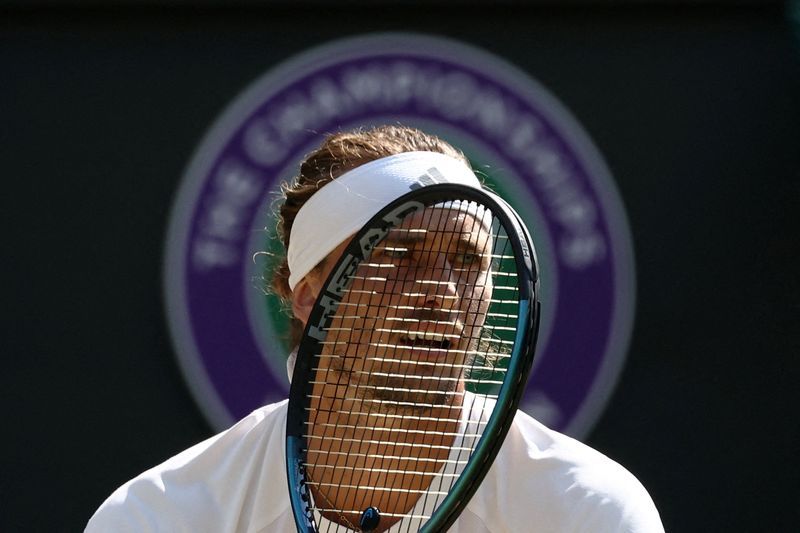
German second seed Alexander Zverev has dismantled Taylor Fritz with a commanding 6-4 6-4 6-2 victory on Court One at the All England Club, finally breaking through a frustrating seven-match losing streak that had haunted him for more than two years. The French Open champion's dominant display propels him into his first Wimbledon semi-final and keeps alive his pursuit of back-to-back Grand Slam titles, with his next opponent being Britain's Arthur Fery, who defeated Flavio Cobolli in an earlier match.
Zverev's breakthrough against Fritz carries particular significance for the 29-year-old's career trajectory. The psychological weight of consecutive defeats against the same opponent, especially at a major tournament like Wimbledon where he fell to Fritz last year, had become an unwelcome narrative surrounding his campaign. By reversing that trend with such authority, the German has removed a considerable mental barrier that could easily have derailed his tournament run. His composed performance under pressure, particularly in defending break points early in the contest, demonstrated the mental fortitude required to overcome ingrained match histories at this level.
With this victory, Zverev has etched his name into German tennis history at Wimbledon. He becomes only the fifth German man to reach a Grand Slam semi-final in the professional era since 1968, joining an illustrious lineage that includes three-time Grand Slam champion Boris Becker, French Open winner Michael Stich, Rainer Schuettler, and Tommy Haas. This statistical achievement underscores both the competitive depth of men's tennis in the modern era and the rarity of German players reaching this stage at the grass-court major.
The tactical brilliance Zverev displayed against Fritz was evident from the opening moments. He seized an early break to establish a 5-4 lead in the first set, then weathered a spirited late push from his opponent during the tenth game. Under intense heat on Court One, with the sun beating down relentlessly, Zverev showed exceptional composure to close out the opener, setting the tone for what would become an increasingly dominant performance as the match progressed.
Fritz's physical struggles added another dimension to the contest. A medical timeout for a right knee issue after just three games in the second set provided Zverev with momentum and opportunity. The American's reduced mobility became increasingly apparent as the German ramped up the intensity, capitalizing on a crucial break of serve that effectively shifted the entire complexion of the match. What might have been a competitive encounter evolved rapidly into a one-sided affair, with Zverev's confidence visibly swelling.
The crowd's energy shifted markedly when news filtered through Court One that Britain's Fery had secured a commanding two-set lead on Centre Court against his opponent. This surge of local enthusiasm seemed to energize rather than intimidate Zverev, who responded with a comfortable service hold that further distanced him from Fritz's fading hopes. By this point, the German had seized total control of the match's trajectory, and his opponent could only prolong the inevitable.
Zverev sealed victory with a flourish, unleashing a scintillating backhand winner to secure a double break at 4-1 in the third set. He subsequently closed out the decisive set with minimal further resistance, demonstrating the clinical finishing that characterizes elite-level tennis. This 12th Grand Slam semi-final appearance represents another milestone in a career marked by consistent excellence at the sport's highest echelon.
Despite his comprehensive dominance, Zverev emphasized the mental challenges he had overcome. He acknowledged that the weight of not defeating Fritz for over two years had been a constant presence throughout the match, particularly during the nerve-wracking opening game where he faced three break points on his own serve. Rather than viewing his performance through the lens of victory alone, he recognized that executing near-flawlessly had been the only viable path to overcoming such a formidable psychological hurdle.
The prospect of facing Fery in the semi-final presents an intriguing narrative for the tournament. Both men will be appearing in their maiden Wimbledon semi-finals, making the contest genuinely unpredictable despite Zverev's superior ranking and experience. The crowd will overwhelmingly favor the home hope, as Fery represents a potential fairy-tale story for British tennis. Zverev handled this reality with characteristic humor and grace, joking that supporters would naturally back the local player while expressing confidence in his own ability to deliver under pressure.
For Malaysian and Southeast Asian tennis enthusiasts, this clash of titans underscores the global reach of the sport's elite. Zverev's pursuit of consecutive Grand Slam titles and potential triumph at Wimbledon represents the kind of sustained excellence that captures regional imagination. The German's journey to this semi-final stage, particularly his conquest of a personal demon in Fritz, exemplifies the psychological resilience demanded at tennis's highest level—a quality equally relevant to sporting audiences across Asia.
As Zverev prepares for his semi-final encounter, the significance of his victory against Fritz extends beyond mere tournament advancement. It represents a psychological watershed moment that may prove pivotal not only to his Wimbledon campaign but also to his broader confidence heading into the remainder of the season. His demonstration that even seemingly insurmountable losing streaks can be overcome through superior execution and mental resolve provides an instructive lesson in competitive sport.

