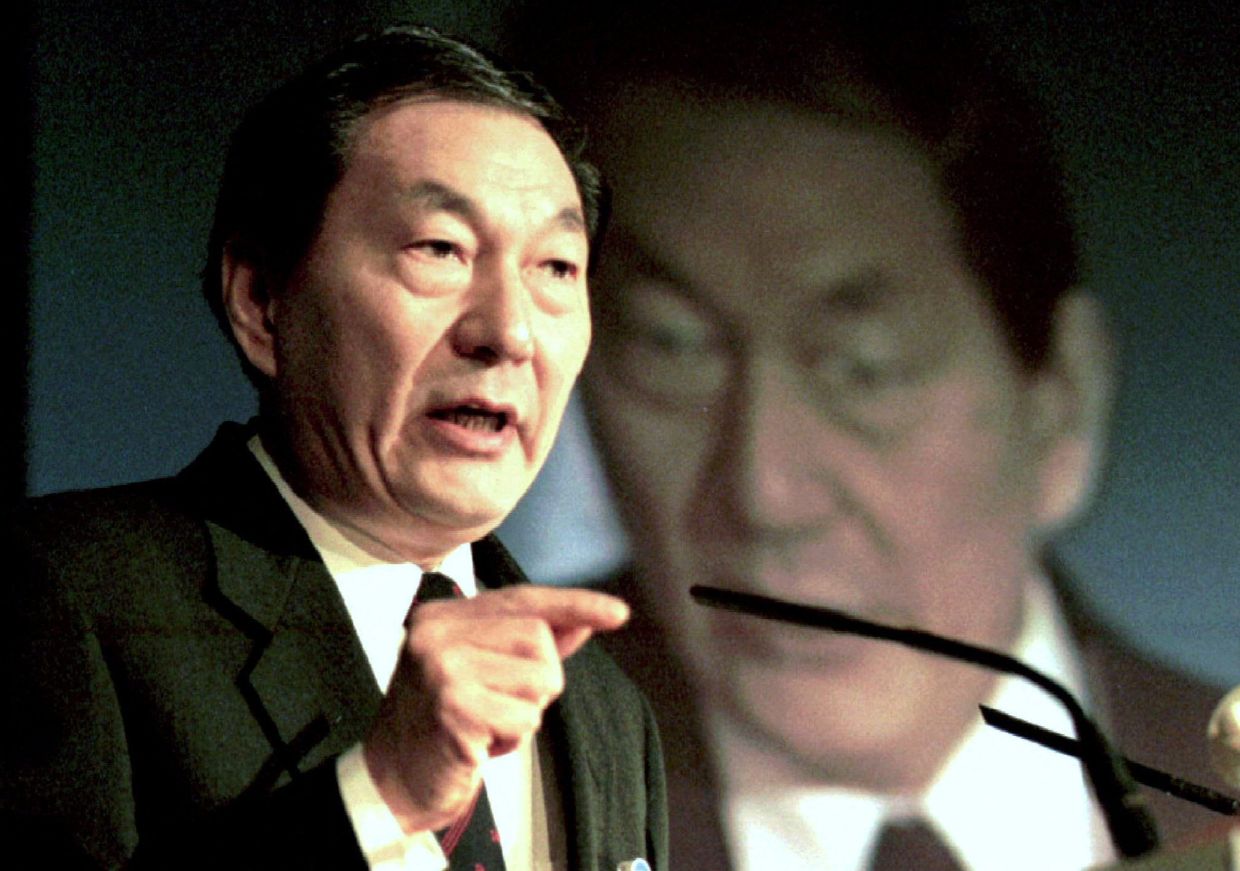
Zhu Rongji, the economist who fundamentally restructured China's state-owned sector and orchestrated the nation's integration into global trade frameworks, has passed away in Beijing at the age of 98. The influential former premier died on Wednesday, August 12, following medical treatment for an undisclosed condition, according to Xinhua News Agency. His death marks the end of an era in which China's leadership embraced radical economic liberalisation, a path that would later be abandoned by successive administrations in favour of state-directed development.
During his tenure as economic supremo before becoming premier in 1998, and throughout his five years leading the government until 2003, Zhu navigated China through extraordinary turbulence. The 1997 Asian financial crisis and persistently elevated inflation rates tested his resolve, yet he maintained his commitment to dismantling the inefficient apparatus of Communist-era planning. His administration shut down tens of thousands of underperforming state enterprises spanning telecommunications, banking, petroleum, and other sectors—actions that displaced millions of workers but fundamentally reshaped China's economic structure toward private-sector dynamism and reduced the drain of unprofitable operations on national finances.
The contrast between Zhu's market-oriented philosophy and contemporary Chinese economic doctrine is striking. President Xi Jinping and his administration have systematically reversed this trajectory, championing what they describe as a "stronger, better, and bigger" state-controlled economy designed to serve strategic national interests. Where Zhu believed competition and privatisation would unlock growth, modern Beijing has reasserted state dominance over key sectors, signalling a philosophical rupture from the Zhu era that resonates throughout East and Southeast Asia's relationship with China.
Zhu's economic acumen impressed international observers, particularly Western financiers accustomed to different models of governance. John Thornton, former co-president of Goldman Sachs, recalled meeting Zhu in the mid-1990s and later working with him during China Mobile's landmark 1997 Hong Kong initial public offering. While Goldman Sachs assembled company executives and Deutsche Telekom specialists on Hainan island to discuss operational structures, Zhu engaged in detailed technical questioning more characteristic of a corporate chief financial officer than a national leader—demonstrating an unusually intimate command of economic mechanics that set him apart from many peers in the Chinese political hierarchy.
Earlier in his career, serving as governor of the People's Bank of China from 1993 to 1995, Zhu aggressively opened China's financial sector to foreign participation through pilot programmes and orchestrated the nation's first international bond sale. These moves prepared institutional groundwork for later integration. In 1999, he personally negotiated with European Union Trade Commissioner Pascal Lamy to resolve outstanding disputes, ultimately paving the way for China's accession to the World Trade Organization in 2001. That achievement would prove transformative—China's gross domestic product has expanded elevenfold since entry, elevating the country to the world's second-largest economy. However, Western trading partners now contend that Beijing has systematically violated WTO commitments through subsidies, import barriers, and intellectual property violations, suggesting that Zhu's vision of rules-based international commerce has been compromised.
Among Zhu's most consequential domestic interventions was the establishment of asset-management companies in 1999 tasked with purchasing 1.4 trillion yuan—equivalent to approximately US$220 billion—in non-performing loans accumulated by China's four largest banks. These institutions, burdened by mandatory lending to inefficient state enterprises, faced insolvency without intervention. By removing bad debts from their balance sheets, Zhu enabled the banks to pursue market-oriented restructuring and eventual public listing, beginning in 2005. This mechanism proved essential for China's financial system modernisation and remains instructive for developing economies managing state-bank portfolios.
Zhu's administrative reforms extended beyond sectoral restructuring to governmental operations themselves. His anti-corruption initiatives and bureaucratic streamlining earned him the colloquial designation "one-chop Zhu," referencing the official seals required for document authorisation in Chinese administration. His efforts to reduce procedural complexity and eliminate superfluous approvals represented a cultural shift toward efficiency that contrasted sharply with entrenched Communist Party practices. These initiatives attracted admiration from foreign dignitaries, who noted his fluent English and diplomatic dexterity. During a 1999 joint press conference with United States President Bill Clinton, when confronted about Chinese political donations to American campaigns, Zhu delivered a quip that encapsulated his pragmatic wit: noting that with US$146 billion in foreign-exchange reserves, China could certainly spare US$10 billion if such contributions were effective, rendering the alleged US$300,000 contribution laughably inadequate.
Zhu's political trajectory reflected both the turbulence and opportunities of modern China's development. Born in Hunan Province in October 1928, he studied electrical engineering at Tsinghua University from 1947 to 1951, joining the Communist Party the year of the People's Republic's proclamation. During Mao Zedong's Hundred Flowers Campaign, when temporary freedom of expression was permitted, Zhu criticised the chairman's economic policies as producing irrational growth rates, a candid assessment that resulted in his labelling as a "rightist" and demotion. The subsequent Cultural Revolution subjected him to five years of rural labour, where he raised livestock and cultivated rice—an ordeal that might have permanently derailed a lesser figure's career.
Following rehabilitation in 1978, Zhu ascended through governmental ranks with remarkable speed, becoming Shanghai's mayor in 1987 and securing a vice-premier position in 1991. His elevation to the Politburo Standing Committee in 1992 positioned him as a leading architect of the economic transformation that would define the 1990s. When he relinquished the premiership to Wen Jiabao in 2003, Zhu devoted subsequent decades to enhancing Tsinghua University's international profile and supporting rural educational initiatives through book royalties—endeavours reflecting his belief in long-term institutional development.
Zhu's personal philosophy regarding public service was notably modest. During a 2000 legislative session, he expressed hope that the Chinese people would remember him as an honest official rather than a corrupt one, adding that he would be "very satisfied" with such remembrance. Should they judge him to have accomplished substantive achievements, he would be grateful—words that suggest a leader conscious of both the weight of his decisions and their human consequences. His family continued his engagement with financial institutions; his son Levin headed China International Capital Corp through the early 2000s, while his daughter Zhu Yanlai held senior positions at Bank of China (Hong Kong).
Zhu Rongji's legacy presents an ambiguous portrait for contemporary China and Southeast Asia. He demonstrated that state-owned enterprise reform, however painful in human terms, could catalyse economic dynamism and international integration. Yet his market-oriented vision has been substantially superseded by a model emphasising state control and strategic direction. For Malaysian readers observing China's evolving role in regional trade, investment, and governance, Zhu's career illustrates both the possibilities and complexities of managing massive structural economic transitions—lessons increasingly relevant as Beijing reasserts state authority and developing economies throughout Southeast Asia navigate pressures from competing visions of capitalism and state power.

