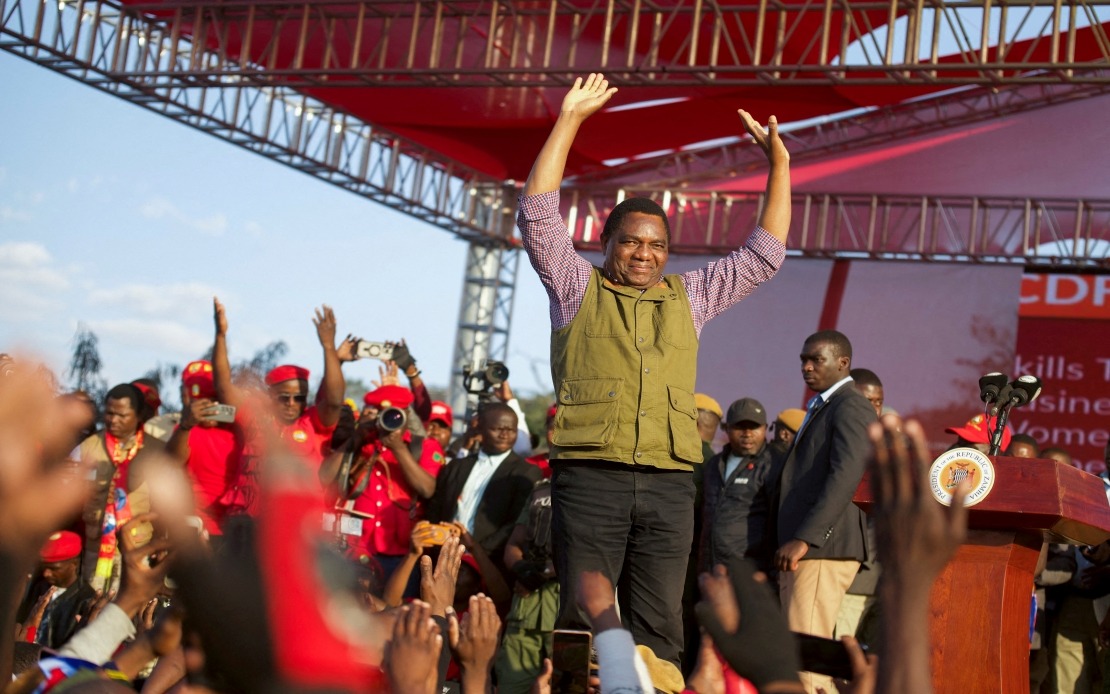
Zambian President Hakainde Hichilema has emerged with a decisive advantage in the country's presidential race, accumulating over 1.5 million votes as preliminary results emerged from roughly 60 per cent of polling stations nationwide. The 64-year-old economist and rancher, contesting under the governing United Party for National Development (UPND), had secured 1,544,140 votes from 135 of 226 constituencies when electoral authorities released consolidated figures at the National Election Results Centre in Lusaka on Sunday evening. This substantial margin positions him favourably for a second consecutive term, barring an unexpected reversal in the remaining constituencies still being tallied.
Hichilema's nearest rival in what has proven a competitive race is Brian Mundubile of the National Reconciliation Party for Unity and Prosperity (NRPUP), who has accumulated 1,030,662 votes across the same constituencies. The 55-year-old lawyer commands considerable support particularly in Zambia's urban strongholds stretching through the capital and into the mineral-rich Copperbelt region, where his opposition coalition has secured multiple parliamentary seats. Yet the current arithmetic suggests he faces an uphill path to closing the approximately 513,000-vote gap, particularly given that Hichilema has demonstrated strength across diverse regions rather than reliance on a single demographic base.
The electoral commission, headed by Chairperson Mwangala Zaloumis, has established a constitutional requirement that any presidential victor must capture more than half of all valid votes cast to claim outright victory in the initial round. Should no candidate achieve this threshold, the country's constitutional framework mandates a runoff ballot featuring the two leading contenders. This provision has shaped campaign strategies, as candidates recognise that while plurality support matters, crossing the 50 per cent barrier remains the ultimate arbiter of presidential victory. The rules have created incentives for coalition-building and coalition-maintenance throughout what has been a competitive but largely peaceful electoral contest.
Hichilema's first term since 2021 has been defined by his pursuit of major economic restructuring initiatives that his government credits with stabilising Zambia's finances following years of debt accumulation. The president has championed his administration's efforts to renegotiate onerous external obligations that previously constrained fiscal space, allowing for increased investment in critical sectors. These economic rehabilitation efforts represent his government's primary narrative for seeking voter endorsement of a continuation, centring on the argument that additional time is required to fully realise the benefits of structural reforms already implemented.
Beyond debt management, Hichilema's government points to revitalisation of the mining sector as a signature achievement of his first five years. Zambia's copper-dependent economy had contracted significantly in preceding years, making resource sector recovery essential for employment and revenue generation. The administration has pursued policy frameworks intended to attract investment and improved operational efficiency in mines that constitute the lifeblood of export earnings and government finances. These initiatives carry particular resonance in the Copperbelt constituencies where mining employment remains concentrated and where economic fortunes directly correlate with sectoral performance.
Educational expansion has also featured prominently in Hichilema's development agenda. His government instituted a free education initiative covering primary and secondary students attending public institutions, representing a significant expansion of access and removal of financial barriers to learning. This policy, while resource-intensive, addresses a fundamental constraint on human capital development that previous administrations had not prioritised with equivalent commitment. For many rural and lower-income households, the elimination of tuition costs has proven transformative, enabling children who might otherwise have remained out of school to access foundational education.
The competitive nature of Sunday's election, marked by Mundubile's substantial support base, suggests that Zambian voters have engaged seriously with questions of governance alternatives and policy direction. The opposition coalition's parliamentary gains, concentrated in urban and Copperbelt zones, indicate that dissatisfaction exists within certain demographics and geographic areas regarding the incumbent administration's performance or priorities. These results suggest that support for Hichilema, while commanding, is not unanimous and reflects genuine electoral competition rather than a predetermined outcome.
For regional observers including Malaysian policymakers tracking African governance trends, Zambia's election cycle offers insights into the durability of reform programmes implemented during initial terms and the mechanisms through which African democracies manage competitive transitions. Hichilema's 2021 victory represented a significant repudiation of incumbent Edgar Lungu, with the prior election margin exceeding one million votes decisively establishing popular appetite for leadership change. Whether voters in 2024 perceive sufficient progress justifying continuation or prefer to test alternative leadership remains central to the election's significance.
The remaining 91 constituencies still being tallied will determine whether Hichilema achieves outright victory or whether a second-ballot runoff becomes necessary. Given his current advantage and the geographic distribution of support, attaining the 50 per cent threshold appears probable even accounting for variations in performance across remaining polling stations. Nonetheless, final results will carry implications extending beyond presidential succession, potentially reshaping parliamentary composition and establishing the political trajectory for Zambia's next five-year governance cycle. The institutional strength demonstrated through orderly electoral management and transparent result-sharing suggests that Zambia continues navigating democratic competition comparatively more successfully than several continental peers.

