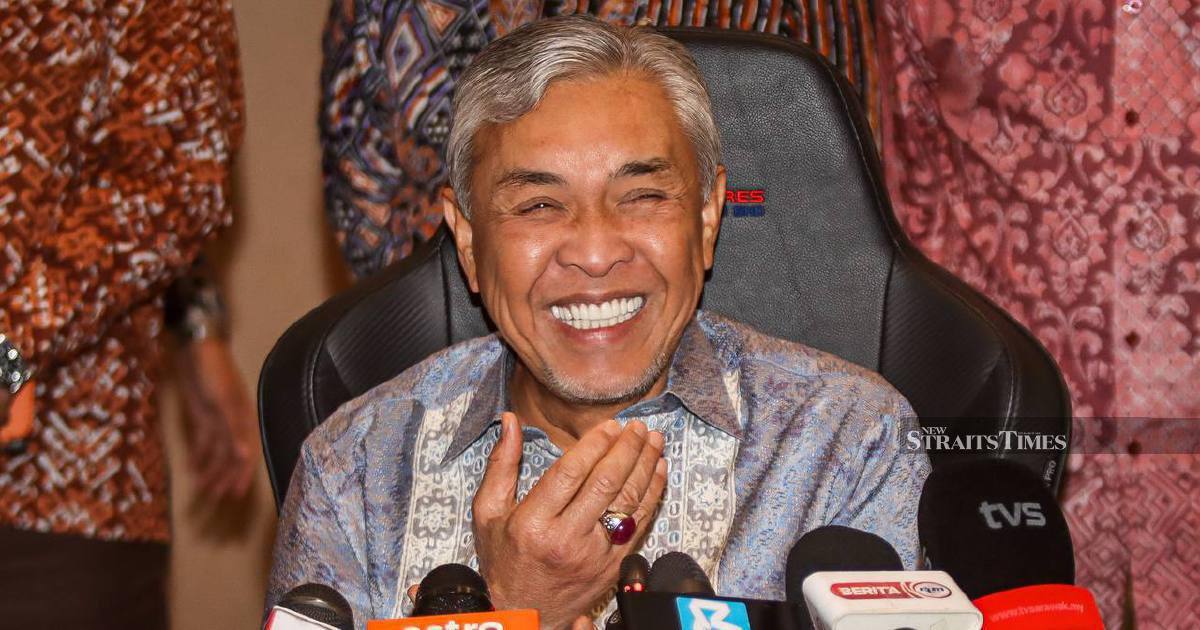
Deputy Prime Minister Datuk Seri Dr Ahmad Zahid Hamidi has offered his own rendition of the traditional Malay poetic form, pantun, in response to Prime Minister Datuk Seri Anwar Ibrahim's recent contribution to the dialogue between the two leaders. The exchange, which took place in George Town, marks another chapter in what appears to be an increasingly creative mode of communication at the highest levels of Malaysia's government.
The pantun, a centuries-old verse form rooted in Malay literary tradition, has become an unexpected medium for political messaging between Zahid and Anwar. These four-line verses, often employing metaphorical language and cultural references, allow leaders to express complex political positions through the lens of Malaysia's rich heritage. The use of such traditional forms in contemporary political discourse reflects a deliberate choice to ground national conversations in cultural continuity rather than through purely formal or technical statements.
Anwar Ibrahim's initial pantun, which emphasised themes of national unity, set the tone for what has become a more nuanced exchange about the government's direction and cohesion. The Prime Minister's choice to frame unity as a central concern suggests underlying tensions or divisions that require symbolic acknowledgment and reaffirmation. By selecting the pantun as his medium, Anwar leveraged a form that carries deep cultural legitimacy and widespread resonance among Malaysian citizens, transforming what might otherwise be routine political messaging into something more resonant and memorable.
Zahid's response, featuring imagery relating to roofs and storms, introduces meteorological metaphors that carry their own significance. In Malay literary tradition, such natural imagery often symbolises protection, shelter, and the challenges that test structural integrity. The Deputy Prime Minister's choice of these particular symbols appears deliberate, suggesting reflections on how the government withstands external pressures while maintaining stability. This poetic riposte demonstrates Zahid's engagement with the conversational framework established by the Prime Minister, even as it introduces his own conceptual dimensions.
The exchange between these two powerful political figures through pantun reflects broader patterns in Malaysian political culture, where traditional forms often serve as vehicles for expressing current political realities. Unlike direct public statements or formal speeches, which can appear confrontational, the pantun allows for simultaneous expression of disagreement and respect. The form's inherent ambiguity and metaphorical nature creates space for multiple interpretations, enabling leaders to communicate with their various constituencies without explicit contradiction.
For observers of Malaysian politics, these poetic exchanges offer a window into the current state of relations between the Prime Minister and Deputy Prime Minister. The fact that both leaders are engaging actively rather than maintaining silence or making declarations through formal channels suggests a relationship characterised by ongoing dialogue and mutual engagement, however complex the underlying dynamics may be. This symbolic communication transcends the typical media briefing or parliamentary statement, reaching Malaysians through a cultural form that carries emotional and historical weight.
The choice of venue—George Town in Penang—also carries significance, as this historic city occupies an important place in Malaysia's cultural and political landscape. The setting lends additional gravitas to the exchange and reinforces the national rather than purely factional nature of what these leaders are attempting to convey. Public figures conducting political dialogue through shared cultural forms like the pantun demonstrate commitment to maintaining certain standards of discourse, even during periods of substantive disagreement or political manoeuvre.
This mode of communication also speaks to the sophisticated tastes of Malaysia's educated classes and reflects respect for cultural literacy among the general population. The expectation that significant portions of the audience will understand and appreciate the nuances of pantun verse suggests confidence in the cultural awareness of Malaysian society. It positions political leaders not merely as administrators or power brokers, but as stewards of national cultural traditions who can articulate complex political positions through inherited literary forms.
For the broader region, the exchange demonstrates how Southeast Asian nations can conduct high-level political communication through culturally rooted means that remain accessible and meaningful to ordinary citizens. This approach contrasts with purely technical or bureaucratic modes of governance communication and creates opportunities for deeper public engagement with political processes. The pantun exchange between Zahid and Anwar illustrates how tradition and contemporary governance can intersect productively, transforming routine political positioning into moments of cultural significance.
As Malaysia continues to navigate complex political terrain and multiple competing interests, the willingness of senior leaders to engage through traditional literary forms may serve an important stabilising function. By elevating political discourse to the level of cultural performance, such exchanges remind the nation of shared values and inherited wisdom that transcend partisan divisions. Whether the substance of these poetic exchanges will translate into concrete policy alignment or bridge the gap between these two influential figures remains to be seen, but the symbolic commitment to maintaining respectful dialogue through shared cultural forms carries its own political importance.

