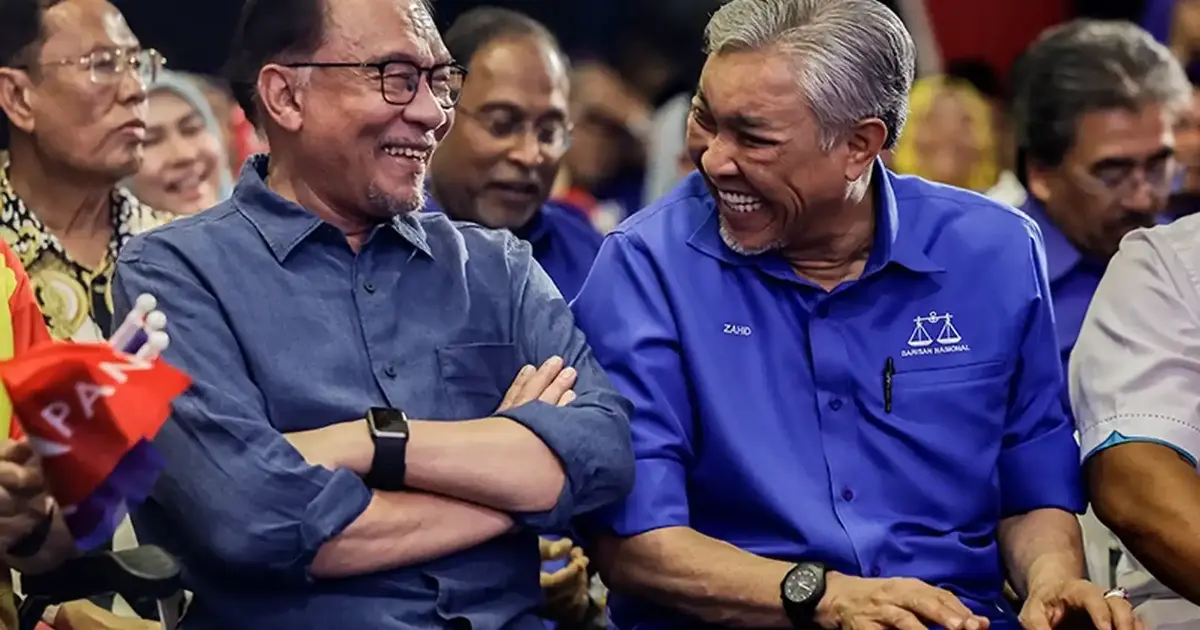
Deputy Prime Minister Datuk Seri Zahid Hamidi has engaged Prime Minister Anwar Ibrahim in a poetic exchange, crafting his own verse as a reply to the premier's recent composition. The gesture underscores the creative and sometimes unconventional manner in which Malaysia's senior political figures communicate their positions to the public and each other, extending beyond conventional statements and official announcements to capture broader messaging that resonates with supporters and citizens alike.
Zahid's poetic response carries particular significance given his position as chairman of Barisan Nasional, the historic coalition that continues to navigate its role within the broader unity government framework that has defined Malaysian politics since the 2022 general election. The exchange between the two leaders, though expressed through verse, reflects the ongoing negotiation of power, influence, and political narrative within Malaysia's complex governing architecture. Poetry and creative expression have occasionally surfaced as tools for politicians to articulate philosophical positions or emotional appeals that standard political discourse might not fully capture, allowing for nuance and subtlety in message delivery.
The unity government, formed following the 2022 general election, brought together previously opposing political blocs to govern the nation. This unprecedented coalition arrangement between Pakatan Harapan, led by Anwar, and Barisan Nasional has required careful management and public reassurance from all participating parties. The fact that Zahid chose to respond poetically while simultaneously reaffirming BN's commitment demonstrates a dual approach: acknowledging the creative engagement initiated by the prime minister while using the moment to reinforce institutional messaging about political stability and coalition durability.
For Malaysian observers and international analysts tracking the country's political trajectory, such exchanges carry weight beyond their literary merit. They serve as barometers of the relationship between major coalition partners and indicators of whether tensions exist beneath the surface of formal government operations. The tone, timing, and content of political communications at the leadership level often precede or reflect shifts in the broader political landscape, making even seemingly cultural gestures potentially significant from a governance perspective.
Barisan Nasional's emphasis on its continued commitment to the unity government addresses an underlying concern that has periodically surfaced since the coalition's formation: whether the arrangement represents genuine partnership or tactical positioning by its constituent parties. By explicitly restating this commitment through Zahid, who holds one of the nation's most senior political offices, the coalition attempts to project stability to both its internal membership and external stakeholders including international investors and observers who monitor Malaysia's political stability as a factor influencing economic and security considerations.
The unity government framework represents a pragmatic response to Malaysia's deeply fragmented political landscape, where no single coalition has commanded overwhelming parliamentary majorities in recent elections. This arrangement has forced traditional rivals to collaborate on policy implementation, budget allocation, and legislative agendas. The success or failure of such power-sharing arrangements often hinges on the personal relationships and political discipline of senior figures, making public expressions of commitment from both Zahid and Anwar material to the survival of the governing coalition.
For Barisan Nasional specifically, participation in the unity government has presented both opportunities and vulnerabilities. The coalition, which governed Malaysia for nearly seven decades until 2018, required rehabilitation and repositioning following multiple electoral setbacks and corruption scandals that affected its electoral appeal. Partnership within the unity government has allowed BN to maintain ministerial portfolios and influence over government policy, but it also requires BN leaders to coordinate their messaging with coalition partners whose political bases and ideological positions sometimes diverge from BN's traditional appeal.
The poetic exchange between Anwar and Zahid also reflects the broader Malaysian political culture in which personal relationships and individual leadership styles substantially influence institutional outcomes. Unlike systems with highly institutionalized power structures and mechanisms, Malaysian politics frequently depends on the compatibility and mutual respect among senior leaders to function effectively. When those relationships face strain, it reverberates through government institutions and complicates policy implementation, as Malaysian observers witnessed during previous periods of political turbulence.
Looking ahead, Zahid's reaffirmation of BN's commitment through both creative expression and direct statement aims to provide reassurance to BN members and supporters who might harbour doubts about the coalition's direction or the sustainability of the unity government arrangement. Maintaining coalition cohesion requires constant communication and public demonstration of unity, particularly when individual party interests might occasionally diverge from collective coalition positions on specific policy or resource allocation matters.
The unity government's tenure remains contingent on multiple factors, including economic performance, successful legislative agendas, and maintenance of parliamentary support from all coalition partners. Recent global economic headwinds and domestic policy challenges have tested the unity government's capacity to govern effectively, making leadership communications that emphasize stability and long-term commitment valuable tools for maintaining public confidence and coalition discipline during potentially turbulent periods.
As Malaysia approaches subsequent electoral cycles and potential transitions in leadership within both Pakatan Harapan and Barisan Nasional, the state of relations between Anwar and Zahid carries outsized importance. The poetic exchange, seemingly light-hearted on the surface, masks the serious political calculations underlying their public interactions, with implications extending throughout Malaysia's political ecosystem and resonating across Southeast Asia's wider geopolitical landscape.

