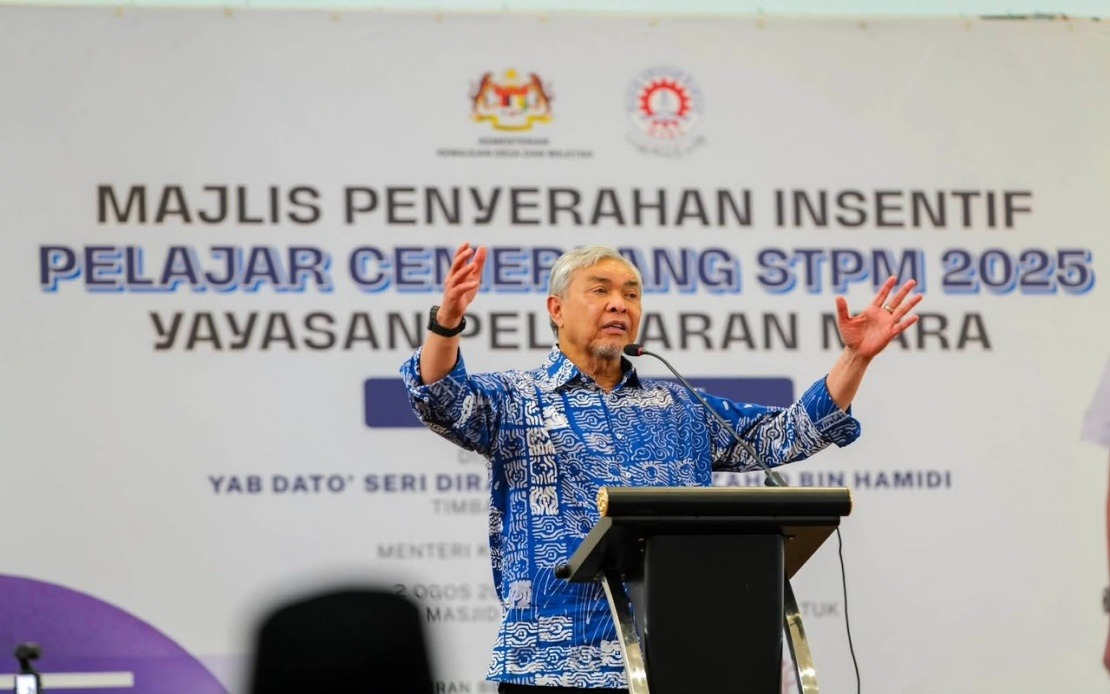
Thirty-eight students from secondary schools in Bagan Datuk have been recognised by Yayasan Pelajaran MARA (YPM) for their exceptional performance in the 2025 Sijil Tinggi Pelajaran Malaysia (STPM) examination. The award ceremony highlighted the academic strength emerging from two major institutions in the Perak constituency: Sekolah Menengah Kebangsaan Khir Johari and Sekolah Menengah Kebangsaan Tun Abdul Razak. This recognition underscores the consistent quality of education being delivered at secondary level in the district and signals growing momentum in academic achievement among young Malaysians in smaller urban centres outside the major metropolitan areas.
Deputy Prime Minister Datuk Seri Dr Ahmad Zahid Hamidi, who also serves as Member of Parliament for Bagan Datuk, publicly celebrated the milestone achievement, emphasising that the results demonstrate the untapped potential present within local communities when appropriate resources and mentorship are made available. His remarks reflected a broader narrative about talent development beyond conventional education hubs, suggesting that excellence in examinations is not confined to urban centres and well-resourced institutions. The incentive programme itself forms part of YPM's wider mission to support high-achieving students and ensure that financial constraints do not become barriers to further education.
Beyond the STPM excellence awards, the cohort's achievements extend into internationalisation of Malaysian talent. Three students from the Bagan Datuk district have secured admission to Al-Azhar University, one of the Islamic world's most prestigious institutions, to pursue studies in Islamic Syariah and Usuluddin. This development carries particular significance for Southeast Asia's Muslim-majority region, as it demonstrates Malaysia's continued engagement with global centres of Islamic scholarship and learning. The placement of local students at such a renowned institution reflects both individual academic capability and the growing internationalisation of Malaysian secondary education outcomes.
Complementing the excellence recognition, YPM has also extended support through its Education Compassionate Fund, with twenty-three students receiving assistance through this mechanism. This dual-track approach—simultaneously rewarding academic excellence while providing financial assistance to deserving students—reflects an understanding that academic potential often exists across different socioeconomic strata. The compassionate fund element ensures that family financial circumstances do not become determinants of educational trajectories, a particularly relevant consideration in Malaysian policy contexts where equity in education access remains an ongoing national priority.
Dr Ahmad Zahid's comments positioned education as fundamentally transformative, capable of reshaping individual life prospects and broader community development patterns. His emphasis on parental engagement as a critical success factor reflects contemporary educational research showing that home support structures significantly influence student motivation and achievement outcomes. The message implicitly acknowledged that schools operate within broader family ecosystems, and that external recognition of achievement—such as the YPM awards—serves to reinforce parental investment in their children's academic pursuits.
The Bagan Datuk MP articulated aspirations for sustained educational advancement within his constituency, expressing hope that recipients would progress to tertiary institutions both domestically and internationally before eventually channelling their enhanced capabilities back into local community development. This framing of education as cyclical—investment in human capital generation creating future contributors to regional prosperity—aligns with longer-term nation-building narratives prevalent in Malaysian political discourse. It suggests a conceptual link between individual educational achievement and collective economic and social advancement.
For Malaysia's broader educational ecosystem, the Bagan Datuk awards data points to consistent performance quality across dispersed secondary institutions rather than being concentrated in a handful of elite schools in Kuala Lumpur or Selangor. This geographic distribution of excellence raises questions about resource allocation and teaching quality across the peninsula's secondary education network. The results suggest that when conditions are appropriate, schools in smaller towns can produce examination outcomes competitive with more celebrated urban counterparts, potentially informing broader education policy discussions about efficiency and equity in school funding mechanisms.
The recognition programme itself reflects evolving corporate and institutional approaches to talent identification and development in Malaysia. YPM, as a government-linked foundation managing educational investment, uses merit-based incentives to signal that exceptional performance receives tangible reward. This creates positive reinforcement loops within school communities, potentially encouraging heightened academic engagement among younger cohorts aware that excellence translates into concrete benefits such as financial awards and international educational opportunities.
For students in regional secondary schools contemplating their academic futures, the Bagan Datuk cohort's achievements demonstrate viable pathways to both prestigious local universities and internationally recognised institutions. The successful Al-Azhar placements particularly signal that Islamic studies remain valued globally and that Malaysian students maintaining strong academic credentials can access these networks. This becomes increasingly relevant as Southeast Asian students seek education abroad and seek institutional recognition that validates their qualifications within global academic hierarchies.

