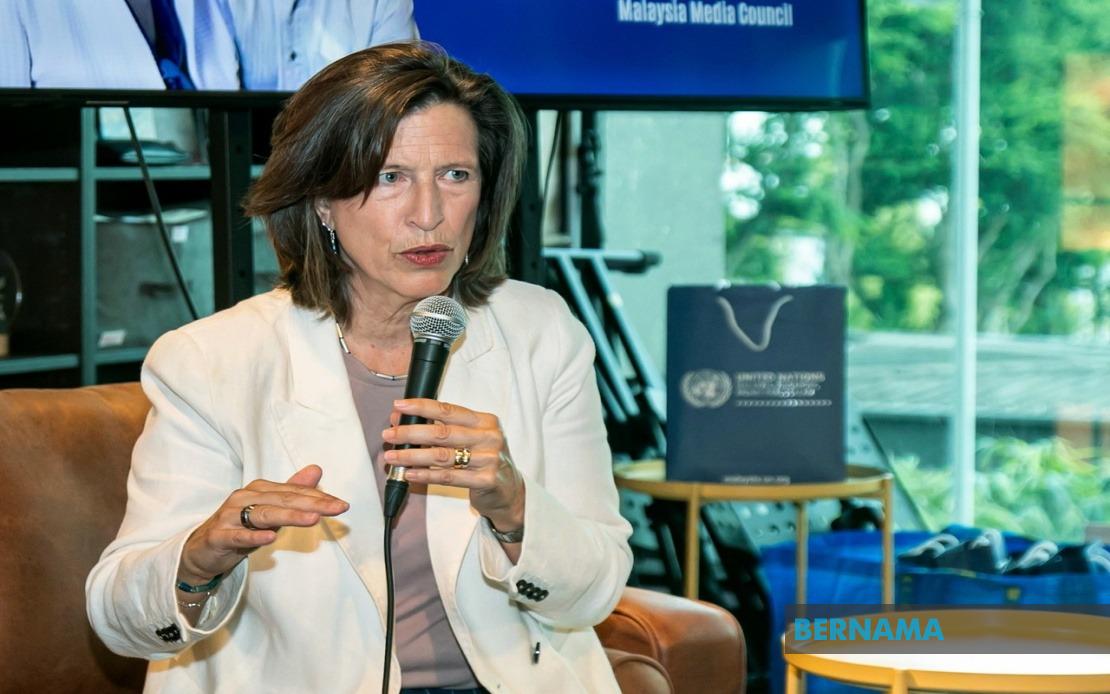
Young people represent a vital frontline in the battle against misinformation, according to a senior United Nations official who addressed a dialogue on information integrity in Kuala Lumpur. Melissa Fleming, UN Under-Secretary-General for Global Communications, emphasised that engaging the youth was not merely desirable but essential, as they navigate an increasingly complex landscape of competing messages, false narratives, and coordinated disinformation campaigns. Her remarks during the "Media and Youth Dialogue on Information Integrity in the Digital Age: Strengthening Trust, Countering Hate Speech and Misinformation" reflected growing international concern about the corrosive effects of falsehoods on democratic institutions, public trust, and social cohesion.
Fleming outlined an ambitious vision in which young people could become active agents of positive change within their own digital networks. Rather than viewing youth as passive consumers of online content, she sought to empower them as communicators capable of spreading messages that improve rather than degrade the information environment. This perspective recognises that authentic peer-to-peer communication often carries more weight among younger audiences than top-down messaging from authorities or traditional institutions. By leveraging their native fluency with digital tools and platforms, young people can model responsible information practices and challenge false narratives within their immediate social circles—a grassroots approach that institutional actors cannot replicate.
However, Fleming's message carried a parallel and equally forceful warning directed at the technology companies that have accumulated unprecedented influence over global information flows. Social media platforms, she insisted, must transform themselves into genuinely safe spaces where users can participate in democratic discourse without encountering deception, manipulation, or harassment. The current operational model of most major platforms, she argued, actively undermines this objective. By prioritising engagement metrics that reward sensational, polarising, and emotionally charged content, these systems inadvertently amplify misinformation and hate speech while marginalising measured, factual analysis. Fleming called for platforms to recalibrate their algorithms and business models to better align with the public interest.
A central element of Fleming's critique focused on the profit motive that drives technology companies. She argued that expecting corporations to self-regulate in the absence of external pressure was fundamentally unrealistic. Companies, by their nature, optimise for shareholder returns rather than societal wellbeing. Without regulatory pressure from governments and market pressure from advertisers, they have little incentive to invest in the expensive infrastructure, human expertise, and artificial intelligence systems necessary to detect and suppress misinformation at scale. This structural reality means that relying on voluntary corporate responsibility represents a strategy destined to fail, leaving vulnerabilities that bad actors continue to exploit.
Governments, Fleming contended, must therefore assume a more active regulatory role. She advocated for governments to establish and enforce standards that explicitly address misinformation, disinformation, and hate speech circulating through digital channels. This governance approach differs from traditional media regulation, which largely relied on licensing authorities and content standards for broadcasters and publishers. The borderless, decentralised nature of social media platforms presents novel regulatory challenges, yet Fleming argued these challenges could not serve as an excuse for governmental inaction. Developing appropriate regulatory frameworks requires ongoing dialogue between government officials, technologists, civil society experts, and youth representatives—all of whom bring different perspectives on what constitutes harmful content and how to address it effectively.
Beyond platforms and governments, Fleming identified advertisers and public relations firms as underutilised allies in the effort to strengthen information integrity. Many major brands unknowingly subsidise the creators and distributors of misinformation and hate speech through programmatic advertising systems that automatically place ads alongside diverse online content. This financial incentive structure effectively allows bad actors to monetise the very falsehoods and hateful messages that undermine public discourse. Fleming noted that the UN is actively engaging with the advertising industry to alter these perverse incentives, working to redirect advertising spend away from disinformation actors and toward creators of reliable, factual content. Such market-based approaches can complement regulatory efforts by making it financially unviable to operate disinformation operations.
Fleming advocated for a holistic approach that recognises the interconnected nature of the modern information ecosystem. Rather than treating social media platforms, artificial intelligence systems, traditional media, advertisers, and public institutions as separate domains, she urged stakeholders to understand how each element influences and reinforces the others. Artificial intelligence increasingly shapes what content users encounter online, amplifying or suppressing particular narratives based on opaque algorithmic decisions. Traditional media outlets, meanwhile, sometimes amplify falsehoods by reporting on viral misinformation in ways that further spread the false claims. Advertisers fund both reliable journalism and disinformation depending on algorithmic placement decisions. Public institutions struggle to reach audiences directly because algorithms often deprioritise official government communications. Only by addressing this ecosystem holistically, rather than regulating individual components in isolation, can meaningful progress be achieved.
The dialogue itself, organised by the UN in collaboration with the Malaysia Media Council and Akademi MySDG, brought together an unusually diverse coalition of stakeholders—professional journalists, content creators, youth activists, and civil society representatives. This inclusive approach reflected recognition that effectively combating misinformation requires multiple perspectives and sustained coordination across sectors. Malaysia, as a multi-ethnic nation with significant online activity and demonstrated vulnerability to disinformation campaigns targeting communal tensions, provided a relevant venue for such discussions. Regional patterns of misinformation, including coordinated inauthentic behaviour targeting elections and religious communities, underscore why this conversation matters urgently across Southeast Asia.
The conference highlighted a fundamental tension that defines contemporary information policy. Greater regulation of online content, however well-intentioned, carries risks of governmental overreach and suppression of legitimate speech. Yet completely unregulated digital platforms demonstrably allow harmful falsehoods to spread unchecked, eroding public trust and enabling real-world harms. Fleming's framework attempts to navigate this tension by emphasising shared responsibility across multiple actors rather than concentrating power in any single entity. Governments set standards and enforce minimum guardrails; platforms design systems that protect users from abuse while respecting legitimate expression; advertisers redirect financial incentives; media institutions prioritise verification; and youth engage as informed, responsible participants. This distributed accountability model differs markedly from both complete governmental censorship and corporate self-regulation.
For Malaysian readers, Fleming's remarks carry particular salience given the country's recent electoral cycles and ongoing challenges with communal polarisation amplified through social media. Instances of misinformation campaigns targeting specific ethnic or religious groups have demonstrated how false narratives can poison public discourse and inflame tensions. Young Malaysians, who represent a rapidly growing proportion of social media users and creators, hold significant potential either to perpetuate these harmful patterns or to model alternative approaches grounded in factual accuracy and respectful dialogue. Fleming's emphasis on youth agency suggests that positive change need not wait for regulatory frameworks to be perfected or for major platforms to undergo complete institutional transformation. Individual users, beginning with young people, possess meaningful power to shape their information environments through their consumption and sharing choices.

