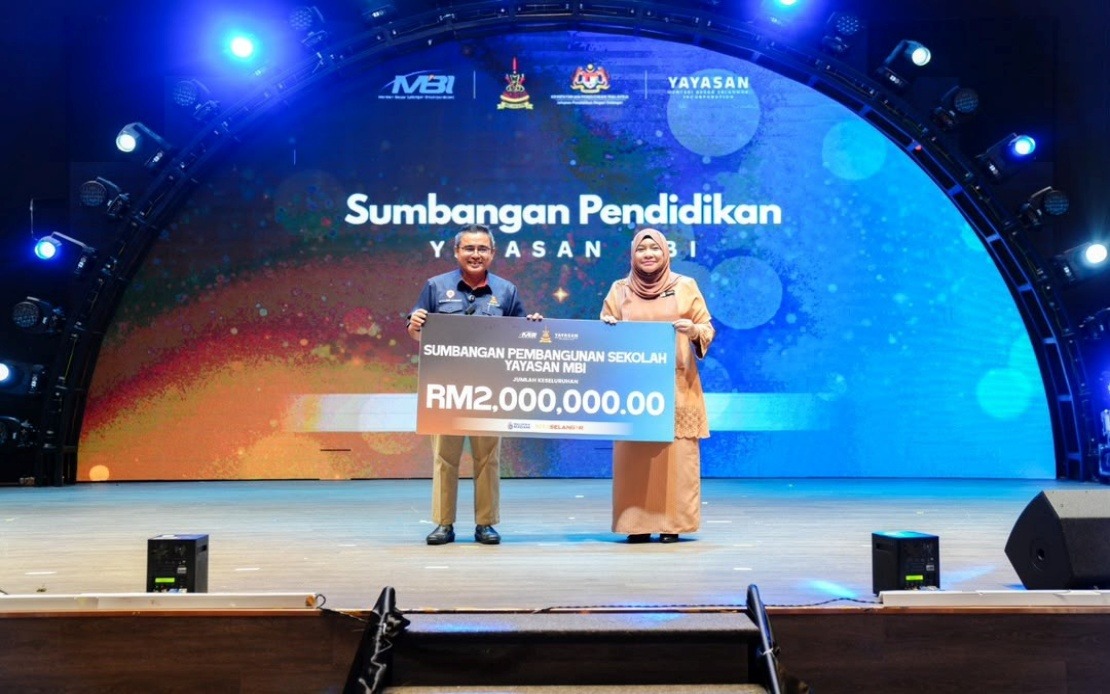
Yayasan Menteri Besar Selangor (Incorporated), commonly known as Yayasan MBI, has committed RM2 million in funding directed through its School Development Contribution programme, marking a significant step in its ongoing efforts to enhance educational infrastructure across Selangor. The disbursement, announced at the foundation's Education Aspiration 2026 gathering, demonstrates a sustained institutional focus on strengthening the conditions under which learning takes place throughout the state's schools.
The financial allocation is designed with dual objectives: to modernise and improve the physical learning environments within schools, whilst simultaneously creating workspace conditions that benefit both educators and students. This approach reflects an understanding that educational quality depends not solely on curriculum content but also on the tangible spaces and resources available within institutions. By targeting infrastructure alongside human comfort, Yayasan MBI seeks to address foundational barriers that can affect attendance, engagement, and overall academic performance.
Ahmad Azri Zainal Nor, heading the foundation, characterised education investment as representing approximately two-thirds of Yayasan MBI's portfolio of initiatives. This allocation reflects a deliberate strategic choice to prioritise the sector as a driver of long-term societal advancement. Rather than viewing educational support through a lens of short-term charitable assistance, the foundation frames such investments as integral to developing human capital—a crucial economic and social asset for Selangor's future competitiveness and prosperity.
The foundation's education philosophy extends beyond infrastructure to encompassing a comprehensive ecosystem of support programmes. The Back to School Tour Programme provides direct assistance during the critical transition periods when families face educational costs. Simultaneous collaborations with Parent-Teacher Associations create institutional bridges between home and school, recognising that parental engagement remains fundamental to student success. The Selangor People's Tuition Programme offers free supplementary learning, addressing gaps that may emerge in formal instruction, whilst the Didik Kasih Programme delivers targeted educational support to vulnerable student populations.
These diverse initiatives collectively represent a layered strategy acknowledging that educational barriers are multifaceted. Some students struggle with infrastructure deficiencies, others lack tutoring support, and many face economic pressures that threaten their continued schooling. By operating across multiple intervention points, Yayasan MBI attempts to address this complexity rather than relying on single-issue solutions. For Malaysian policymakers observing this approach, it offers a model suggesting that sustained educational improvement requires coordinated investment across physical, pedagogical, and social dimensions.
Strategic coordination with the Selangor State Education Department ensures that Yayasan MBI's initiatives align with institutional priorities and directly respond to documented needs rather than assuming where support matters most. This partnership approach reduces duplication and enhances effectiveness by grounding foundation programmes in the professional expertise and on-ground knowledge of the education system. Such collaboration also builds institutional sustainability, as educators become invested partners in programme delivery rather than passive recipients of external assistance.
For Southeast Asian readers, Selangor's education funding approach deserves attention as a case study in state-level educational investment within a federal system. Unlike centralised models where national governments direct all educational funding, Selangor's approach distributes responsibility across state institutions and foundations, creating multiple funding streams and diversifying support sources. This decentralised model has potential advantages in responsiveness and contextualisation, though it also raises questions about equity—whether all Malaysian states possess comparable institutional capacity and philanthropic resources to support their schools comparably.
The Education Aspiration 2026 event where this allocation was announced served broader purposes beyond financial announcement, functioning as a convening platform to strengthen partnerships and publicly recognise educator contributions. Such recognition carries particular importance in Southeast Asia, where teacher morale and retention face documented challenges. By elevating the visibility of educational professionals' work, Yayasan MBI contributes to creating a cultural environment valuing teaching as a respected professional calling rather than merely employment.
The emphasis on creating an "inclusive, quality and sustainable education ecosystem" signals alignment with Sustainable Development Goal Four, which calls for ensuring inclusive and equitable quality education across all communities. For Selangor, this means deliberately reaching marginalised student populations—whether economically disadvantaged families, rural communities with limited school resources, or students with particular learning needs. The foundation's multi-programme approach suggests recognition that inclusion requires tailored interventions rather than one-size-fits-all solutions.
Looking forward, the foundation's commitment carries implications for understanding how Malaysian states prioritise development. Education investment competes with infrastructure, healthcare, and economic development initiatives for limited resources. Yayasan MBI's allocation of two-thirds of its activities to education indicates a clear ordering of priorities, reflecting a conviction that human capital development represents the highest-return investment for a state's long-term prosperity. This perspective deserves wider examination within Malaysian policy circles as states contemplate their development trajectories.
The RM2 million disbursement, whilst meaningful in absolute terms, also raises questions about scale and coverage. With Selangor's school system encompassing thousands of institutions and hundreds of thousands of students, the allocation averages to relatively modest per-school support. This reality underscores that foundation contributions, however valuable, function best as complements to rather than replacements for consistent, adequately-funded public education systems. Selangor's model suggests that comprehensive educational excellence emerges through layered funding combining public investment, state-level foundation support, and community engagement.
The foundation's articulation of education as investment in human capital rather than charity reflects evolving frameworks within Southeast Asia regarding how societies resource education. This distinction matters because it shifts education from welfare provision—which faces political fluctuations—to strategic economic development, securing more sustained institutional commitment. As Malaysia navigates technological change and increasingly knowledge-intensive global economy, such foundational investments in broad-based educational quality become prerequisites for national competitiveness and inclusive prosperity across all states.

