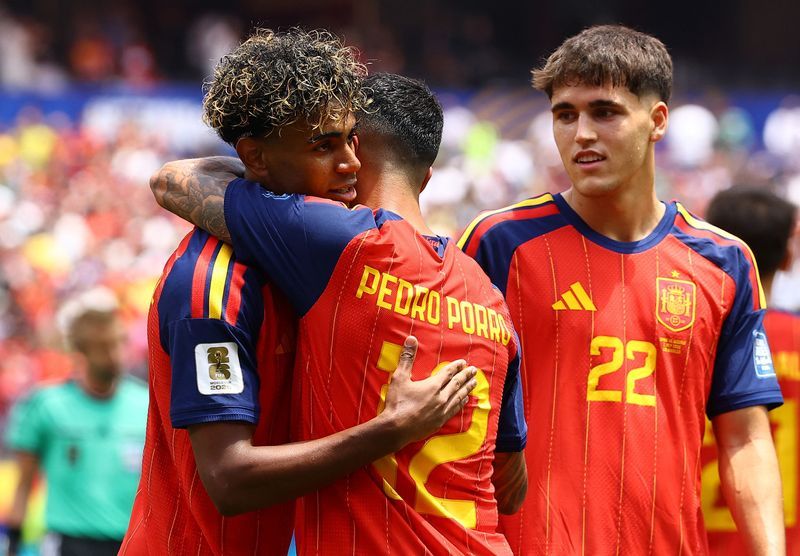
Spain have rediscovered their championship form after a rocky beginning, with 18-year-old Barcelona prodigy Lamine Yamal serving as the catalyst for their resurgence. The teenager's return to full fitness and integration into the side has coincided with a dramatic improvement in Spain's performances, culminating in a comprehensive 3-0 dismantling of Austria that showcased the tactical sophistication and attacking verve that earned them the European Championship title last year. Yamal's influence extended far beyond traditional statistics—despite not scoring or assisting, he was named player of the match, underscoring how thoroughly he has captured the imagination of Spanish football.
Spain's journey to this dominant display began with considerable uncertainty. Arriving in North America with a troublesome hamstring injury, Yamal began from the bench as Luis de la Fuente's squad stuttered to a goalless draw against Cape Verde. That opening performance raised troubling questions about whether the defending champions could replicate the intensity and creative dynamism that made them the tournament's standout team in Germany. The absence of Yamal's distinctive qualities—his ability to operate at high speeds while maintaining composure—left Spain's right flank looking predictable and uninspiring, with Gavi and Ferran Torres unable to generate the same attacking thrust.
What makes Yamal's emergence particularly significant is his almost paradoxical ability to blend individual excellence with collective purpose. In an era of Spanish football celebrated for its adherence to possession-based principles and structured movement, the teenager represents something subtly different: a player whose spontaneity and dribbling prowess elevate rather than undermine the team's philosophical foundations. His breakthrough from Barcelona's celebrated La Masia academy at just 16 years old demonstrated precocious maturity, and his starring role in Spain's European Championship victory proved this was no mere flash of youthful promise. Yet tournament football demands consistency across multiple matches with varying opposition, a test he is now passing with increasing conviction.
The introduction of Alex Baena alongside Yamal's growing involvement has fundamentally altered Spain's attacking geometry. Where the opening match saw Spain frequently congested in midfield with limited width, the pairing of these two young talents has restored the lateral spread that allows Rodri and Pedri to control the tempo in advanced positions. Baena's positioning on the left created constant problems for Austria's defence, stretching the pitch and forcing them into reactive defending. Simultaneously, Yamal operated as a magnetic force on the opposite flank, drawing multiple defenders towards him in predictable patterns that inadvertently created space for teammates. This interplay between structured intelligence and individual brilliance appears to be the missing ingredient that eluded Spain during their sluggish opening phase.
The Austria performance revealed another dimension to Spain's tactical evolution under De la Fuente. Their approach shifted between periods of settled possession and moments where Yamal was deliberately isolated in one-on-one situations, essentially trusting the teenager to create asymmetrical advantages through pure technical quality. More impressively, when Yamal drifted infield—a movement that compressed Austria's defensive shape—Spain orchestrated their most dangerous passages. This flexibility suggests De la Fuente has learned to harness Yamal's gifts without abandoning the midfield control that remains central to Spanish identity. The partnership between Yamal and veteran midfielder Rodri proved particularly fruitful, with the elder statesman flourishing once the tactical framework allowed him genuine progression routes.
Defensive solidity has become an underappreciated strength in Spain's resurgence. Austria failed to register a single shot on target, a remarkable defensive achievement that marked the first time any team had achieved this feat in a World Cup knockout match since Germany's victory over Argentina in the 2014 final. This statistic carries particular weight in tournament football, where defensive discipline often determines progression. Marc Cucurella and Pedro Porro provided excellent service from fullback positions, demonstrating that Spain's defensive infrastructure remains robust. Combined with their unbeaten streak stretching 34 matches and an absence of World Cup goals conceded since their 2022 defeat to Japan, Spain have constructed a formidable defensive foundation upon which their attacking talents can operate with greater freedom and ambition.
Yamal's fitness trajectory will warrant careful monitoring throughout the remainder of the tournament. His hamstring concerns at the outset suggested Spain cannot simply assume his availability week to week. De la Fuente's initial caution in deploying him from the bench proved prudent, allowing gradual integration rather than risking aggravation through premature overuse. As Yamal's minutes accumulate and his rhythm sharpens, Spain's entire tournament trajectory appears to hinge substantially on his continued availability. This concentration of dependence on a teenager presents both opportunity and vulnerability—opportunity because Yamal has already demonstrated he can elevate teammates and influence matches in nuanced ways, vulnerability because youth and injury history occasionally intersect in unpredictable fashion.
For Southeast Asian observers, Spain's revival holds instructive lessons about tournament football's unpredictability and the profound impact individual players can have on collective results. Regional teams increasingly face opponents of Spain's calibre, where technical excellence alone proves insufficient without tactical discipline and positional intelligence. Yamal's success stems not simply from dribbling ability but from his understanding of when to progress the ball, when to create space for others, and how individual actions serve larger architectural designs. This philosophy—blending flair with functionality—represents a sophisticated approach to modern attacking football that Asian teams would benefit from emulating.
Spain's path from disappointment against Cape Verde to dominance over Austria in mere days illustrates how quickly tournament momentum can shift once key personnel return to full fitness and integration. The European champions entered North America with considerable expectations, only to see early doubt creep in when their performances fell below previous standards. Yamal's journey from injured substitute to match-controlling presence has catalysed this transformation. As Spain advance deeper into the tournament, opponents will have observed footage of his performance against Austria and will understand he cannot be ignored or simply contained through conventional defensive mechanisms. Yet understanding this challenge and solving it represent entirely different propositions—a distinction that may prove decisive in determining how far Spain progress.
The teenager's performances also merit consideration within the broader context of Spanish football's generational transition. Established midfielders like Rodri and Pedri remain central to the system, but Yamal's integration suggests Spain are building a sustainable model that blends experience with exceptional youth talent. This architectural approach offers possibilities for sustained success beyond this tournament cycle. If Yamal maintains his developmental trajectory and avoids serious injury, Spanish football may be entering a period where they combine the controlling principles of their golden era with a new dimension of attacking unpredictability. Opponents have been warned.

